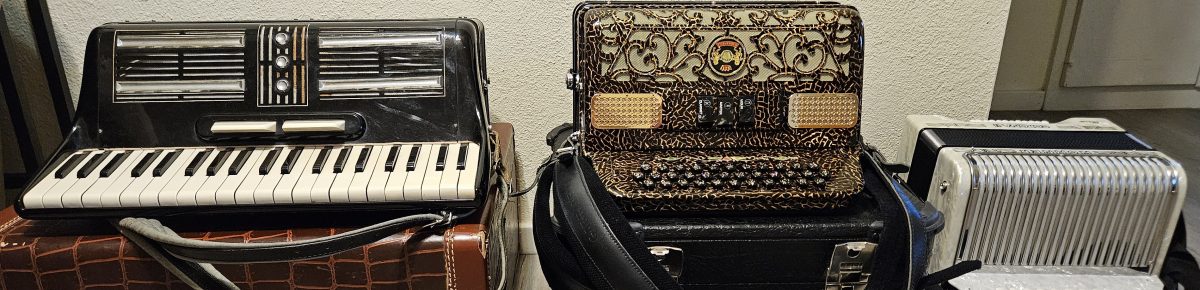
Un Instrumento Mágico

Every so often, we manage to go to a concert. For such a small town, we get some big norteño acts, such as Conjunto Primavera. This last weekend we went to Grupo Liberacion, which is a classic Mexican band. To be honest, there were so many acts coming up, I wasn’t sure this was the one I would choose. But I didn’t get a chance because my husband bought tickets with our neighbors, and we went as a group. This was a positive. The concert or baile, to be exact, was in a small venue, the Epiq Nightclub, and I was quite surprised at how many people they could pack in there and still have room for a dance floor.

Grupo Liberacion is really a rock band, but they have done a little bit of everything regional that a Monterrey band would produce; that is, they have a repertoire that includes cumbia and banda. During the 80s, they hit the keyboards pretty hard, but they never failed to have catchy songs. At this event there were about ten band members, including a saxophonist, as well as a keyboardist who doubled as an accordion player. Because they are really a rock band, they had a rock guitarist and bass player. They were very impressive, their performance topnotch. I was particularly impressed by their singing. These men are true performers with incredible voices.

Like all bailes, this one had three bands (some even have four); they start at about 9 PM and go until 2 AM. Yes, that’s a lot for a person not in her twenties, such as myself, but, strangely, there are always people much older than I am dancing until 2. Mexicans are superior that way. They definitely have their cultural strong points, and the ability to dance all night is one of them.

The first and second bands were fairly standard conjunto acts, Conjunto Rienda and La C Norteña. Both were good, the second especially so, and I found myself taken with the acordeonista of La C Norteña. More on that in a minute. First, a definition of terms is in order: conjunto is the term for a norteño band that includes an accordion, a saxophone, and a bajo sexto. Of course, there are drums and a base, but the three instruments I just noted are what make conjunto special. I’ve loved conjunto for a long time; some of my favorite bands, such as Los Rieleros, are classics of the genre.

But I have to admit that lately I’ve become increasingly frustrated with the sound of the saxophone because unless a band really mixes it well, the brassy sound doesn’t complement the accordion at all. AT ALL. I can’t emphasize that enough. In bands like Conjunto Primavera, the saxophone sound predominates many songs, and their sound is so iconic that I accept this reality. In concert, the accordionist and saxophonist being the same person, the songs either had saxophone or accordion, not both together, which is better in my opinion.

Now getting back to the acordeonista that I was quite attracted to (his sound, not him obviously, though I imagine accordion players are chick magnets), I would be just getting into his accordion parts when the sax player would jump right in and obliterate the sound. The saxophone is a dominant instrument, and the players thereof need to be put in the back with their mics turned down to highlight the truly important instrument, which is the ACCORDION.

Sax players need to stay in their lanes, in other words. The sax simply doesn’t have the magic of the accordion. The magic of the accordion is what I live for. It is what I need. It is what I try to achieve. It is why I come home from work and play my instrument every day. The thought of playing it gets me through the day, in fact. Forget about errands — I shouldn’t admit this, but I let myself run out of soap and deodorant for more than a week recently because I always forget to stop at the store when I have my Gabbanelli waiting at home. Did you know shampoo works great as a body wash? It’s true. And scraping the last of the deodorant tube is just good economy… If you don’t quite get it yet, I’m focused and driven to have the accordion in my life, and when I hear the sounds of magic from a good accordionist, I don’t want it suddenly smothered by the primadonna saxophone.

There is a genre I’ve been listening to lately that has replaced the saxophone with a sousaphone. Now THAT is a complementary instrument to the accordion. Sousaphone players provide a pleasant background rhythm that still allows the most important instrument to roll out its magic. Sousaphone players know to stay in their lanes. As far as I can tell, this genre is called norteño-banda, which makes sense, as banda will have a sousaphone or similar tuba-style instrument. I would like to find a friend who plays the tuba or sousaphone; then I could have a rhythm section. For what, I don’t know because the likelihood of my ever performing is about zero. However, I’m still trying to work out some songs about birds because they make the best norteño and banda songs, even if I don’t know precisely why.

I admit I know nothing about the first two bands that played on Friday night, but when I went looking for a video of La C Norteña, it was obvious the first I played had been filmed here in Roswell. A local band, then? The ice cream shop featured is Yoly’s, one of my favorite places. I mean no offense to a local saxophone player. Maybe I do, to be honest. He needs to step back a little when playing live. We all know the accordion is superior and needs to be heard.

Being Particular About Coffee and Books

Finding a good book is like finding a good cup of coffee. Regarding coffee, I’ve come to realize I have to make it myself. It does not have to be high-end coffee. At work, we have a Members Mark Colombian medium roast pre-ground in a can, but if I make it and drink it before the burner turns the flavor, it’s really quite good. It’s a grade above Folger’s, as it’s Arabica — even if not high-end Arabica.

I like medium to dark roasts. I like some light roasts, too, but they are tricky because they often are very mild-flavored and if you try to make them strong for more flavor, they end up so acidic they will take the enamel off your teeth. Roasts like French or Italian are often so dark they taste like ashes, but at least they have flavor. French presses will give almost all varieties a robust flavor, but you have to take the silt and grounds and oiliness along with it. Keurigs are all right if you use high-quality coffee and stick to eight or ten oz cups; otherwise, they produce an unsatisfactory, watery brew.

I avoid local coffeeshops because without exception, their brewed coffee tastes like water. However, I also avoid Starbucks because they no longer keep their brewed coffee fresh. Here’s a clue: if the lights are flashing on the machines, the coffee is no longer fresh. They don’t use burners to avoid burning the coffee; this means when the coffee is old and loses its piping hot temperature, the lights on the machine will flash. I can’t remember the last time I went in a Starbucks anywhere at any time of the day and didn’t see flashing lights. Yesterday, I was traveling and went through the drive thru in the morning; I couldn’t see the machines, but disappointingly, the coffee was barely clinging to a concept known as hot. I’m not sure when or why Starbucks let down its brewed coffee crowd for the diabetic frou-frou crowd, but it has.

I know this will trigger the “Starbucks burns their beans” crowd, but let’s just ward away such ignorance. Starbucks offers an array of roasts from the tasteless light breakfast blends all the way to the Italian roasts, which are meant to be roasted until they are black and sticky with oil. This crowd is under a delusion that Starbucks only has one roast. The truth is, they have many nicely roasted medium beans, but they will not make fresh coffee in house. Not do they serve medium roasts on tap, old or fresh. They do a light roast, a dark roast, and a medium-dark every day in their shops. But good luck with the timing on getting any of it when it’s fresh.

That is my rant on coffee. I’m not a snob. I’ve met coffee snobs, and I’m not one. Plus, it’s difficult to find good coffee in my cowtown. Nobody is a coffee snob in Roswell. The people here don’t want coffee; they want a sugar bomb. This is a growing American fad, I’ve heard. Even though I’m not a snob, I want robust flavor and gone are the days when I’d add a dash of salt to the Farmers Bros coffee at the diner to make it palatable. Therefore, I must always make my own coffee or suffer disappointment.

This do-it-yourself mentality does not work with books, on the other hand. Yes, I write books, but I don’t want to read my own labors. I want something new and different, which is odd because my tastes have dwindled from reading almost all genres (literary, comedy, mystery, sci fi, biography, history, religion/apologetics) to only reading mysteries, gothic romances, and comedies. I still buy religious works, and I start them and lose my patience and don’t finish them.

Mysteries are hit and miss, too, though. Romance is fine, if it’s a side plot. But imagine my distaste when a plethora of mysteries have a focus on romance or sex. No, just no. Cozy can be far too cozy, but at least it doesn’t come with explicit sex or old ladies finding youthful exotic lovers who just fall madly in love with their personalities…or something. I don’t know about other women, but as someone close to fifty, I find it a repellent thought to have a younger mate. The weird thing is, it actually happens more than people like to think. Two of my close friends went that route when they were forty, both dating men in their twenties; one eventually tossed out her boy toy. The other married him and is still married ten years later. So, I guess it worked for her…? But I still find it hackneyed and unbelievable in books.

All that being said, I tend towards cozies from British authors, or at the very least, mysteries where the extent of the sex is a closed door. I like intrigue and investigations. I like justice. I like everything resolved neatly in the end. I prefer unlikely detectives, such as Miss Marple, who simply understand the nature of people. And I also like to see even the most discerning detective get it wrong because humans will always have lapses in judgment.

One series I love is the Slim Hardy mysteries by Jack Benton. They have everything: supernatural and gothic elements, an unlikely hero, and justice done in the end. These aren’t really cozies, but there isn’t a lot of romance and sex is behind closed doors (that is, fade to next morning and spare us the details). And honestly, these books are just weird in a good way. Highly recommend. I will be sad to reach the end of the series.

Another is the Bea Abbot series by Veronica Heley. Bea Abbot is a widow who gets embroiled in murders through the domestic agency she takes over after her husband passed away. These are definitely cozies with a lot of good comedy and plenty of unlikeable characters. They are also very Christian, but in a good rather than preachy way. I love Bea, as she’s her own person. She’s a bit introspective and will often let chaos swirl around her before she tackles it, but she always snaps awake to deal with it. The most important part: she is her own independent person who doesn’t let people push her around. I’m also quite sexist and find this kind of commentary funny: “‘What a day! Suppose you choose something light for me to eat?’ [Bea says this to placate the man she’s eating with after she was late for their date.] Men liked to feel superior that way.” Or: “Men always think you’re intelligent if you get them to talk about themselves.” That last bit is true of women, too. Most people who ask questions and let others talk are perceived as having high intelligence.

Along the lines of a cozy series with a widow, one that I’ve chosen to abandon is the Mrs. Pargeter series by Simon Brett. The first two books were intriguing enough re their plots and mysteries. Like Bea Abbot, Mrs. Pargeter is a widow. Mr. Pargeter seems to have been some kind of Robin Hood of justice, using underworld contacts to bring justice about when it couldn’t be done by ordinary means. Mrs. Pargeter still has all her husband’s contacts and makes use of them, which makes the series interesting. However, I lost interest when Amazon recommended the eighth book in the series to me (which I bought by accident). The books are their own plots; they don’t have to be read in order necessarily. On the other hand, I realized that there will never be any true character development if there wasn’t from book one to book eight. The clue is in the character’s name. In the Bea Abbot series, the widow is her own person and is called by her first name. In this series, the woman goes by her husband’s name, Mrs. Pargeter. She clearly had a domineering, larger than life husband, and the widow has no discernible personality in her own right. At least I can’t detect one. She dresses the way her husband wanted her to dress, uses her husband’s proverbs as life guides because she apparently has no moral compass of her own, and everything she knows about the world was taught to her by her husband. There is a sad bit in this last book I read, where the widow waxes on about how her husband had taught her to have an art aesthetic. She, therefore, decides that a gift of a porcelain cat figure from a man who likes her needs to be hidden away or destroyed because it doesn’t fit her dead husband’s snooty art aesthetic. Near the end, she uses it to smash a bad guy over the head. All that would be fine, if it was her own art aesthetic and she didn’t like the man who gave the cat to her. But it’s not couched that way. I find it exceedingly depressing for a widow with a domineering husband to still lack a personality years after he has passed. I want to see her grow and find out who she is outside her husband. But some people are like that — moldable shells who live through others. I don’t think they make good heroines, though.

There are some men out there — not all or most of them I realize — who believe God created women to live and breathe their life goals. The funny thing is Mrs. Pargeter doesn’t believe in God, but Bea Abbot prays regularly. Because of this, the strange irony is that Bea believes in her own value, but Mrs. Pargeter clings to her husband’s ghost because she doesn’t have anything else, except the loads of money he left her and all his contacts who help solve crimes for her. You know who helps Bea? The two young people she helped, who are loyal to her and not her dead husband.

So sorry about that. I haven’t had a decent cup of coffee in a while, and I have become very particular about my books and my coffee. When it really comes down to it, I like the Jack Benton books the best because of their weirdness. Also, the detective is a divorced alcoholic with PTSD. He doesn’t have pleasant thoughts about his long-gone wife. He’s obsessed with solving mysteries and doesn’t live vicariously through anyone. A true independent. Except dependent on alcohol when he falls off the wagon. Oh, dear. And then he becomes dependent on coffee (which he’s very particular about!)

The Large View

I was going to call this post The Picture Window, but I don’t technically have one. I have a large front window that, in its original form, had numerous small pieces of glass. Now that we’ve updated, it has three pieces to incorporate the sliders on each side. I find these sixties’ style windows to be aesthetic and don’t understand why people renovate by installing small windows in place of the large ones. It gives their houses a dingy appearance, both in and out.

I don’t care what the pulp fiction enthusiasts and other crusaders claim; architecture in the sixties could be lovely. There is a belief that postmodernism brought only ugliness, and we must reach again for the elaborate beauty that existed prior to this time. The problem with these purists is that they fail to see the beauty because they believe it does not exist. They have an ugly filter over their eyes. This is a kind of brainwashing; you can see it go the opposite direction, too. There was once a YouTube video out there that demonstrated that men had been brainwashed to see anything in yoga pants as attractive; therefore, their sexual beauty triggers went off even when the person wearing them turned out to be a man when he drew closer. It’s a dumb video, of course, as most on YouTube are. However, it did demonstrate that ideas people hold can create a filter for what they observe. In other words, humans aren’t all that capable of being pure scientists. Scientists are either unaware of this in themselves, or they are liars. Same, same, as people who lie to themselves are still liars.

Despite the goals of postmodernism, which was to destruct the traditions, institutions, and valued art and architecture of the past, it’s nearly impossible to entirely squelch the human artist’s desire to create beauty. That is why, if you examine the elements of mid century homes–preferably without the ugly filter in place–you will see an emphasis on natural beauty that appears to be an integral part of the earth. Sixties’ homes often incorporated natural materials such as wood paneling, tile, and stonework. Within these natural materials, there were planters with greenery, both inside and outside the house, as well as large windows and perhaps skylights to allow in natural lighting that would infuse the plants, obviously, but also the people. The malls we used to visit in the eighties were influenced by this same aesthetic (they were no doubt built in the seventies), as they had clean lines, plenty of open space, terrazzo tiles (which look like a pebbled beach), skylights, and very large indoor planters, often containing trees and surrounded by wooden benches. This open area of the mall was always pleasant to me, but I have to admit that being dragged to the department stores was quite a different thing. Department stores were and are indeed ugly, crowded, dingy albeit brightened with false light, and they stink like perfume and pumped-in fragrance. Btw, please don’t ever invite me to your house if you use Glade plugins because, if you do, your house reeks like a department store. I used to have meltdowns when I was forced to go shopping as a child due to the inevitability of visiting a store. I kind of still do–inwardly. If there is one activity that I find a bane of existence, it’s shopping. When my husband drags me to the stores, I have to be prepared ahead of time. Maybe a few drinks at a pub first might help. Most of the time, I would rather dress in rags than have to do it. But sitting on a bench under a skylight and the fronds of an overhanging tree, while staring at terrazzo tiles–that I will gladly do.

My sixties’ house has tile, large windows, a brick fireplace, bricks flowing around the winding large kitchen counter space, and it used to have wood paneling in the family room; it still does, to be honest, but the previous owners slapped a few gallons of white paint over it. My office at work is from about the same year as my house, 1962, and is now a mishmash of elements. However, it still contains large windows, and I can’t tell you how much it pleases me that I can stare out this window and watch the world go by throughout the day. Also, the old windows were replaced, just as at my house, and now they can all slide open, allowing in the breezes. Yes, something this small brings me immeasurable happiness. Old windows tend to be caulked down and sealed with a hundred pounds of silicon because it’s better for insulation, which tempts me to throw a chair through the glass so that I can experience fresh air. Thankfully, I’ve withstood that temptation.

On weekends, I enjoy sitting in my living room and staring at the world go by, just as at work. People jog and walk their dogs; I now have two neighbors who are professional yard-salers, which means there is occasionally much traffic drifting past. I play my accordion in this front room, while sitting on the couch and staring out the window. I also have a music stand for learning new songs or propping up song lyrics, so I am often staring at that, but the temptation to watch the outside world is too big to withstand most of the time. On weekdays, now that we’re in DST, when I play, the dipping afternoon sun lights up the bling on my accordion, flashing it everywhere. It’s incredibly beautiful and blinding, and when that happens, I often have to play with my eyes closed–again, with the looming temptation to stare at the reflection beginning to emerge on the window, as I’m a shadow behind the lustrous shine of my instrument.

At some point, I become part of the drifting traffic, as I go for my own daily walk. As much as I enjoy the large view from my window, the view outside is even larger. Being outside is a restorative for the brain, even if this time of year, daily walks give me hives. I live in an area where people create their “aesthetic” by spraying Roundup into the spring wind, which means I’m generally very ill after walking. I don’t know what to do about that. Part of having a large view is accepting the foibles of almost civilized humans, which includes putting up with laziness. I just hope it doesn’t someday kill me, as my reactions are anaphylactic. I have to remember that they are also killing themselves, as no one wears hazard gear (this is a legitimate time to wear a mask and cover up). Ultimately, I still take my daily walk and try to give sprayers a wide berth, though I still end up with hives, the taste of Roundup in my mouth, and splitting headaches. Nature. It kind of sucks at times–this is assuming humans are part it, along with their inventions. At best, sixties’ houses are mock nature, a cultivated attempt at mirroring what God created, which can be quite ugly at times from a human perspective. A large view is a large view.

Los mejores de los mejores

It’s long past time that I make a list of my favorite acordeonistas. I mean, it’s really not, but I won’t let that stop me. Obviously, I’m coming at this from a different perspective than most. I didn’t grow up with the music I love. I tuned in one day to the Mexican channels because all the other music playing on the radio in Albuquerque bored me to tears. But when I paused on the Mexican channels, it was like magic to my ears. The accordion. The brass. The vocals.

In the early days, I did a lot of exploring, looking up the bands I’d hear on Radio Lobo (the other Mexican channels never lasted long, but Radio Lobo has remained) and buying the CDs. Seriously. I have a giant collection of Norteño CDs somewhere. Out in a box in the garage, probably. I also did what I used to do with my life: research. It’s hard to believe that approach to the world was appealing to me at one time. I wrote essays in both Spanish and English about the history of Tejano and Norteño. I did presentations on the music for my classes at UNM–Southwest History 120 or Spanish 400 or whatever it was. The response to my obsession from professors and students was general bewilderment. That’s nice Jill; you do you. What a dumb way to be. Never again.

I’ve decided recently that I want to be completely braindead. Like, if I were the Scarecrow in Wizard of Oz, I would sing I would while away the hours, talking to the flowers, singing in the rain, if I didn’t have a brain. That is my fantasy right now. Never analyzing anything. Just writing in fragment sentences and having natural reactions to life. How amazing! I WANT TO BE BRAINLESS! I expressed this to my husband the other day, and he said, Good for you! as if I’d managed a major life breakthrough. At least I get support.

All that nonsense about research and being brainless was really meant to give you an idea of why I have experienced many of the classic accordion players that are not played on the current Mexican channels, such as Tony de la Rosa or Narciso Martinez. My mix of greats has a range from different eras, up through young millennial musicians (there’s actually just one millennial on my list, Eden Muñoz of Calibre Cincuenta [who has recently left that band]; the other Muñoz is a gen-Xer). Speaking of the classics, I’m not ever going to forget seeing Flaco Jimenez play live. Because of that–watching him as an old man dance with his Hohner–he’s on the list. Your list might differ. You might not have a list. You might write a top-ten reasons I don’t make lists list. The top reason on my list of why I don’t write lists is owing to my newfound braindead state.

In no particular order, here are my favorite acordeonistas:

  • Flaco Jimenez
  • Ricky Muñoz
  • Paulino Bernal
  • Ramon Ayala
  • Lupe Tijerina
  • Reynaldo Gonzales
  • Eden Muñoz
  • Celso Piña
  • Jesus “Chuy” Garcia

I’m leaving the last spot empty because I can’t decide. The others fit neatly into my braindead state, as they were no-brainer picks. They are the people I can’t stop listening to for style or innovation or general magic, but I could not decide who else should be on the list. If I decide, I’ll fill in the spot. There were a few Tejanos I was considering… I might need to do a binge listen to old CDs.

A few on the list have passed away–Lupe Tijerina, Celso Piña, Paulino Bernal–may God rest their souls; I’ve also seen quite a few of them live. Others I regularly miss (such as Ricky Muñoz of Intocable) because I’m broke when they come round these parts. Or working. Or hugely pregnant. I actually saw Ramon Ayala live when I was two weeks from giving birth. I was sooooo exhausted, my brain wishing it were dead. I had just finished a dissertation in which I translated Sor Juana’s poetry into English. I hadn’t yet bought my first accordion, so I longed instead to write brainless odes to accordion players in my terrible Spanish, which I did right after graduating. I guess you could say Señor Ayala inspired that.

If I ever start studying again, just shoot me. Or give me a lobotomy and wipe up my drool so it doesn’t spill on my accordion.

Being Wanted

The one argument coming from the pro-abortion crowd that repels me deeply is the one that says human life is valuable based on whether it’s wanted or not. When you grow up as the awkward, bullied reject, you understand deeply how much your presence is unwanted by the people around you. You can’t help but to exist, and on some level, you might believe that God wants you or you wouldn’t be here. But there is the sense that, given an amoral and lawless society, you would be deemed expendable and taken out.

I’ve heard it numerous times from the mouths of pro-abortion activists; when asked what the difference is between a human baby and a fetus that can be flushed or ripped violently from the womb, the answer is when the mother wants it, it’s a baby who needs protection. Otherwise, it’s a clump of cells with no personhood rights. These are virtually direct quotes from any number of abortion supporters.

I’ve discussed before that we humans are not logical creatures. This is, to be honest, the way God created us. He created us to be primarily emotional and instinctive; that is our first response to any given situation. Our instincts are intriguing, as they can be very basic, as in, I’m starving; I must have instant sugar, and they can conversely be very complex, instant decisions made based off years of inputs that work together in the background to aid us in this process. Logic is a secondary, learned skill, but it is solipsistic, processed through our filters. The conclusions are only as good as the premises, as well, so it’s possible to have flawless logic and still be completely wrong.

Most people have not learned logic and don’t understand cause and effect very deeply, especially when they want or don’t want something very badly. I don’t think I need to explain why the concept of only wanted people should be allowed personhood status will have a very bad logical outcome. But it’s going to be difficult to get around the initial instinct and emotional drive of a human that simply wants to escape consequences. They won’t understand the logic. They will turn it into a moralistic argument about the bad ethics of forcing a woman to go through an unwanted pregnancy. This is, of course, a false input, but most won’t perceive why. Even professors, who are supposed to be above-average, will refuse to accept that their conclusions are wrong.

You might recognize that I have an emotional response to the argument that only wanted people have value. Yes, it does make me emotional. Very emotional. My life experiences have taught me on an emotional level to be sensitive to the maltreatment of underdogs whom nobody likes. We know what happens when we devalue certain people; history has left humanity with those emotional wounds. And if you consider that a pre born child isn’t unwanted for any particular reason, it’s even more emotionally devastating. I was and am a scrawny, awkward person. It’s easy to dislike me. I’m obnoxious. But a mother who doesn’t have any personal grudges against a tiny being who has done nothing offensive because they haven’t had the chance to yet…just tears me up inside. It’s so cold. It’s so wrong, like the neighborhood boy who unaccountably pulls the wings off insects. He can; that’s the only reason. Well, she can, too, except those aren’t wings she’s ripping off a fly. They are the arms and legs of her own child.

This battle will never be won by pitting logic against emotions, anyway. What it really comes down is spiritual oppression. That is why you often find pro-abort protestors screaming obscenities and hail Satan. They do this ostensibly to rattle Christians, but it rather becomes an outpouring of their souls. These people are not emotional wrecks; they are spiritual wrecks.

Therefore, praying and preaching the gospel are the only answers. Too simple? I don’t care. My state’s a mess, with some of the most liberal abortion laws in the world. It is overwhelming to live here sometimes. What can I do? Sign a few petitions? Carry banners? Jesus is better. He is always the answer.

Being Punk Rock

I find the music almost intolerable, but I have to admit that my anti-authoritarian nature closely resembles those now old youths from the late seventies and early eighties. I never could manage to force my hair to stand on end. In high school, I asked a punk rock friend how I could shape my hair into a mohawk like he had. He looked distinctly uncomfortable and told me it would wreck my beautiful hair but gave me a recipe nonetheless.

My hatred for authority figures is not as shallow as spiky hair. It comes from a lifetime of observation, watching what petty tyrants are capable of because most people make no hue and cry over their overreaches. Being institutionalized from kindergarten up allows most to be right in line with injustice and overreach; it’s simply what they’re used to. A handful of us freaks never adapt, however. We might have very low or very high IQs–we might not fit in for whatever reason–but we never can fall into line. We are belligerent with every unconstitutional traffic stop, we don’t wear our masks, we just don’t. One year, I refused to acknowledge DST, completely confusing everyone who has been deluded by the government into thinking the sun is directly overhead at 11 AM. Guess what? It is not.

I am more punk rock than I wish to be at this time of year. What gets to me about DST is that it’s completely arbitrary. There’s no reason to do it. It never did save energy, and the evidence is conclusive that it’s bad for the health. It makes me excessively angry, only I never know who to take out my aggressions on. This week is, therefore, like every time change before it: running off no sleep and desperately wanting to hurt someone in the government, anyone will do. Use torture until the forces relent and go back to standard time. God’s time–when noon means the sun is directly overhead, and we are allowed the healthy properties of early morning sunlight.

Today my mentality is better. Oh, don’t get me wrong, I’m still punk rock about the issue. But I rose this morning and plodded through my exercise as exhausted as the other days, and felt less angry. The problem is it’s just as life-sucking to be constantly angry as it is to be forced into enacting ridiculous nonsense. The government and its nanny state doesn’t care two wits about me or you, and neither do I care for them. They can strip us naked, search our luggage and homes and cars, interrogate us for no reason, shut our churches down and force us to pay over twenty percent of our income to them in taxes so that they can continue being tyrants, but what they can’t do is steal my soul or my joy.

Tomorrow is St. Patrick’s Day, and I will wear my green (green stands for being Catholic, btw, but my ethnicity is also Irish). In fact, I purchased a green shirt with a norteño style accordion on it, and I will wear it to work tomorrow. It says “Air Accordion” at the top, which is a bit ridiculous, as I would be playing my own ribcage. Just the thought of being that ridiculous brings me further joy. I think I might die laughing while I pretend to play the accordion at work.

I happen to work in an office that sits under the Vatican flag, and it makes me consider how young this nation is; it’s tyranny is childlike compared to older authority systems. And despite the mixed history Rome has as an authority figure, to me it’s quite a bit more valid than the US government. It has reformed itself throughout many centuries. I don’t see the US government reforming itself. I could be wrong, though. I’ve been known to be on at least three occasions.

I hope you enjoy your corned beef, if you do that on St. Patty’s Day. As for me, I will eat my American-Irish cuisine and pretend I’m a San Patricio, playing my Mexican songs on the accordion. My excuse is never learning Irish songs…because, why would I when I can learn perfectly good polkas and cumbias to sing along with? I’m a woman obsessed, a woman on a mission. Please do not get in my way, unless you are playing punk rock Irish rebel songs. Those are almost tolerable.

Lent Update

I gave up drinking alcohol two weeks ago. I often want to give up alcohol for Lent, but until this year, it hasn’t happened. It doesn’t help that people like me better when I drink because it helps me relax and get a few hours of sleep per night. I didn’t start immediately; it took me until the 26th to decide I no longer wanted to rely on an addictive substance to relax my central nervous system and block the negative thoughts that inevitably emerge when I lie awake most of each night. I’ve had chronic insomnia since childhood. I don’t know what causes it, but it isn’t simple. It doesn’t stem from anxiety or the spiral of negative thoughts themselves. I rarely feel the former, and the latter is a result of being awake for hours and not the cause of it.

The cause is probably related to an overstimulated nervous system, which is why ordinary fixes for insomnia don’t help, e.g., spending time in nature, exercising intensely, etc. Both are far too stimulating–although, the last time I spent several hours in Carlsbad Caverns, I slept an unprecedented nine hours straight. Walking slowly through a dark cave might actually be the nature and exercise level I need! That not being a regular option, however, means that alcohol is the most useful medicine I have at my disposal. But I’d still rather not be addicted to it.

There is a purpose to giving up our worldly addictions during Lent; for a start, we simply have too much of everything in our modern day. Suffering can bring us closer to God. That is the goal, anyway. We are preparing our hearts for Jesus and the suffering he endured for our sake. It’s supposed to bring about the renewal of our hearts as is promised in the Advent season, which starts off the church calendar. Did you know that the church calendar ends in November instead of December, as the solar calendar does? Advent brings joy because it’s a reminder that God sent his son to be savior of the world. But Lent brings sorrow because Jesus and his act on the cross remind us that we are desperate sinners in need of a savior. Lent is a time to prepare our hearts for Him.

Has depriving myself of alcohol helped to prepare my heart? In the ironic sense that I’ve suffered from depression and excruciatingly negative thoughts, sure. I know that underneath the veil of alcohol and my endless pursuits lies hopelessness. I can’t see my way out of that hopelessness, not on my own. I can only cover it up. Maybe I should have given up writing and music in this season, too. I gave up writing once–it was the longest Lent season I ever experienced. I prayed that God would show me whether I should continue pursuing that dream. I have a difficult time discerning God’s voice. I heard no clear answer, and so eventually carried on with it, albeit, certainly not as a priority, which explains why I have published only four books since 2013. Again, this Lent I’m asking God for answers. But I already know that unless he speaks in a loud voice, I won’t hear it. Meanwhile, I know what sin is. God makes that clear enough. And so I have a clear path forward regardless. We all do; we know what sin is. None of us has an excuse.