The Suffering Olympics and Fr. Stu

“Life is pain, Highness. Anyone who tells you differently is selling something.” –The Princess Bride (William Goldman)

I’ve about had it up to my eyeballs with those who take great pride in suffering more than others. It’s a pandemic that I ward away with teenage level eye-rolling. But I don’t want to make light of suffering, on the other hand, because it is very real. It is simply not a competition. There are a few universals to humanity — well, I’m sure there are many that could be added to the list — but regarding the big concepts, there are only three: God, love, and suffering.

When people choose to believe they are unique in their suffering, they also choose misery. Suffering is universal; misery in the face of it is not. Self-absorption beyond the age of about three absolutely should not be universal, but it is an unfortunate fad right now. There is an old-fashioned contrary self-absorption in toughness; I wouldn’t like to see that fad return, either (you know what I mean: “if you can’t pull yourself up by your bootstraps, you deserve what you get”). Neither of these attitudes is particularly helpful to anyone. Neither are they Christian, albeit one of them goes by the moniker the Protestant work ethic.

I was thinking about the idea of suffering this morning because it’s a universal that’s been put on full display for me lately by people who can’t give up their misery and bitterness. While I’m tempted to be annoyed because this inevitably comes with an inability to recognize they aren’t alone in feeling pain (eye-roll, remember?), it’s uncharitable to feel annoyed. If someone is so caught up in their misery that they can help no one, least of all themselves, then they deserve compassion…if they will accept it. Giving ompassion is better than feeling mocked (see quote above, which was in response to Buttercup’s you mock my pain; this is what it feels like to be around a self-absorbed miserable person. Of course, Wesley isn’t exactly a miserable narcissist, but his quote is still apropos…) Self-absorbed people are hard nuts, after all, and compassion is not always what they are seeking, even if it’s what we should be offering.

I was considering the universal nature of suffering this morning, but I had no intention of writing about it (the subject was too aggravating at that point) until I went to see Fr. Stu in the theater. Wow, what a film. I expected it to be; I had lofty expectations because it has Mark Wahlberg and Mel Gibson. It did not disappoint. It’s a beautifully done inspirational story that contains more than one theme: forgiveness, grace, sacrifice. Primary among them, however, is also suffering. The eponymous protagonist suffers greatly, more than the average person, and fights through it to find his life purpose. It’s all the more harrowing knowing it’s based on a true story.

There are two types of people in the world. No, you should never believe a smug author like myself who tells you there are only two. For the purpose of this post, there are still only two. Sorry. The two are these: the sufferers who dwell in misery, and the sufferers who choose not to. Choosing not to is not always a physical act; sometimes we really can’t pull ourselves up, not by our bootstraps or anything else. Rather, it’s an attitude. It’s an attitude of sympathy, gratefulness, and faith that surpasses circumstances.

I don’t want to look too askance at the Suffering Olympics. It does give everyone the opportunity to win gold, even if they can’t tumble, ski, or swim. What is necessary is coming alongside these competitors and ensuring they have their basic needs met so they have a chance to find their worth elsewhere, in fulfilling their unique purposes that spring from life’s three universals. That fulfilment is a shiny gold medal that all of us could have waiting for us. I believe that. I honestly do.

El nuevo acordeón

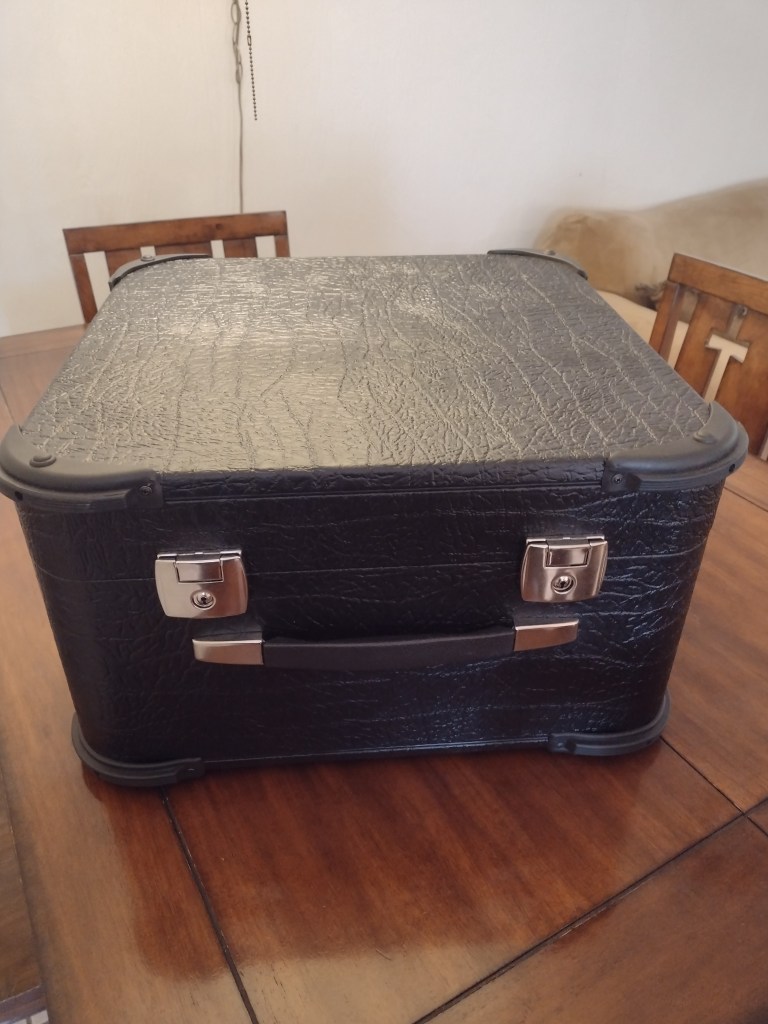
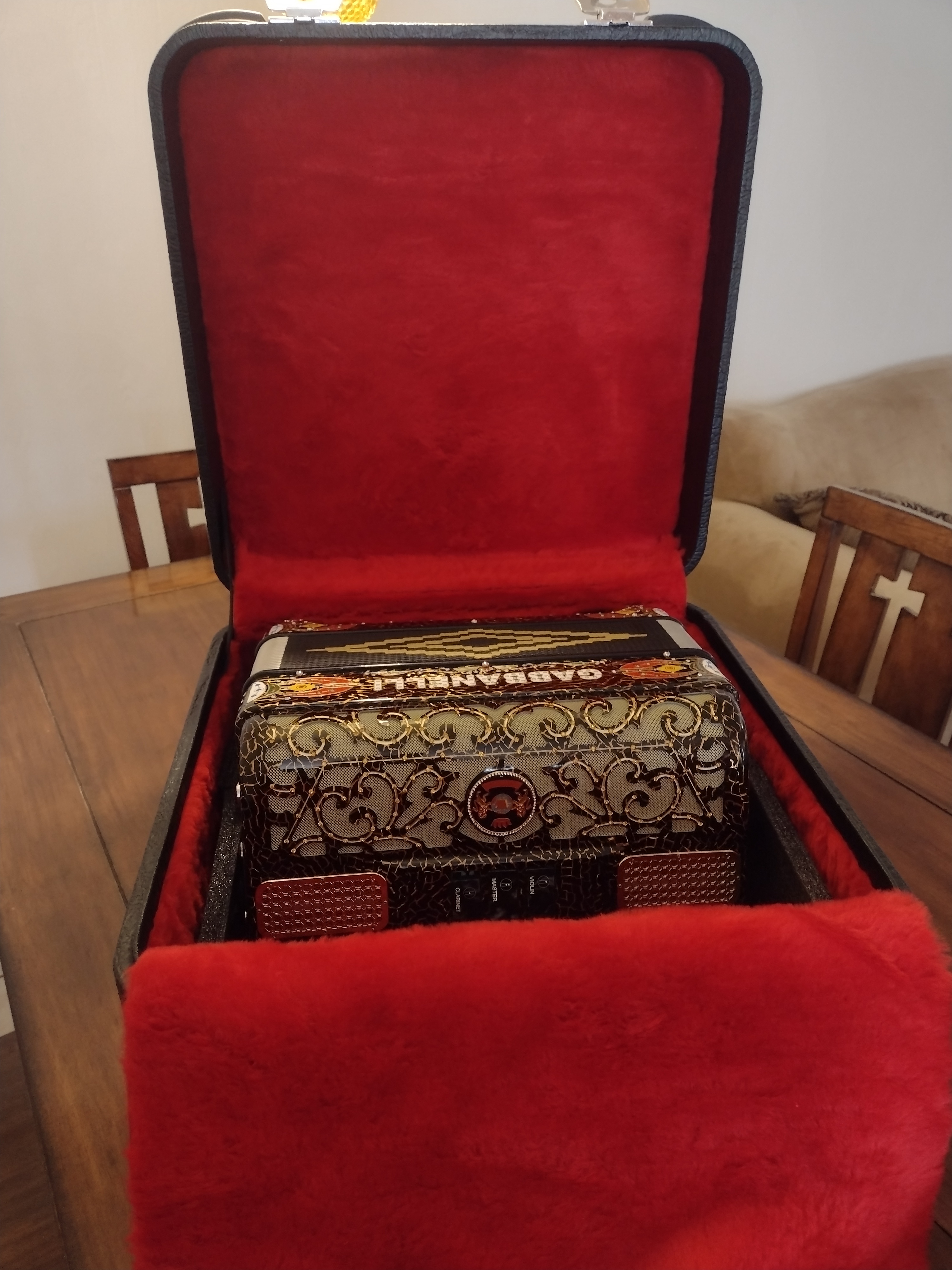
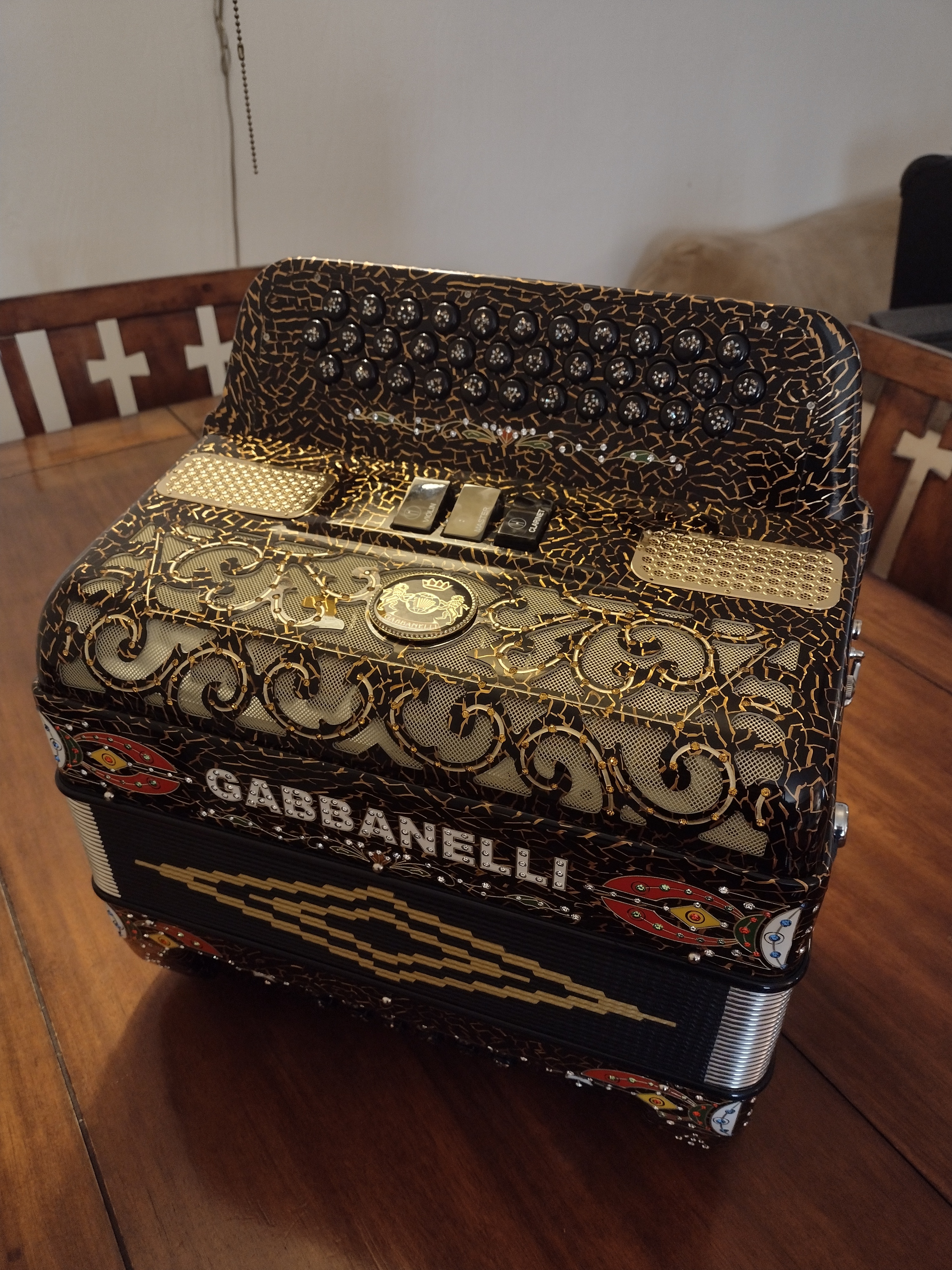
Yes, I bought an accordion. I replaced the Hohner with a Gabbanelli. I had wanted to have both someday, but it wasn’t meant to be. I’m not sure if “meant to be” is quite the right way to look at it, though. Maybe I don’t like it because it’s passive and mundane, whereas the pursuit of meaning is active. Are you the type of person who wants to find meaning in everything, like I am? There is meaning in the most mundane; I know there is, but it might not be graspable.

This is one of the biggest draws of the Catholic faith. Things mean things to Catholics. Little things, big things. They matter. This could be translated as nitpicking or excessive rule enforcement, and it frequently is translated that way. However, now that I’m in a position of upholding some of those rules, I’ve come to value and appreciate them. By “upholding rules,” I mean that I’m involved in record keeping and acting as the office delegate, ensuring that frontend protocol in matters such as baptism is kept. For example, I’m a witness to potential godparents signing affidavits attesting to their living godly lives. This is important. It is not to be taken lightly. We are a very lackadaisical culture; we value little. But “it will all be alright” shouldn’t happen when adults are tasked with the faith formation of children in their care. Hence, there is a religious notary process, and baptism certificates act as legal documents.

Speaking of lackadaisical legal dealings, we discovered today that due to sloppiness on the part of a notary republic months ago, we couldn’t be issued the title to our car. Someone should have caught this error long before we purchased the vehicle, and it didn’t happen. Sometimes, you have to sweat over the things that seem small because they are often not. In this case, the notary had crossed out a date and written a new one without initialing it, thereby rendering the power of attorney statement invalid.

While I can’t say what the meaning of specific events in my life is, at least not regarding all of them, I do know that God works all things together for good for those who love him and are called to his purpose. Purpose and meaning are conjoined twins. And for some reason I now have a new instrument. I have to tell you a little about that. The Gabbanelli company is a family-run business, and in some ways, being small means they are extremely lackadaisical (that is the word of the day). For example, although they have a secure online store, they want their customers to send photocopy images of their credit cards and IDs (yes, at the same time with a form that has the security code on it, too!) to them through insecure emails, after they’ve already charged the customers’ cards. They won’t ship the product unless customers are willing to compromise their identities. Hence, we sent them a wire transfer. They don’t take online security seriously.

On the other hand, they take their products seriously, sending a signed certificate with each instrument, stating that it is an official Gabbanelli. The instruments are high quality and unique in design; they don’t want imposters selling cheap knockoffs. For that reason, they also have one single store in Houston, TX. There are no other entities licensed to sell their products.

The oddities of humans and what they are careless about never ceases to surprise me. Whether it’s becoming a godparent or incorrectly issuing legal documents, such as notarized power of attorney statements, they will let it slide. And then they will proceed to dig in their heels at someone who uses the wrong tone of voice or commits a social crime like a malapropism. Well, thankfully, most things we sweat over do indeed work out in the end. Most do. Even malapropisms have an absurd sense of working out their intended meanings.

This musing over meaning was brought to you by my new accordion! I find the accordion meaningful, despite its status as a mere object. It makes beautiful music, and the instrument itself is a work of art. Beauty is inherently meaningful. The life events surrounding it…huh, who can say?

“To Err is Human…

…to forgive divine.” I thought of this quote yesterday, which was written by my historical soulmate, Alexander Pope. I know; perhaps we wouldn’t be soulmates if we met in person. But as that won’t happen on this side of the veil (time travel not being a reality), I can maintain my romantic notion.

This quote comes from his Essay on Criticism, published in 1711. I know this is hard for moderns to wrap their minds around, but essays didn’t used to be the five-paragraph atrocities that are taught in school these days. This particular essay was done as a long-form poem composed of heroic couplets. Can you imagine turning that into a sophomore English class? Education went downhill precipitously over the course of the twentieth and slid right into the garbage heap of the twenty-first century, and I conjecture that part of the problem was the rejection of traditional forms of essays, such as poems. Once these forms and structures are thrown out, what do you have left? I know teachers try to elicit cohesive groups of thoughts from their students, but when the students don’t even know what a heroic couplet is, how can anything cohesive be expected?

Losing traditions was not, however, what this post was about. Losing minds, yes. Well, there is also the loss of minds that comes along with the loss of traditions. But again, that was not the point. The point is that, as much as humans try to dot all their I’s and cross all their T’s, they still make errors because it is human to err, as Pope declared several hundred years ago. I tend to be very hard on myself when I make errors. Generally, I believe I will have to give up my human card and allow the floor to swallow me up when I make them, when the opposite occurs instead. Not that I would like to make them just to keep being a human being. That would be silly.

It’s been a hard few days. It’s been a hard few weeks and months, too. My life has dramatically shifted in so many ways in the last few months, culminating in my traffic accident, which has wrecked my ability (for now) to exercise. And as I haven’t replaced my accordion, it has wrecked my ability to play my instrument. That isn’t to mention writing my books. That is gone from my life for now because I have jobs I need to complete that predate my new fulltime job — and so I am completely strapped for time. I don’t know why I’m obsessive about accomplishing and moving and doing, but remove my long list of pursuits, and I have little ability to cope. I’m not complaining as much as I’m setting the stage for why I was consumed with abject misery yesterday. The cherry on top was that I became a self-martyr because I made a mistake on something I had done at work. Nobody else had said anything; it was all my own self-flagellations I was bleeding over.

And then a voice of reason reached down from heaven and asked me what else I was miserable and fretting over. Huh? Why was God asking me this? By the way, when I say God, it is merely my perception that this was an authoritative voice outside myself — that is, God. But if so, why was he asking me to dwell on further misery? And then he provided the answer: multiple people have made work errors recently that have cost me both time and money. In addition, the traffic accident was not my fault. You aren’t the only one who makes errors, the voice told me. In other words, the world of martyrdom doesn’t revolve around me. Then the Alexander Pope line ran through my head, and I was consoled because it shifted the world back into perspective.

Maybe Pope is my historical soulmate, and he was looking down from heaven and shaking his head. Maybe he did ask God if he could remind me of the line from his poem to aid me in my distress. Yes, I’m still allowed my romantic notions, which aren’t that romantic if you believe in life after death. Pope, you see, was a Catholic, and Catholics are not materialistic believers. They truly believe in life after death. That is why they ask long-dead saints to pray for them. While Alexander Pope has never been bestowed with the capital “S” saint status, he was a small “s” saint — and why can’t a small “s” saint carry our petitions to God?

I’m better now, less despondent. I actually do attribute it to the reminder from one of my favorite poets. I will offer the full stanza below, just so you can get an idea of where this oft quoted line comes from. This particular poem has a number of oft quoted lines, but it’s far too long to provide the whole essay here. You will have to seek it out on your own.

And while self-love each jealous writer rules,

Contending wits become the sport of fools:

But still the worst with most regret commend,

For each ill author is as bad a friend.

To what base ends, and by what abject ways,

Are mortals urg’d through sacred lust of praise!

Ah ne’er so dire a thirst of glory boast,

Nor in the critic let the man be lost!

Good nature and good sense must ever join;

To err is human; to forgive, divine.

Alexander Pope

Ouch! The entire poem is harsh in this way, and yet apropos and consoling at the same time. Thank you, God, for inspiring Mr. Pope. Let him know he has helped me, if you would.

In the News

Oh, so you thought I wouldn’t put up my yearly hate towards daylight savings time? Nah, well, I might have skipped it, and then I read that the Senate wants the entire nation to follow permanent DST This is because they are all demonic jokers. I think it might even be called the “Sunshine Protection Act” and purportedly “will give people more sunlight.” Sen. Rubio is quoted as claiming permanent DST is “backed by science.”

What is wrong with these people? You know what’s backed by science? The actual sun up there in the sky. The ancients understood this science. Why can’t we? As far as “giving people more sunlight” and “curing seasonal affective disorder,” I was just thrown into the depth of despair because it had started getting light at my 6 AM get-up time…until DST. Now it’s dark and miserable again. So much for protecting my sunlight, Big Daddy. It just doesn’t work that way. Because science is real…real science is real, anyway.

Also, from the news: who wants to ally with Putin now that he’s made sanctions against Biden, Clinton, et al? People like to willy-nilly call Putin a psychopath, and maybe he is Machiavellian, but sometimes that’s what a leader must be. I am being mildly sardonic. Seriously, though, he’s absolutely right to make sanctions against these people who are stirring up trouble on the border Russia shares with the Ukraine.

I wish I could be more patriotic than I am, but I don’t like the way we stir up trouble around the world. I’m just astounded at how generally decent actual Americans are — they are the ones I root for — in spite of their leaders. In my current job, I process charitable donations. Even in this little backwater, the people are generous. They are strapped and hurting from increased prices on basic necessities, and yet they gave more this week than last. And my neighbors, for no good reason except that they are kind, delivered dinner to our door. Maybe they noticed my husband working on plumbing. I don’t know. But it makes me weepy how much I appreciate actual Americans.

I’m sure there’s more in the news. A Deltacrom variant or some such nonsense. Bill Gates talking smack about how we’re going to have another pandemic (he would know, right?). I mean, how does he know? His words are what fuels the conspiracy theories! I’ll pass on the vast majority of news. Not only is it useless propaganda, it’s not even interesting on an absurdist note.

Lastly, it’s not really news that my accordion died in a traffic accident. I’m in the market for a Gabbanelli. I’ll just put that out there, in case someone knows someone who needs to sell a Fa or Mi, preferably three registers. Oh, and I should specify, it needs to be a three-row, button diatonic. These are not even available new right now on the Gabbanelli site; now that I actually want to fork out the cash, I can’t find one. These are weird times, indeed. But I’m holding out for the rich tones of a Gabbanelli.

I had a Hohner. Hohners are very good accordions, but they have a brassier sound. That is why you can find them available new and for resale. They are durable instruments (unless hit by semi-trucks going over 75 mph, apparently), and accordionists will often sell up for Gabbanellis. I should clarify; there is like-for-like. The Hohner Anacleto is a $5k-$6k instrument. They have good quality cheaper accordions, though, such as the Corona ll and the Panther. And when students are ready to purchase a more expensive instrument, they often buy a Gabbanelli with its smooth tones. I had planned on having both someday. The best-laid plans….

My God is a God of miracles, and here I am, asking for one!

La muerte del acordeón

Se murió como…un acordeón. It’s true. I had a moment last weekend in which my life flashed before my eyes, mostly in retrospect, though, because at the scene, it took me a while to process. I was involved in an accident with a semi truck, and I won’t say more than that. But I climbed right out of the car in one piece, and it was only later that I realized my accordion probably didn’t survive. I checked, of course; it was crumpled in the accordion that the back end of my car had become. Is that an appropriately poetic way for an accordion to die? I’m not sure yet, but it’s always better to laugh than cry. Well, it’s not always better. But when God spares your life on the interstate, I’d say laughter is an appropriate response.

The Galileo Syndrome

Yes, I made that up, but it’s bonafide. Also, even though I’m not a diagnostician, I’m ready to diagnose a great many people with it. Those afflicted with Galileo Syndrome believe the powers-that-be in the past unjustly persecuted scientists who wouldn’t stick to the mainstream narrative, while simultaneously believing that the modern-day criminals are those scientists who won’t stick to the mainstream narrative.

There are multiple levels to this psychotic delusional state, one of the most hopeless being those lost souls who believe that Galileo was executed by the Catholic church for conducting science™ and forwarding a true heliocentric narrative. I don’t know who started that rumor, but it’s quite absurd. In fact, he wasn’t executed at all but put under house arrest. Like most of history, the story is not as straightforward as some would like it to be.

It would be good to backtrack a little and remember that the mainstream scientific narrative in Galileo’s time didn’t agree with a heliocentric model of the solar system. Clinging to the geocentric model was not merely a case of religion pitting itself against the scientific experts of the day. In fact, the great Aristotle had already debunked heliocentrism because of the absence of detectable parallax. All those many centuries later to Galileo’s day, the equipment necessary to detect parallax still didn’t exist. Because neither Galileo nor anyone else had proven heliocentrism, it wasn’t widely accepted. Mostly, this was because it violated what scientists of the day could observe. The stars did not appear to shift.

So, what exactly happened to Galileo? Well, he grew arrogant. I suppose that’s my opinion. But it’s likely that if he hadn’t pronounced his theory to be truth with a capital T, mocked people who might have aided him, and insisted on his own interpretation of biblical passages, his soft sentence might never have happened. By “soft,” I mean being forced to stay home with a servant attending him (a far cry from execution). One thing the church authorities didn’t like was being told what capital T truth was or how to interpret the Scriptures. Or mockery, apparently. You might find that to be small-minded, but it was mostly meaningless when viewed from a broader perspective because Galileo’s case didn’t involve papal infallibility; the Pope declared no dogma regarding models of the solar system (or universe, for that matter). Ultimately, that’s as it should be. What if the church had endorsed Galileo’s theory of the universe? Well, wouldn’t it be considered foolish now, since we don’t hold to a Galilean model of the universe? The poor persecuted Galileo was not correct … according to modern scientific knowledge.

Let’s return to mainstream science because our modern reflections on Galileo can be quite muddled. The Catholic church did not control all scientific thought, albeit religion and politics were intertwined. Like the government today and the government-controlled media, the political world at that time had their own reasons for controlling the narrative and pushing an official story. And there were people assuredly who had no desire to control others, but rather believed they were right. They were experts, see — they had done their due diligence. Perhaps you could fault the Catholic and Protestant churches for holding too tightly to the official scientific narrative of the day, under the misapprehension that it would help to solidify the truth of Christianity, when it had little to do with the Gospel, nor even with the truth of Scripture.

Essentially, as I already stated, the Galileo Syndrome finds fault with the experts of the past for making martyrs of out-of-the-box thinkers like Galileo, snidely siding with a man who had only a small part of the truth, meanwhile considering the entirety of modern-day mainstream thinkers to be martyrs of a few out-of-the-box Galileo types. I guess simpler terms for this would be hypocrisy and cowardice. It’s so much easier to believe the experts of your day. It just makes life simpler. Also, people like Galileo can be hard to take. They can likewise be humble and well-spoken … and still hard to take.

In conclusion, try to avoid delusion. The Galileo Syndrome is not a good look. Suppressing ideas that don’t fit the most popular ones of your day just means you will be viewed 500 years from now as a foolish religious nut, even if you pretend not to adhere to any religion at all. The future humans won’t believe your pretenses. They will be like most of their ilk, ready to declare that if you crack like a nut and bounce like one too — you’re a nut. Because that’s science.

La razón del ser

This blog is titled Joy in the Southwest. There is an entanglement of peace and joy; the two go together. And where is this elusive entanglement to be found, you ask? It’s found in the inheritance of what our forebears have passed down to us. For example, look at the image above. I live in New Mexico because my great-greats passed on a legacy of rippling clouds over a desert landscape that rolls down into a lush River Valley. I live here because it’s my inheritance.

My forebears–my maternal grandmother specifically–passed down Christianity to me, as well. She passed it down to my mother, who passed it down to me. My father, of course, also found Christ and passed his faith along, but the story of the desert is centered around my maternal ancestors, who were enamored with the beauty of New Mexico. There are, in fact, reams of photographs from a great-great grandfather who was an early Wild West photographer.

It is funny, but my phone just rang, and after I was done talking, I glanced at the news articles on my phone and spotted this title: El ‘boom’ de la espiritualidad laica: la nueva religión es creer en uno mismo. In other words, the new secular religious fad is to believe in oneself. That is exactly the opposite of what I’ve found to be fulfilling in life. Why would I believe in myself? That is not a religion. It’s extreme myopia. It centers the universe around a single person instead of a history, a chain of people that has led to a distinct person, and a creator who brought it all about.

Some might tell me I need to believe in myself a little more. As a daughter and granddaughter to all these forebears who lived and died before me and left me with a legacy, why not be confident in that? Yes, I should be confident in that. There is a certain limited sense in which I have to acknowledge that God has given me gifts, some of which were brought about due to heredity, and I should stand strong in those. All this shillyshallying around with feeling incapable of accomplishing even those things I’ve worked so hard at over the years is ridiculous and needs to stop. But believing in oneself is not an end unto itself. It’s not a “secular religion.”

I don’t live on my inheritance property any longer. Lately, I’ve realized I might not for years to come. This is because I was able to get a job that will keep us in the land of aliens, instead. While still New Mexico, it is a far cry from the peaceful enclave of the River Valley.

I visited my home last weekend, though. My true home. Well, perhaps, not my true home as depicted in Christian gospel songs that wax poetic about heaven — my home in the Southwest that was passed along to me by my forebears. I love to visit. There are many dark and disappointing aspects about the town where my home is located, and yet I can’t stop loving its beauty and strangeness. Walking in the desert, at that high elevation, looking out over the landscape, my heart is filled with joy. Of course, I’m generally walking with my parents or one of my daughters. There is, no doubt, at least one dog with us, who is loping after jackrabbits and splashing through the warm spring water that feeds the pond. Can this be a piece of what heaven looks like? If not, it surely is an image of worldly joy. Dogs, family, the beautiful desert.

I’m sure you know I didn’t grow up here in the Southwest, but I fell in love with it as soon as I first laid eyes on the landscape. But it’s also the history here that ties me to this place, both my own family history and the much older history of the peoples who settled this land. There were the native pueblo peoples, and then there were the Spanish, who brought with them Christianity.

Along with a walk in the desert with my parents and their dog last weekend, I attended Mass at San Miguel Mission. San Miguel Mission is one of the oldest churches in the United States; it is also one of the most beautiful. However, it doesn’t get the tourist traffic and fame that the old churches in Santa Fe and Albuquerque get. Instead, it’s a quiet gem tucked into the heart of central New Mexico.

On our first visit to New Mexico, many years ago, we did play the tourists and slip inside San Miguel to study the architecture. Well, I can’t say I was there to study the architecture. Yes, the history of the church is fascinating, but I was instead interested in what the church felt like inside. Yes, felt. This is a building that has bodies of long-ago people buried beneath it — it has been a refuge for the living and the dead for roughly 500 years. Buildings have personalities (for lack of a better word). They contain their histories and soak up the tangible and intangible elements in their walls.

I was captured by the beauty of the church, yes, assuredly. The main church is a small building with the muted colors of the desert on its walls and in the old woodwork. It also has the gentle colors of the Mediterranean in the statuary, while the stained glass boasts the vibrant church tone of royal blue. But more than that, I was captured by the feeling of peace inside its walls. I wanted to sit in a pew or kneel on the bench and stay there forever. Peace is not a feeling I was or am generally used to experiencing — I generally run off of agitated energy stores from caffeine, exercise, vitamins, and an average of three hours of sleep a night. I wanted whatever was present in that church. It was something, obviously intangible, that I had never felt in a Protestant church building.

I didn’t know at that time that all Catholic churches feel that way inside. I hadn’t spent too much time in Catholic churches in my young adulthood. In my youth, I had several Catholic friends, and I went to Mass with them once, but I hardly remember the building and what it felt like inside. I only remember being devastated that they hadn’t explained to me beforehand that I couldn’t partake of the communion as I could in the Protestant church my parents attended. When I became a Lutheran briefly before going full Catholic (Lutherans are often described as “Catholic Lite”), I remembered and understood … but that was many years later.

Why do Catholic churches contain a perpetual feeling of peace? One of my daughters asked me that; she apparently has slipped in and sat in a handful of Catholic churches and made note of it. Devoid of congregants gathering, Protestant churches feel vacuous. It is a very different reality. I spent some time as a church janitor in a Protestant church, and I loved it because it was empty. I could sing and fill the space and think deep thoughts, or not so deep thoughts, and get my work done with zero interruptions. But “peaceful” would not be a word I would use to describe the building. Empty and echoing — yes, those are the correct adjectives.

At a Catholic church, the sanctuary building is generally unlocked during the daytime, and many people are coming and going. There are daily Masses and Adoration prayers at various times. So, for a start, they simply aren’t empty as often as Protestant churches are. But it’s more than that: if you ever have the opportunity to sit for a few minutes in a Catholic church, you will notice there is a candle lit almost perpetually during the liturgical year. That candle signifies the presence of Christ in the small tabernacle, set into a niche on the back wall behind the altar. Through the Eucharist, Christ is present in a Catholic church almost all the time. That’s what I attribute the difference to — the constant presence of Christ.

As Christians, we should all have that constant peace inside our bodies, which are the living tabernacles of Christ. And in a sense, we all do. Even I do, with my agitated insomnia and caffeinated mind. The problem with being human — oh, and there are many more than one — is that we have our corporeal bodies there, ready to snuff out the peace of Christ in us. That is a primary reason why I look to my inheritance for a peaceful joyfulness. My people and my God have passed along so much to me, and I cling to that like a drowning person in a shipwreck. It gives my life purpose and meaning. And, also, of course, I go to Mass. While Christianity in general was a family legacy, Catholicism wasn’t. It will be now, though. It’s a legacy that I will be leaving for my descendants who come after me, who might inquire Why did our great-great grandmother convert? Perhaps I’ll even write a book about it.