Exhaustion. What to do?

I have no advice. I will generally live off vitamins, caffeine, and exercise and hope that tonight I will get the sleep I need. But I hit walls like everyone else. And like everyone else, I realize I can’t take a break because I have to get up and go to work. I have to clean the house, wash the laundry, and go to the store or to my son’s award ceremony at school or his sporting event. I also have an insane paranoia of losing my hobbies in the melee, and so continue to play my accordion, study Spanish, exercise, and write books.

When I go to Mass at St. Peter’s, sometimes I lose track of the liturgy because I’m drawn to the stained glass at the front of the church of Jesus as the Good Shepherd carrying a lamb in his arms. I want to be that lamb; I want to feel cloaked in his arms and to hear his reassuring voice that I am his and that he has a purpose for my life. Have I lost a sense of purpose by being too busy? I don’t know. I like to think that if we’re following him, that the essential person he has made us to be will emerge. The desire to write could not be entirely outside his will. Or could it? Maybe I need to just step back and rest.

Do you have a hard time hearing God’s voice and feeling his presence? I do. I have to say I’ve tended to feel spiritually inferior to people who can hear God’s voice and feel his presence surrounding them. I do feel his presence at Mass, but I’m an intellectual. I don’t carry that outside with me. I can only picture myself in his arms rather than feel those arms around me.

During my son’s triathlon yesterday, we sat in the shade of trees by the small lake in Dexter. Normally, I view nature as being a recuperating force. Instead, the experience was so sapping of energy that when I arrived home again, I passed out on the couch. Anyway, that is all I have for this week. I have to push through the exhaustion at some point and return to normal brain activity. Maybe tomorrow the vitamins and exercise will work again, and my favorite music will enliven rather than enervate with emotions I can’t really put a finger on.

So, what does one do for utter exhaustion? I don’t have a clue. What do you do for exhaustion?

Christian Marriage

There is a Trad Wife trend going on social media. I didn’t know it was a trend, albeit, I did see video shorts labeled as such filtering through my YouTube feed. It’s difficult for me to parse YouTube algorithms. I get dating advice, too, but I’ve never actually searched for such channels because I’ve been married for almost thirty years. Maybe dating advice is also on trend? Or maybe my actual searches add up to Trad Wife and dating advice? I primarily listen to Catholic and Protestant apologetics videos. Secondarily, I watch accordion tutorials and music videos. Thirdly, I still watch food budgeting and recipe videos, even though I’m at a point in my life where I do little cooking. Occasionally, I click on a video because it sounds intriguing or like a trainwreck I can’t turn away from. The Trad Wife trend might fall into “trainwreck.”

I learned this hashtag was a trend when one of the Protestant apologetics creators, Allie Beth Stuckey, made a video on it. My take on what I had seen was that it was based off of a lot of naivety. In one or two cases, there seemed to be a cosplay, sexual kink aspect to it, in which the wife primps like Marilyn Monroe and pretends to be a traditional wife, something which Marilyn Monroe was not. A sex kitten Hollywood starlet is not what any normal person would call a trad wife leading a trad life, though there perhaps is a parallel to the way in which she was owned and controlled by immoral men and the way in which these trad females wish to be owned and controlled by, hopefully, moral men.

Hopefully. I tend to make no theological arguments regarding marriage dynamics. We have no intact traditional culture; therefore, traditional Christian marriage roles end up being acted out artificially in our times. The most successful marriages I have witnessed in my years in very conservative Christian circles (I was a homeschool parent for years) were egalitarian marriages. The least successful I have witnessed were philosophically patriarchal with much talk about female submission and male leadership. The results have been so catastrophic in some cases that the children have left the faith altogether for agnostic or even deviant lifestyles. As someone who is a lifelong observer who doesn’t prefer to join movements, what I have witnessed is a sign that we’re doing “trad marriage” wrong, or maybe putting all our eggs in a one- or two-verse Scriptural basket without much thought to the examples put forth in the rest of the Bible.

I will add a caveat in here that, although complementarianism was a term invented by Baptists, the concept is held by the Catholic church, as well. There is no doubt that men and women are different in nature and that society requires both to function. But I do not see the hard and fast rules in Scripture that moderns preach. I see women such as Rebecca and Abigail defying their husband’s authority and unwittingly siding with God’s position. I use the term “unwittingly,” but I don’t really know this; maybe Rebecca’s deception was based off a God-given conviction that Jacob was the son God had chosen. That brings me to another point: God defies human wisdom and hierarchies regularly by raising up second-born sons. Getting back to Abigail and her siding with David instead of her husband at a time when no one yet knew he would be king — that man she sided with was a youngest sibling with many brothers ahead of him in the hierarchy. He was not even the second son! It is obvious, no matter what words you want to use to convince me otherwise, that God doesn’t think much of human hierarchies, and that includes women being on a rung below men. Go read the Old Testament, and you will find other examples of this phenomenon.

Modern-day marriage is a mess. Traditionally, people were married when they were too young* to really consider the consequences of being stuck with someone who might very well become loathsome after twenty or forty or even sixty years of marriage. But, thankfully, there was rarely a way out of the prison they’d placed themselves in. Yes, of course, there are stories of men divorcing their wives (historically, it didn’t generally work the other way around) or of men having their wives committed to asylums when their wives became annoying and asylums were a thing. Otherwise, though, the best hope was that a married couple would end up loving each other more as the years passed. I don’t think this was ever common, though. Am I being cynical? Maybe a little. Nowadays, I’m not even certain I would recommend people marry young because of the ease at which divorce is available. It’s probably better to wait until you aren’t a fool and know yourself a little better, so that you can marry someone you enjoy being around instead of filing for divorce once you’ve realized what a fool you were. I see so many divorces and subsequent remarriages where the husbands and wives are much more mentally balanced with partners chosen at mature ages. I even see this in my job. The Catholic church does try to prevent them by restricting annulments and remarriages, but they still happen all the time. The drawback, of course, is people aren’t even bothering to get married nowadays due to the fact that it’s a sham. Consequently, our reproduction rates have plummeted. None of this is good, despite those who are happier in second marriages.

Are men and women supposed to be happy together and to fulfill each other? To love and cherish each other? I would say yes, if this were a perfect world. It’s not, and, sadly, fulfillment is unlikely to happen. For traditional marriage to work, therefore, divorce must be made more difficult. Misery and long-suffering must be taught as good for the soul. God as our true soul fulfillment must also be instilled in us as Christian people. We have largely walked away from God as a culture. For that reason, I should be cheering for a trend such as #tradwife or #tradmarriage. But I can’t. I can’t find it in me to cheer for a binary worldview in which it’s believed that women need only love and men only respect. Love without respect is pity. Respect without love is a business relationship. I can’t cheer for that, not after seeing this type of marriage come apart at the seams and the children destroyed through it. Without an intact traditional culture, in which men and women have resources to aid them through loveless marriages, such as the old folks giving loving advice and friends offering hugs, this trend is simply not going to work. When one or the other partner realizes the raw deal they were dealt, they will go file for that easy divorce.

Is true love possible? Sure, but it’s a lot of work. I tend to view my parents as soulmates who just happened to find each other. Whether that’s true or an ideal is not up to me to say. However, when I review all that they’ve gone through together, how much they’ve sacrificed for each other, and how much they’ve compromised, I believe it was their intention to love each other, and so they loved as a vocation. They are still loving each other. By the way, they are one of the most egalitarian couples I’ve ever known. Over fifty years and still going. My parents give me hope that people can if they try, no matter what label they slap on. Living requires action rather than philosophy.

*Yes, I’m aware that people didn’t always historically have the luxury of choosing a spouse. This was especially the case for upper crust and royals who wanted to keep wealth and land in small circles of influence. But generally, if an average boy and girl favored each other, they could be married upon approval from their families.

¡Ay, dolor, hecho de la música!

My history as a musician is a sad one, or a lacking one. Sadness is for those suffering losses. I simply lacked education and/or the motivation to get it. I never learned to read music, for a start. We had free violin lessons at school, but they taught via the Suzuki method, which did not teach sight reading of music until students were at a more advanced level than I reached. I took up the guitar in high school but mostly learned chords and scales. I gave it up at some point in my twenties, as I wasn’t passionate about it. There was other dabbling, such as with harmonicas and piano. My skills for my dabbling instruments never moved beyond beginner level. In other words, I’m not a natural at music. Fast forward to the future when my heart was taken by the accordion. Learning an instrument, really learning it this time, in one’s forties is probably not the best way, but it isn’t impossible.

At the start of my journey, I had a few instructional books, including a book of scales. I used to keep my books in a pocket in my accordion case. It wasn’t a proper case, but a “gig” bag. That was why it had a pocket in it for music. As it was a cheaper Hohner Panther accordion, buying an expensive hard case for it didn’t seem worthwhile. All my books were, therefore, destroyed with the Hohner in the accident. Some of these books I’ve moved past in skill and don’t care much about. Others, I’d like to replace, but, unfortunately, they are all out of print and nearly impossible to find. One of them specifically taught sight reading for the accordion, which I appreciated, albeit it used the American music notation. None taught the songs I listen to on the radio — or YouTube or Spotify. I had one video tutorial I’d purchased on CD that had Flaco Jimenez teaching some traditional songs. Just watching him is inspirational. Flaco is the best. Also, I like his personality.

I’m a stereotype, really, amongst norteño accordeonistas because the first song I learned was Tragos Amargos. It’s not a difficult song, though I’m not sure why it’s the ultimate song for student acordeonistas to learn first. It’s funny how the word “ultimate” has evolved in English to not just mean “last” but to also imply something is “the epitome.” Because I listen to Spanish so frequently, I found myself adding the word “first” as a descriptor so that my audience didn’t think I meant “last.” Moving past that little rabbit trail, I found Tragos Amargos on El Bigshow’s YouTube channel. I used to love doing his tutorials. I still do them every once in a while. He’s easy to follow and has a teaching personality I like; I’m particular about personalities, and that’s going to be a heightened snobbery regarding any artists. I’m sorry, I apologize — it’s just that artists are annoying. Anyway, for most people struggling to pick up an instrument, mastering a song they enjoy will help get them past the hurdle of frustration that comes with learning an instrument. There’s a reason I used to force myself to play only half an hour a day five days a week. It was hard work, but I knew if I put at least a little time in, I’d start enjoying it and experience less frustration. Now I play an hour each day, seven days a week. I would play longer if I had the time.

Another goal that helped me jump over my hurdles of frustration was to be able to play along with songs I liked. It’s one thing to know how to play a song. Playing at speed and with good musicality is another skill. The first song I could play along with was Abeja Reina. I didn’t, however, learn that from one tutorial. I learned the song from various sources, including listening to the song itself (by Los Traileros). Playing with my favorite accordion players has been tricky, to put it mildly. Yes, I can play a handful of simple songs with the recordings, such as the aforementioned, and La del Moño Colorado, Navido Pavido, Hay Unos Ojos, etc. Simple songs…but honestly, playing along is a big hurdle to jump over.

Sometimes, I look at my musical history and realize that it’s a royal mess. Despite never learning to read music with fluency, I did learn the basic structure. FACE and Every Good Boy… You know. And then along came this obsession with norteño, and I’ve had to adapt to the tonic scale. In Spanish, the tonic scale is do, re, mi, fa, sol, la, si. No ti with jam and bread, sorry. I play a Fa accordion, which has a row of Fa, Sib, and Mib. The b stands for bemol, which means flat. In America, they are denoted as F, Bb, Eb; I assume the b used for flat comes from the Latin. This is the most commonly played accordion in norteño; that’s why I chose it. I’ve also noticed numerous songs are played in Sib and Mib. I was listening intently to a song the other day because I wanted to learn it and realized the entire song is played on the Mib scale in terceras (thirds). In theory, it’s an easy song to play. More on that in a minute.

I often watch Body Project videos for my exercise, and even when they’re not that difficult, Daniel, in his Aussie accent, tells us we’ve gotten to the point of “mass carnage” on the exercise floor. That’s how I feel about my musical journey at this point. Norteño musicians speak and sing and write in Spanish. They use the tonic scale…in Spanish. I started playing in my forties. I’m still in my forties (for a little while longer), so I haven’t been playing that long. It’s carnage, my brains splattered everywhere. Some days, I understand everything because my brain has adapted, and other days, I just can’t. I can’t figure out the fingering on a song, and if I watch a tutorial, I can’t understand the Spanish. Well, I’m sure I can. It’s just so much extra work. And I’m tired. I suppose opera singers feel the same if they didn’t grow up speaking Italian or German. Maybe scientists do, too, because it’s guaranteed they didn’t grow up with Latin spoken at home. If I’m going to be a norteño accordion player, Spanish will be my trade language, and I have to accept that. By the way, I love Spanish. My love of Spanish long predates my love of the accordion. The only problem is it’s not my first language.

Unfortunately, I’ve reached a point where the frustration with my instrument has returned. Yes, it’s carnage on the exercise floor. I don’t know how to push past this intermediate level I’m playing at. If my fingers were more flexible or if they could keep up with the complicated songs, I could enter the realm of competent musicians. Being competent isn’t what it’s about, though. It’s about the magic. That’s what I want. There are mechanics to it. A song that sounds easy almost never is. There are runs of hidden notes that are played in fast arpeggios that add to that sound but aren’t immediately obvious. And don’t forget the trinos. Trinos are everywhere. In English, that would be a trill. Trinos are what give the norteño accordion such a distinctive and magical sound, and they aren’t as easy as noodling back and forth between alternating buttons; I mean, yes, they are that easy. But there is still a technique to it. There is also the…whatsit that can’t be defined or broken down. Achieving that is like trying to physically capture any intangible. Music itself is inexplicable to a materialistic world. How does one capture the inexplicable? The magic? The thoughts, prayers, or feelings that can’t be put into words? The norteño accordion is, in my not so humble opinion, the most magical of all instruments. I just wish that magic would emerge from my fingers.

Eating & Exercise

This is a follow-up from yesterday. What is my actual eating philosophy? To some, it’s dangerously, weirdly healthy. To others, it’s S.A.D., which stands for Standard American Diet. The truth is there are way too many eating philosophies out there that are polar opposites. So, I eat what I want and adhere to a few principles, but those principles are also to my taste. As in, I can’t stand the taste of soda, diet or regular. Thus, I don’t consume it. That’s not really much of a principle, is it?

  • I don’t eat foods I’m allergic to, except corn…oops. I love my local Mexican food. I try not to eat it often or hives are the result.
  • I balance my macros. E.g. breakfast might consist of plain yogurt with whey protein and blueberries and buttered gluten-free toast.
  • I eat whatever fruits and vegetables I want because I love their tastes and textures. The anti veggie and fruit crowd can…. This is a family-friendly site.
  • Potatoes are the staff of life. Take that haters.
  • Carnitas are amazing.
  • Chile must be consumed regularly. Bonus points for cilantro and raw onions.
  • Black coffee is the other staff of life.
  • I really don’t like sweets and am principled about cooking with only butter and olive oil. Even high-end restaurants will use soy or canola oil, both of which taste like sweaty gym socks. Thankfully, spices cover that flavor.

My exercise philosophy is not that different. My only principle is to do it every day. I don’t care what gym bros say. They can shove their philosophies up their narcissistic… family friendly. If I want to bee-bop up the street to Los Huracanes or Los Dos Carnales (my current favorite band), I will. If I end up with flaccid arms because I’m only doing weight training two to three times a week, sobeit. If I look older than my age, who cares? If I drop dead because I’m not bench-pressing 200 lbs, then I will die happy with the plaintive sound of the accordion in my head.

Choosing an exercise or diet philosophy is like choosing a religion. If you have no real convictions, then there’s not much point because you won’t stick to it. This is the one area where I listen to and learn from the hedonistic Janis Joplin philosophy of how can it be bad if it makes you feel good? That philosophy killed her; I understand that. But I’m not mainlining heroine. I’m eating food that makes me feel good and exercising for enjoyment. Now I just need to work on my personal relationships. Not having them is just as likely to kill me young. Loneliness will eat up a person’s soul from the inside out.

And now for some Los Dos Carnales:

Dietary Dictocrats

There is a comedic Wodehouse story in which some Hollywood folks are put on a diet consisting of a half grapefruit for breakfast, another for lunch, and, you guessed it, another half grapefruit for dinner. Naturally, this diet turns the adherents into crazy people. It’s good for a laugh and a romance that emerges from it, as two of the diet victims find each other, as they can understand each other’s pain.

What’s a harder laugh is knowing these diets and their dictocratic pushers are real, and their advice for health not that different from “eat a half grapefruit for breakfast, lunch, and dinner.” Of course, they couch it all in scientific language and show graphs and use fancy words and catchphrases. I used to listen some of these lunatics when I was doing keto to, in theory, reset my digestion and help my insomnia. If a keto guru made a video on how to fix a health ailment, from skin tags to cracks on heels, the cause would be “insulin resistance” and the cure “keto diet” involving organic free range meats and eggs and, if they hadn’t gone the carnivore route, pounds of organic salad a week, skip the veggies like carrots because they will knock you right out of keto and increase your sugar addiction.

Recently, YouTube has been heavily pushing a diet dictocrat called Dr. Boz. I’ve watched a few of her videos out of curiosity and had to laugh because her “what I eat in a day” was possibly more repellent than a grapefruit and a half, consisting of coffee, “bubble” water, and two cans of sardines. I don’t know if these people are liars or have serious eating disorders they’re using the internet to flaunt. Some people just need attention for their disorders to really shine. I laughed, but it’s a little sad when you consider that these people have an audience that laps up their advice. I’ve seen a couple of her other videos, in which she eats entire sticks of butter, and my gallbladder and stomach gave shrieks of pain at the thought of it. So, apparently, her diet consists of two cans of sardines daily, plus the occasional stick of butter…? I have no idea. That’s a problem with YouTube — random, out of context videos. Still, it’s on the creator to give a little more context to very weird health advice.

Keto dieters are insane, in my not so humble opinion. I suppose it has its medical use for obese or diabetic people who can’t control their diabetes. But otherwise it comes across as a religion, much like veganism. Vegans rattle on about heart disease, while keto dieters obsess over insulin resistance. If keto had aided me in any way for my chronic sleep and digestive problems, I might have stuck with it despite the side effects. But it didn’t help with anything. It rather made everything worse, if that’s possible. It’s definitely possible to have worse digestion; my digestion is mostly stable if I remove hard to digest grains like corn, wheat, and oats from my daily eating. The insomnia I consider incurable at this point, and it gets better or worse. Keto makes it worse.

After doing keto for a while, I suffered from massive stomach pain and upset from too much fat, as well as a cessation of my female cycle. Don’t bother telling a keto nutcase about the infertility it can cause in women (I’ve read it’s around fifty percent of women who suffer this way from keto); they will make excuses and claim the dieter is doing something wrong. I had an MD at one time that tried to convince me it was my fault, as he was a big believer in keto. Any food that contained carbohydrates, such as an apple or a whole grain teff tortilla, he called “sugar bombs.” That doctor was into the AIP and wasn’t much a believer in vegetables such as bell peppers or raw salad or…I can’t remember what vegetables he was okay with, but the list of foods worthy of consuming was very small. Surely, if I only ate this list consisting of three different foods, my female cycle would work spotlessly, and I would sleep like a baby and float on a cloud of organic cotton.

Worst among all diets is vegan, however. I call it worst because the symptoms of stomach pain and massive inflammation occur after a week in my experience. Kudos to anyone who can manage veganism long term and remain healthy. You are probably a genetically superior human. And no doubt another big time religious nutcase. Healthy body, unhealthy mind? Or it could be the reverse, I guess.

There was one diet that helped me sleep and didn’t bother my digestive system, but it came with intense migraines: fasting. I’ve fasted for three to ten days at intervals, simply to reset my body or for prayer, and I admit I do sleep while fasting. That isn’t really a long-term cure; it simply means my body has no fuel, and so I pass out. And get migraines. It’s really awful for my health but definitely useful for my prayer life.

Most of the long-lived people in the world are clustered on islands and eating a varied diet that involves plenty of carbs, such as potatoes or pasta. My takeaway from centenarian studies is one must move to an island, be genetically isolated, and drink a lot of alcohol. That doesn’t seem to work for the Irish, however, which is my ethnicity, albeit clustering with Irish Americans. I don’t much care about living a long life. At the same time, I find it fascinating looking at the habits of centenarians. They tend to drink alcohol, eat carbs, and exercise and/or stay active physically. Some are dedicated athletes and others walk daily and do gardening and light housework. They also seem to have let go of grudges and are thankful for life. All I know is carbs, alcohol, walks and gratitude sound a whole lot better than bubble water and sardines.

The Absurdity of Misanthropy

The concept that humans are worthless is very popular in both Catholic and Protestant circles. I’ve been in Protestant services where the extended worship time focused on repeating mantras of self-immolation in song. I’m glad my husband stopped attending that church. To be fair, I stopped attending Protestant services with him entirely because I’m burned out on all of them.

But self depreciation certainly isn’t confined to Protestantism. Catholics have a long history of self hatred, which they have demonstrated through absurd physical means such as flagellation and the wearing of hair shirts. I don’t have a problem with self denial at all; fasting is biblical and can take our focus off the emphasis of meeting our physical needs and onto crying out to God to meet our spiritual needs. But the intentional acts of self hatred and proving our worthlessness to the world is 100% lost on me and, in my opinion, not consistent with either God or other Christian beliefs. Thankfully, these are private rather than corporate Catholic practices. In other words, the Mass is the Mass; there will never be a “led by the spirit” lengthy worship service in which Christians chant about how they need to disappear so that God’s glory can shine.

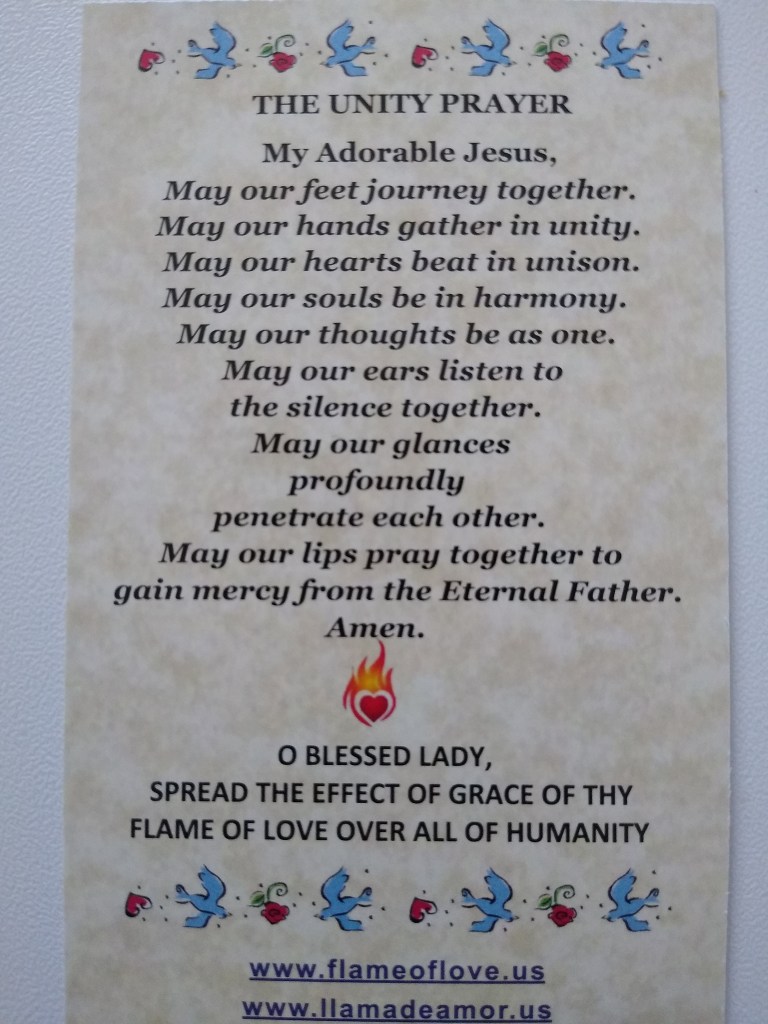
There is a viral Catholic prayer, The Unity Prayer by Elizabeth Kindelmann, that has caught fire in Catholic circles. The prayer itself is lovely (I will post it below) and the testimonies about it binding Satan’s influence over us probably true. That is the power of praying to Jesus. Being that these types of viral movements, in which numerous miracles are attributed to a specific prayer, fascinate me, I decided to read Kindelmann’s autobiography for more context. What a mistake that was! It wasn’t entirely a mistake. However, it is a tale of human suffering that can be very depressing to dwell on for any length of time. On the other hand, trust in God in the midst of suffering can be inspirational. There is both in the text, but unfortunately too much of the former for my mental health.

I stopped reading not too long after the words spoken to her by the Blessed Virgin Mary and Jesus turned the direction of “your priority is to remember that you are nothing.” Granted, this is a translation into English. In fact, it went from Hungarian to Spanish and then to English from the Spanish, so what I’m reading is twice removed from the original language. How difficult is that concept to translate from any language? I don’t know. I’m asking an honest question. Hungarian is a Uralic language and is therefore quite different from English or Spanish, but it still has a word that translates as “nothing.”

Why is this such a problem for me? On an emotional level, I struggle with nihilism. If there is no purpose to my or anyone else’s life on earth, I’d rather just off myself right now. Please don’t be alarmed by that, as I don’t believe my life is meaningless. I don’t buy that lie the evil one is selling. On a practical level, the pro-life movement, which is very important to the Catholic church, has as its core philosophy the value of all human life. Humans aren’t nothing. They matter. That’s why Catholic crusaders are willing to go to jail for protesting against abortion and euthanasia, as well as the maltreatment of humans. That’s why thousands of priests were killed by Nazis — they stood against the Nazi maltreatment of humans. How can they hold that philosophy while believing they themselves are nothing? Are they not as human and, therefore valuable, as the lives they’re fighting for? It’s a strange dichotomy you find all over the Christian world. I’m meaningless; I don’t have value, but I’m going to save the starving people in a refugee camp because somehow they have value despite being humans, too.

In a larger theological framework, there doesn’t seem much sense to God creating humans and sending his Son to die self-sacrificially for them if he regards them as nothing. What kind of capricious God would do that, and then advise these same humans when they are struggling through poverty and loneliness, as Kindelmann clearly was throughout her life, that their number one job was to remember that they are nothing? Her life as a poor woman and young widow had already taught her she didn’t have value. If she is writing that she is nothing, my guess is it’s coming from the worm in her brain implanted by maltreatment and not from God.

The Good Shepherd does not look pragmatically at his sheepfold and say, “Well, I have ninety-nine here. It would probably be better if I keep watch over these than go out and look for that one that left the fold. She left of her own free will. Her choice. She was warned about wolves. Besides, that’s one less mouth to feed, and who wants to give food to a poor female nobody loves? She’s nothing to us. Should we take a vote?” Those are not godly words. Jesus said he would leave the fold to find that one sheep that was lost. The sheep obviously being a metaphor for us, does the Good Shepherd strike you as a savior who would tell us we are nothing? That we don’t matter?

Humans want and need love. They want and need to know that they have value. They want to matter. It is no surprise to me that God built us chemically to produce pleasurable feelings when we do good for others. Doing good gives us a sense of purpose, a vocation. Yes, our chemical reactions can be tainted; there are sadists who instead feel pleasure when harming others. But we are appalled by that twisting of our God-given natures, condemning such people and their behavior, and rightfully so.

Maybe if I read the rest of her story, I would learn why it was important for her to remember she was nothing. I do not know because I’m not going to finish reading something that has already struck me as being false, closer to Zen Buddhism than Christianity. Instead, I’ll return to my fictional murder mysteries, where the sense of justice enacted in the end is predicated off human life mattering. If it didn’t, there would be little point to punishing murderers — which is, by the way, a biblical concept.

Have You Seen Any Christian Films Recently?

This was inspired by a YouTuber I like, Ready to Harvest, who frequently creates polls. I like him because he’s informational more than apologetic in nature. He describes Christian denominations and sects in a neutral tone. He rarely passes judgment. He’s an information and data collector, who then passes on what he’s collected for the benefit of his audience. I’m sure he has his own beliefs, but they aren’t the purpose of his channel. In a poll that just scrolled through my feed, he asked his audience if they had seen a Christian film in the last year, and there were various answering options.

The question gave me pause. Had I? Yes. And I had seen more than a few if it was a year from last May. For example, I watched Fr. Stu in the theater last spring. I also watched For Greater Glory at home. Those are movies with a clear intent of being Christian. Another that was Christian by default rather than intent was The Perfect Game. All were Catholic. All were based off of true stories. All left an impression on me, with The Perfect Game being my favorite. I’m pretty sure I wrote a blog post about that last one, as that kind of film is my personal crack. True. Inspirational. A story of the underdog prevailing. A sports theme. A dedicated priest, and kids with relentless faith in God. Yep. Make a film like that, and I will be there, and I will probably be wiping away the tears sliding down my cheeks.

I also watched some films that had a darker edge (For Greater Glory was heartbreaking and dark, but in a different way), such as Deliver Us From Evil, which is a horror movie based off the true story of a New York cop who becomes an exorcist. It didn’t get great reviews from horror fans because it was truly redemptive in its conclusion, the power of God overcoming evil. I’m not much for horror; I don’t like being terrified. I can’t stand jump scares, but this is a film worth seeing if you want to reinvigorate your belief in the spirit world. Of course, you have to believe that it’s a true story for that to happen. Belief is the sticky wicket, isn’t it?

Overall, I haven’t watched many movies this past year. I don’t have time for movies and shows, though I do admit sometimes I just want to recline on the couch on Saturday and do nothing but watch video entertainment. The problem is good films are difficult to find. There aren’t many stories like The Perfect Game out there. Most of the films I watched last year were Christian or inspirational in nature — true stories, though. There’s something about inspirational fiction that’s a bit too thick for me.

My original question stands: have you seen any Christian films recently? If yes, did you like them?