
Spanish, Dalí, & a Little Lorca

Christ of St. John of the Cross

Imitations or reproductions of Dalí’s famous painting are rife in the Catholic world, with an imitation in the office where I work. It takes me back to high school, when I loved Dalí’s artwork. Also, I had just started taking Spanish in school and therefore believed I could read my dad’s battered paperback of Federico Garcia Lorca’s poetry. These are related subjects, I promise, and not simply because I’m discussing Spaniards who, obviously, spoke Spanish.

We had to study a language; it was mandatory in high school. It doesn’t make much sense at that point, however. Learning a second language should have been mandatory from kindergarten onwards. I have an elderly friend at my parish who attended a private American school where they spoke Polish in classes. She still understands and speaks Polish to this day because of her early exposure to it, despite living in an English-only culture. I will never understand the English-only cultural philosophy. It’s not just xenophobic; it’s an example of my least favorite personality trait in individuals, let alone entire cultures: proud ignorance. Generally, I call this the Cult of Stupid. You can spot members because they roll their eyes and complain if you use words with more than two syllables. They think it’s snooty or some such, without recognizing the irony that syllables has three.

Could I actually read the Lorca book? Sure. It had English translations on the right hand-pages. My dad is not a Spanish speaker, after all. I loved learning the pretty vocabulary in the book, as it set me apart from other first-year learners of Spanish. I’ve always had a big vocabulary, and even though I failed pretty badly at English classes in school, I do have the ability to dissect words to determine what they mean. This gives me an even further edge regarding an intellectual grasp of a second language. It’s too bad this process often confuses words for me rather than making them clear. I ran into a funny example this morning. The word equivocarse and its various forms are related to the verb in English to equivocate. By the way, this might not be a commonly used word in English, but it is a common word in Spanish — like so many Latin words that have more than two syllables. In English, this word takes on the meaning of obscuring the truth. To equivocate is either for the purpose of being circumspect or being deceptive. In Spanish, it has the connotation of simply being wrong. I came across a video with the title, Estos policias se metieron con la chica equivocada… It took me a pretty minute, being in an English frame of mind, to realize a correct translation would be “The police messed with the wrong girl…!” My mind wanted it to be deceptive instead of wrong, but it was clear from the context of the video that the girl was innocent, and the police were the deceptive ones. Context is the best guide to learning a language, and so much for my intellectual, dissecting approach. In fact, although this is a bit of a digression, the only way to understand someone speaking Spanish to me is not to be myself, and to listen without focusing on any one word, picking up the sense from the context. If I stop to pick apart words, I have already lost the rest of the conversation. And unlike a language test in school, I’m not going to earn points for translating a few words correctly.

Lorca and Dalí were close friends, albeit I didn’t know this when I was in high school. I only knew I liked reading through my dad’s books, which also included art books featuring Dalí. I’ve loved Spanish ever since I was first introduced to it; that’s all I want to say about that. This post was meant to be about Dalí. But there is a point of overlap with my previous discussion that is much greater than my dad’s bookcases, as it’s clear from reading about Dalí and studying his artwork that he also took the analytical approach to life. He studied the master artists and picked apart the elements in them in order to understand them, and then he spent some time imitating them. Because of this, he’s known as a master of craft. When he created surreal art, he was playing with ideas that intrigued him. For much of his young years, Freudian psychoanalysis was a large part of what intrigued him. He met Freud; Freud didn’t like the surrealists and couldn’t understand why they were fascinated with him. He liked Dalí, though. He liked his genuine fanaticism.

Dalí was also intrigued by the physics of time and space. This in turn intrigued me as a young person. Beauty is timeless, and I will never cease to appreciate landscapes and portraits that capture the personalities inherent to people and places. But playing with ideas perhaps appeals to me even more. Another artist I appreciate for this is M.C. Escher. They both clearly loved playing with what is possible in flat geometric spaces. These two artists have a number of similarities in thinking, to be honest. They both loved the ideas they were representing and loathed politics. Neither wished to be pinned down politically, during a time when being a surrealist artist meant something political. Dalí was actually voted out of the surrealists because he eschewed Marxism and, especially as he grew older, defended Catholicism, eventually returning to his nation’s historical faith (he even had his longtime civil marriage “convalidated” in the church.) Escher was apparently part of a Christian religious order, as well, but he was as quiet about that subject as he was about politics. Dalí enjoyed creating controversy; Escher did not. There are other artists I love because they have an absurdist, intellectual approach — William Hogarth is one that long predates surrealism.

What about Lorca, though? I don’t know; for me, he was simply the first Spanish poet I read. He and Dalí were artistic friends, but Lorca’s approach was different than Dalí’s. He was a gay socialist, fitting neatly into the world of the avant garde. Dalí never fit in, and nor did he want to. He lived to a ripe old age, changing his psychoanalytic approach over the years to bizarre perspectives of Jesus on the cross. Meanwhile, Lorca was assassinated under a fascist regime (though there is some controversy regarding why and by whom).

Like Dalí, ideas are really what drive me forward. Because of that, I will probably never arrive at a place where I’m an artist at storytelling or making music, or a natural with language and communication. But every time I see Dalí’s crosses in my environment, I’m reminded that there are famous artists who don’t approach the world with a traditional artistic temperament. So, perhaps, I still have a fighting chance. By the way, I have tried to subvert the intellectual approach in learning the accordion, but mostly because I don’t have time to give it an extensive study. I want to live in the magic of the instrument and play the songs I love. However, I’ve determined that taking a more intellectual approach will work better for me, having the emotional artistic state of a gnat. So, I’ve stepped back to think through music theory. In Spanish. The problem with my accordion playing is that it’s always been in Spanish. Switching to English would not be a great idea now that I’m used to Do Re Mi Fa Sol La Si, mi acordeon en tono de Fa, and hearing ahora, tocamos la escala de Sibemol en terceras. I know what that is and can play it. If someone switched to now we’ll play the scale of B flat in thirds, I’d probably panic. Intellectuals just do not switch gears with ease, I’m sorry to say. That’s why we’re often labelled fanatics (see Freud on Dalí above). We get obsessed and taken with an idea and must hammer it out to its conclusion.
Speaking of El Diablo…

As I’ve said before, I don’t do social media, unless this counts. I listen to podcasts and accordion tutorials on YouTube, but I have very low desire to engage with others in the comments. Therefore, I’m sheltered from much of the toxicity in the world right now. But I know it exists — it’s out there damaging others’ lives instead of mine.

Imagine my lack of surprise that while I was joking about cultural appropriation here on my blog, a long-time writing friend was cancelled for it. I suppose I can say what her penname was, as it doesn’t really matter at this point. She was writing under the name Jessica Tescher when she invoked the wrath of the black romance hashtag folks on TikTok. She had the gall, you see, to write about a black couple in her sweet romance southern-themed books.

Naturally, she thought that she should write from the diversity that exists in the South. But this is not okay because she’s white. Whites can only write whites. She was hit so hard by trolls that she trended on TikTok for a day and now, to rescue her sanity or career or both, she’s shut down all her social media. Of course, white writers can’t win in this rigged game. The narcissists on TikTok have to get attention and harm others at the same time. Narcissists do that. They play victim at the expense of other people. If Jessica were to have written her series with no black romances, I’m sure she would be accused of whitewashing. I’ve heard that accusation, too. It’s a balancing act I don’t care to participate in of having a diverse backdrop to a white-prioritized book. The diverse characters have to be given voices…just not too loud and descriptive, so as not to pretend that an outsider can know someone else’s perspective. They must still remain visible in the background, however, and yet not be stereotypes. I don’t know why anyone would bother trying to please narcissists; it’s an impossible task that will get you nowhere.

When you can’t win, anyway, you might as well just write what you want. Write from a perspective that all people are humans who feel the way humans feel and love the way humans love. Write from the understanding that not every member of an ethnic or racial group has the same experience. And also understand that racism is real because people are hateful and tribal and will ostracize others if they perceive it will give them social credit. Most people have been ostracized and rejected if they’ve lived in the world long enough, even if it doesn’t rise to the level of oppression. Therefore, write from that understanding. Write about how hard it is to fit into a majority culture.

I’m not sure if TikTok is aware of this, but when observational people like writers try to understand the world, they are opening their minds and hearts to people different from themselves. This is something we should want. We should want more empathy in the world, not less. Empathy begins with you. And me too, but now I’m simply addressing those people on TikTok who haven’t expressed any empathy towards an author who was trying to develop an audience. She certainly didn’t have that yet; she was no JK Rowling that you just stuck it to. No, you harmed someone who had a very small voice. You punched down, in other words.

What if her book was really that bad, though and deserved the hate? I doubt it. I haven’t read the book she’s being cancelled over, but I’ve read her other work (published under a different name). But let’s just assert for the sake of argument that she screwed up royally with this book. Should you have brought a mob to destroy her, or given her honest criticism? Stop! I already know the answer.

I’ve long given up hope on people being reasonable. Most people just aren’t as a rule. It was a frustrating realization I had to come at about age forty. I’m not even sure why I’m writing this post, since I know people are unreasonable. I guess hope still lives inside my soul.

I’m currently writing this post on my lunch hour; that’s how upset my friend being destroyed has made me. Normally, I use my lunch hour in better pursuits, such as staring at the wall and thinking of that moment later when I can clock off, drive home, and play my accordion for an hour. Yes, I’ve changed my schedule such that I play seven hours a week. I manage this by playing as soon as I get home instead of cuddling my doggies and slowly changing my clothes for my evening walk. The dogs can listen to my music, and the evening walk will still happen eventually. One must have priorities. Because playing gives me great joy lately, I’m living day to day off the excitement of it. I’ve solved my chronic insomnia by replacing sleep with excitement! Try it out! See how it works for you!

I can’t wait to go home and watch the sun disappear through my enormous front window while I squeeze and extend my bellows. From my window, I can actually see the whole world! Or at least my tiny portion of it. There’s so much to discover out there that doesn’t involve worrying about cultural appropriation. Please pray for my friend, as the future must look dark for her at this moment. If she hadn’t already shut everything down, I would instead exhort you to buy her book and give it an honest review. Too bad she caved under the intense pressure — would I have, too? I don’t know. I don’t particularly like being visible. It brings up bad memories of childhood bullying.

El Tema Más Importante

I wrote several very long paragraphs on the Social Contract and then put it aside in my drafts because I honestly hate preaching about subjects such as this. While I appreciate reading about philosophy, politics, and religion, and how they intermingle, there comes a point where people are preaching and nobody is listening. Furthermore, nobody is changing society at all. Oh, yes, of course, one can change society little by little through the infiltration of ideas in schools and universities; progressives did this throughout the 20th C and are still at work today. But sadly, my post was triggered by irritation at the manipulation behind the phrase social contract…and if I keep going, I might as well just pull out my post from its place in the dreaded wasteland of drafts. Another tantalizing yet frustrating subject I had brought up in that post is my unpopular opinion that lowering the teenage pregnancy rate is not positive progress but negative decline. And on that note…

The most important subject is obviously the Gospel. However, the most important subject to this blog has become music. Accordions. My mind has been dwelling on purchasing a new one. After spending $4K on one, you’d think I wouldn’t buy another one for a long time. What you don’t understand is that accordions are like very expensive harmonicas, and acordeonistas need different keys. The one that died in the traffic accident was a GCF. After reviewing numerous norteño songs, I discovered that most are played on the FBbEb accordion. Hence, I purchased one. However, I would still like to have a GCF again, as that is the second most commonly played instrument. Someday, I will purchase an EAD because that one is also occasionally played in the genre. In fact, the master Ramon Ayala often plays an EAD. This confused me for a long time, as I thought EAD was commonly played, but I was being swayed by the sound of Ayala’s songs.

Apart from desiring a GCF accordion, I would also like an accordion with bass buttons that aren’t dummy buttons. Yes, that’s correct; my expensive Gabbanelli has dummy buttons. I suppose this is so that bass blocks could be added at some point; there are tiny tornillos that can be unscrewed to open up the left-handed bass side of the instrument. I’ve heard it’s difficult to persuade the company to put in bass blocks because it will create a weightier instrument with an altered sound. When norteño as a genre has a familiar sound due to the fact that so many of the musicians play Gabbanellis, it’s a bit risky to make any changes. The only way to have pre-installed bass blocks is to buy a cheaper instrument. Therefore, I’m considering purchasing a Hohner Corona II or Classic, which are quality instruments (made in Germany), in order to practice with the left hand again. Also, if the accordion is the only instrument available, and I’m playing for family or friends, songs would be more complete with their bass parts. Of course, norteño bands have rhythm instruments, so they don’t use the left hand anyway. In fact, one of my favorite online accordion tutorial teachers has a video on how to remove the bass blocks from your instrument for the above stated reason. There is already a bajo sexto y bajo in the group.

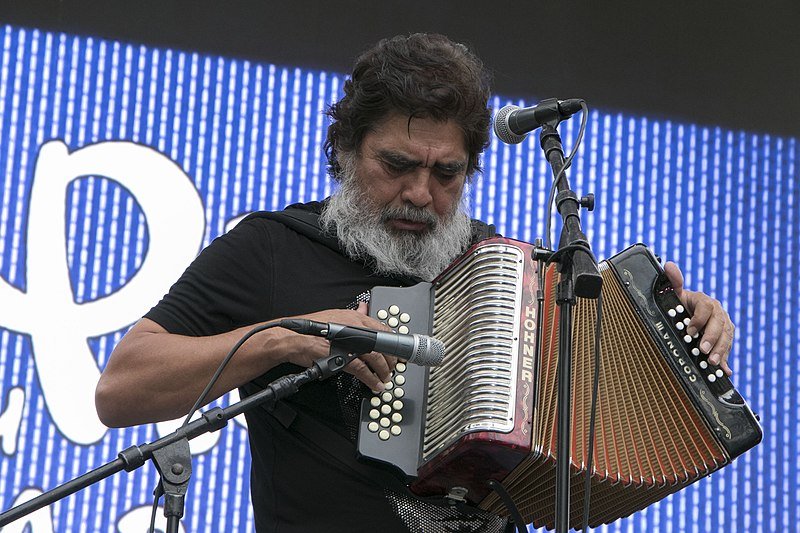
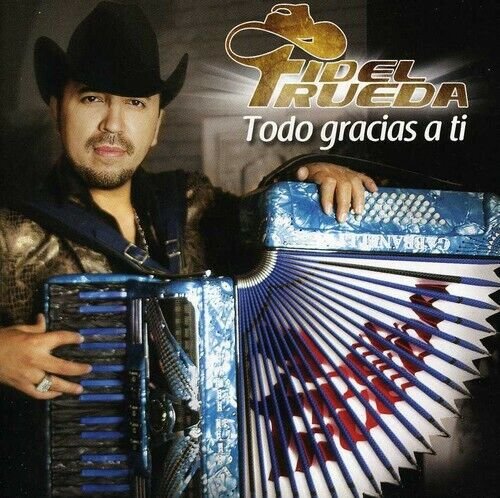
But that isn’t to say no norteño acordeonistas use the left hand — Celso Piña, who has now passed away, used his bass buttons in cumbias. I enjoy his songs because they have a different sound. I also really enjoy watching videos of him playing live. It’s exciting, the music infectious. He played a Hohner Corona, by the way. Believe it or not, you will even find musicians who play piano accordions in this genre. One of my favorites is Fidel Rueda. I don’t know how to describe his music, except as “sexy” but that sounds crass and doesn’t quite express what I want to say when his vocals, the accordion, and the brass blend together. I should probably make up a word, instead.

Speaking of word invention, there is a word for that in Spanish. It is jitanjáfora. I learned this word some time ago when I was trying to figure out what El Pávido Návido means. That’s the name of a song, and it disheartened me when I realized one day I had no idea what it meant, and I’m tired of my poor Spanish vocabulary. Don’t get me wrong; I can understand the music tutorials and interviews I listen to because they have necessary context. But then I’m thrown by a catchy song title. As it turns out, the title is a jitanjáfora. That’s either a relief or not, since I don’t know Spanish well enough to recognize nonsense rhyming words. Today, I will post pictures of the two rebel accordion players I mentioned. You can seek out their songs if you choose.

From Wiki Commons
This is an album cover; I hope it’s okay to post. I wanted an image with accordion!

“Mexicano hasta al tope…” and other not so random thoughts

The part in quotes is a line from Corrido de Juanito, which, as you know, I’ve been learning on the accordion. Because I listen to the song on repeat, I have it permanently stuck in my head and consequently sing it all the time, especially the line above. The funny thing is the line ends up sounding like a commercial when sung on repeat, por ejemplo, “The best part of waking up is being Mexican to the top!” I’m sure you can hear the Folgers song in there, no need to spell it out.

Most of the time, I live in my musical fantasy world, my favorite songs filling my head and keeping me going after my three hours of sleep per night. But then I will have moments when reality wakes me out of my sleep-deprived reverie, and I ask myself who exactly I think I am. I’m certainly not Mexicana hasta al tope. Because of that, some old college friends might call my norteño obsession and accordion playing cultural appropriation. Is it, though? Is it really?

The accordion is German in origin; the name comes from the German akkordeon. Mexicans appropriated the instrument from another culture, in other words — from the German immigrants who settled in Texas and Northern Mexico. This is what happens when cultures rub shoulders. They influence each other. It is unavoidable, or should be. When cultures share music, dancing, and food with each other, they tend to get along a lot better than if they stay suspicious and aloof from each other. There is much cultural snobbery and myopia when people get their hackles up over hoarding aspects of their culture.

I will never forget the article I read years ago, in which a Chinese-American woman claimed the bone-broth fad was appropriation of Chinese culture. It didn’t seem to occur to her that cultures all over the world might have been cooking bone broths for millennia. This doesn’t even fall under the category of sharing; it rather signifies our forebears’ mutual necessity to utilize all parts of the animals they slaughtered. The Chinese were not alone in this.

If I were to only play the music of my culture, I would play the fiddle or one of those tiny accordions popular with hillbillies and the Irish. My family was part of Irish dance culture for years, and I distinctly recall hearing the accordion playing the same jigs and reels fifty times over. I mean, it’s not a matter of recall. All those jigs and reels are indelibly printed on my psyche along with big wigs and bling. But alas, the Irish don’t count Americans of Irish ancestry as being Irish, and there goes my culture. Like so many Americans, I simply have a mezcla of cultural parts and pieces, which includes Mexican pieces because I’ve lived around them my entire life.

Is there such a thing as cultural appropriation in America? I’m going to say yes. I was thinking about this at dawn, having been awake for hours. My body was achy and sore and I thought I might like to do some yoga. I don’t do yoga, though. Oh, sure, I used to. I appreciated its efficiency in strengthening and stretching the body at the same time. I also argued with other Christians who claimed it was wrong to participate in another religion’s worship. They argued against it because yoga, after all, means yoked, as in yoked to spirits and gods Christians don’t worship. I’ve always found it a little bizarre when Christian churches offer yoga hours in their fellowship halls, but doing it as exercise in one’s living room, sans spiritual components, I thought was quite all right.

The way Americans practice yoga is areligious to be sure, but it’s hugely disrespectful of another culture’s religious practice. I’m not sure what hyper conservative Hindus, who still believe in modesty, think of Americans who do Yoga Booty while wearing pants so clingy you can see every bump and jiggle on the legs and backside, wearing the pants to show off the effectiveness of the exercise. The way we practice yoga might very well be what people mean when they cry, Cultural appropriation! It’s rude and offensive. That and maybe chintzy plastic Native American dolls and fake moccasins. Marketing off a culture we very nearly wiped out to extinction no doubt leaves a bad taste in the mouth of the extant native tribes.

Speaking of weird activities Christian churches get up to, along with showing off their jiggly booties…no, I don’t think they make moccasins or plastic dolls or even bone broth. At one time, it was standard charity in England for bones to be used multiple times, once at the wealthy person’s house, who supped on the richest broth, of course, until finally the picked-clean bones were ransferred to the poorest of the poor to make broth with. But church food pantries these days are more inclined to collect canned vegetables and beans than spare animal parts. No, the weird activity I was going to mention is doing counseling sessions using the Enneagram personality typing system. In response, Reformed-style Christians are horrified, despite the dubious occultic roots behind Enneagram.

There are no known accusations of cultural appropriation regarding Enneagram; I just find it amusing that Christians have latched onto it AND that more Reformed types are making a fuss of it. I wouldn’t care one way or the other if Christians didn’t have a peculiar problem with lacking self-awareness. They make lofty claims that we shouldn’t be looking to any other source but the Bible for help, but what they really mean is “I don’t want to know anything about what I’m really like inside.” In other words, they don’t want to be faced with their own egos. Obviously, the ones using the Enneagram are busy identifying with their egos, looking straight into them, but that is not to say that there aren’t many Christians who refuse to look.

I took the Enneagram once, at my husband’s insistence, as he found it gave him an accurate description of his personality. Modern Enneagram type descriptions are incredibly detailed, unlike the truly occultic horoscopes. This might be why some people have an aversion to Enneagram. It’s not always pleasant to read that you fit an archetype that isn’t 100% positive. Was the type I tested as an accurate description of me? Sure, it was…at the time. And I really didn’t like it; hence, it motivated me to not be “my type” as much as possible.

Being self aware is a good starting point for making good choices in this life; I suppose one could be self aware and still make wrong choices. For example, a truly invested thief could be a proud criminal. Or maybe in more ordinary circumstances, a person might learn to identify with their negative traits and never seek growth. Well, I admit I still have personality traits I’m working on. I often shut the world out so I can pursue my personal goals, which my Enneagram description predicts. That pattern of behavior is so ingrained I believe it would be difficult to change. Like my pursuit of the accordion, for example… No, no, I have examined my interior and decided playing norteño on the accordion is a good choice. A wonderfully positive choice. It had better be. That norteño style accordion I bought was really expensive. Plus, I love singing in Spanish. Here it comes again. I. Can’t. Stop. Singing… Mexicano hasta al tope. It’s somehow gratifying to sing a song about someone with an intact culture, even though part of the song’s sadness is the subsequent loss of culture in the US, loss brought on by Juanito’s children no longer speaking Spanish.

Always Seeking Goodness

I’ve been attending the 8 a.m. Mass at another parish in town; the earliest Mass at my parish is 9. When you are an early waker, as I am, you tend to get impatient before 9 a.m. Mass. I wait until after Mass to drink my coffee and eat my breakfast. This is certainly not required by the church; I simply prefer it. Also, there is the ever-present problem of being a parish secretary who is already at my parish forty-plus hours a week. Sometimes, I need a break. Maybe next Sunday, I will go to 7:15 a.m. at the Poor Clare’s.

What can I do before Mass if I wait until 9? Read? I suppose. Recently, I discovered an author, Veronica Heley, whose books I would read any time because they are my special crack: they are cozy mysteries that don’t shy away from the darkness of evil. I’m partial to mysteries; most are cerebral and character-focused and use detection to bring about justice. Yet so many have sleazy main characters who are essentially nihilists hopping into bed with whomever, who don’t understand their own drive for godly justice. Heley’s books, while not having an American preachy quality (the author is English), feature protags who aren’t nihilists, albeit they aren’t perfect, either. The author clearly has Christian faith. That was a long diatribe to say that most books I have no desire to read before Mass. So, yes, the earlier the Mass, the better — before I’m distracted by worldly thoughts and cares. By the way, when I say they are crack, I mean it. I read the first four in her Abbot series back to back in about a week’s time. Then I gave myself a break. I will come back to them soon and read more.

Now it’s noon, and I’ve been to Mass and eaten and had my coffee and….watched a Lawrence Welk documentary that Color Storm linked to in my previous post’s comments. It’s an A&E Biography, and it’s worth an hour of your time (less, if you pay for YouTube and don’t have to watch the ads.) Aside from British mysteries and Mexican music, I have a general affinity for all accordion music except perhaps Tango. Tango* is just too pretentious for me. I’m like Lawrence Welk: I like to keep things light, goofy, and joyful. Life is full of darkness and evil with war and rumors of war — the evil one is always crouching at the door. But you know what? Goodness is also part of reality. It is True reality with a capital T, as that is what God represents. If anything, it is the evil one who usurped reality and turned it into a dark and terrible place, right outside the Garden where weeds consume healthy plants and blot out the fruit. And we humans fall for it. We’ve been falling for this illusory reality from the beginning. Yes, of course, I understand that weeds are very real in our world, but the purer reality is that when a garden is nurtured properly, it will produce fruit. And that is a true metaphor, both for inside our souls and outside in the physical world we must currently live in.

Lawrence Welk represents goodness to me, as far as humans can. He had a very public image and no real controversies that I’m aware of. Even his widow said he was an honest man of integrity, and she was the one who had to suffer for his music career that kept him away from his family for great lengths of time. She could have had mixed feelings or bitterness towards him, done a “tell-all, nitty-gritty, shocking bio” about living with a musician, but she did not. Yes, I’m obsessed with the accordion and want to make the case that the accordion is part and parcel with Welk’s desire for goodness. That’s not it, though, is it? If you want to like Mr. Welk, watch the biography, but please be aware that the A&E producers completely left out the reason for Welk’s staunchness about who he was and what his show would be pushing. That doesn’t surprise me — does it you? Lawrence Welk was a very devout Catholic Christian, who grew up in a German settlement of Catholic Christians. The ever-popular Lennon sisters were also from a devout Catholic Christian family. The intriguing part about the Lennon sisters is they are quintessentially American, with a genetic makeup of German, Irish, and Mexican. I understand that in many cases wholesomeness is just a put-on for the camera, especially if it comes from Hollywood. This show was not Hollywood, though. It was Lawrence Welk to a T. He wouldn’t do the show the way the network wanted to, and by God’s grace the network capitulated to him.

*Ja ja ja, sorry, I didn’t mean to imply that Tango is dark and evil. I don’t like it because it’s too serious for my tastes. The accordion is romantic and happy and magical to me, and I play it with all seriousness, but I want it to remain light to my soul…like bubbles in wine.

El Tau Tau

Since this is the year of the accordion, it has suddenly occurred to me that I should be playing El Tau Tau. Why? you ask. Well, it’s one of the greats. It’s played everywhere, at every party. Like most cumbias, it’s highly repetitive, and it might be simple, but the accordion parts are played very rapidly. In other words, it’s easier to pick out the tune than it is to play it with aplomb and adornos. Adornos are what make norteño and tejano accordion distinctive. The trills and noodling are downright magical. No matter that I now know the secrets to the magic tricks; like any apprentice magician, my own sleight of hand could use a great deal more practice.

The song is by one of my longtime favorites, Grupo Control. Their songs give me a thrill of happiness. Funny thing, I caught my son singing El Tao Tao today, and he admitted he had a playlist with Grupo Control on it. Being my son, he’s grown up listening to Mexican music but always professed to dislike it. His cover is now blown. It is funny the synchronous moments life brings us. I generally play my accordion while he is at basketball practice, so he isn’t exposed to my new song obsessions. I had been playing the song like a mad woman, and then I went for my walk-jog-dance through the neighborhood (it’s been below freezing for days, but the old lady dog still needs her walk — this old lady does too). When I returned, my son was home and singing El Tau Tau as if the notes of the accordion were still hanging in the air.

Grupo Control is not just distinctive for their magical cumbias; they also happen to now have that rare breed in norteño, a female accordion player. Her name is Jennifer Degollado; she’s the daughter of the main singer and bass player for the band. Previously, they had a male accordion player, though I’m not sure what he is doing now. Miss Degollado can also sing, which does not surprise me. Musical talents tend to be clustered in families. I’ll post a couple of videos below, one of the titular song, and another with Jennifer Degollado singing and playing.

It’s a Dog’s Life

I mentioned in another post that I’d watched Alpha, a film fictionalizing the domestication of dogs during the Paleolithic period, as the New Year rolled over. I made much of the song I heard as 2022 turned into 2023, but there wasn’t much song and dance about the wonder that is doggy friendship for humans. I think I even declared this the year of the accordion, as if so many years over the last two decades weren’t. Obviously, before I played the accordion, I was obsessed with listening to it.

But what if this is truly the year of the dog? No, it isn’t according to the Chinese calendar. I don’t mean that. I mean that dogs give me and many other humans great joy, and I have three of them, so three times the joy. Of course, as with the accordion, I’m not sure why this particular year would be declared as such, except that I watched a good movie about a wolf-dog to set the tone.

Dog behavior is fascinating to me; we might learn something from observing it. We can’t get into their heads, but we can watch their repeated patterns of reactions and make some good guesses.

First of all, let’s look at their hierarchical system. While I’ve read articles claiming that the concept of one alpha dog in a pack is false, I see a clear hierarchy among my dogs. Putting aside “alpha” for a moment, we definitely have a “queen bee.” You see, we have an elderly female dog, thirteen years old, who is as spry as they come. She’s a Shiba-Inu mix, and a lovely, loyal, and somewhat neurotic pup. In fact, she tripped me on New Year’s Eve because the neighbors were putting off fireworks, and she was certain it was WWIII, so therefore camped out somewhere I didn’t expect her to be, and down I went, falling on my thumb. I didn’t break one of my accordion-playing digits, thankfully, but she scurried off, now fully convinced of our war-torn world. She is a very anxious dog.

When she was almost eleven, we brought home two boy pups, eight weeks old. She put up with them then and still does now, and she actually enjoys rough-housing with them in the yard. She’s like a child who was an only for too long and is trying to recapture her doggy youth. She grew up with cats, I’m sorry to say. My husband likes cats and used to rescue them all the time. Oh, no, I found this poor stray kitty. I don’t much like cats and didn’t appreciate this, but to be fair to him, he was simply being a good firefighter. Naturally, people used to dump their unwanted kittens in front of the fire station or academy, knowing it was a fireman’s job to rescue cats — they didn’t even have to be up in trees.

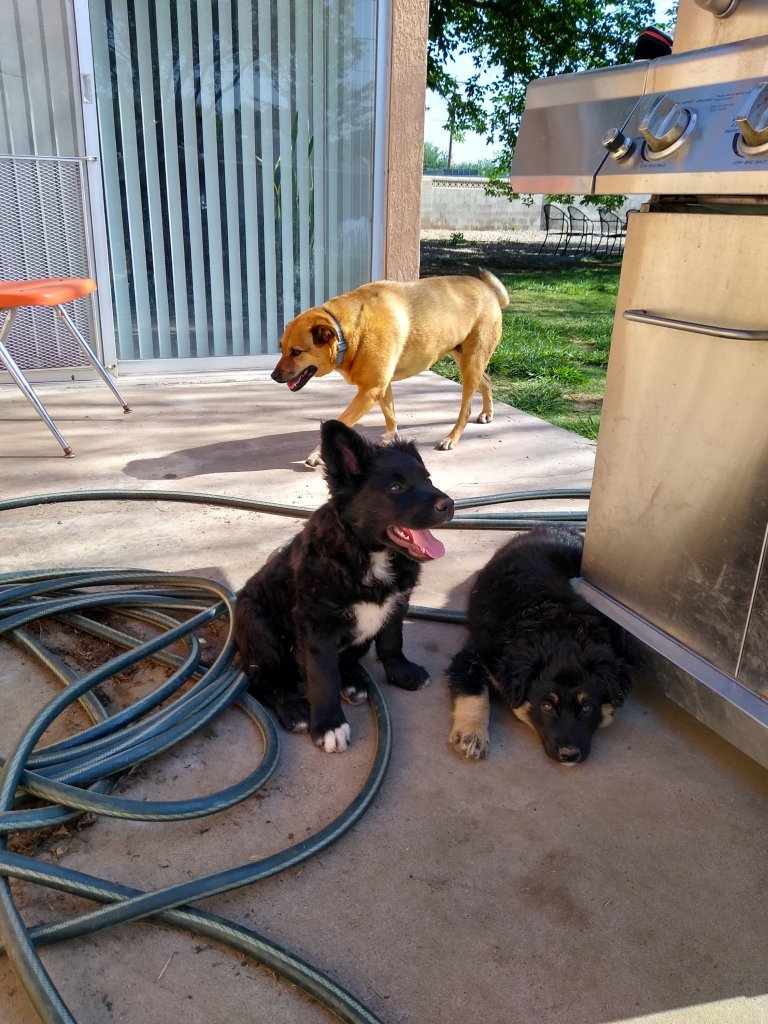
But let me be absolutely clear: my elderly female dog (Kindle) is 100% in charge. The other dogs defer to her. She enters the house first, gets the first tidbits of food treats, and if one of the boy dogs annoys her too much, she will have him on the ground in a submissive posture even though she is smaller than both. Kindle is amazing. I half believe she will live forever, though I believed that about our longest-owned pet, a gray tabby cat called Frolic. Frolic weathered so many near-death experiences. She seemed invincible. And then she quite suddenly got old and died. She lived a good life, did Frolic (yes, Frolic and I put up with each other).

After Kindle, there is still a hierarchy among the two boys, and it honestly comes down to size. One of them is large, the other more a mid-sized pup. The large furry beast of a dog is clearly the alpha of the bros. These two came from a litter where the father was Australian shepherd, and the mother was a heeler, border collie mix. The big furry dog looks identical to an Australian shepherd, and the other like a collie. I don’t know where the heeler went. They are both black and adorably furry.

So, when all three dogs are crowding at the back door, Kindle enters first, then S’mores (the large dog), and then poor dear little Ryuk last. If I’m on the couch, S’mores will plop on my lap to show everyone he’s boss (Kindle isn’t much of a lapdog). He will luxuriate in my petting his thick fur and then climb down and growl at his brother. We used to view this as aggressive behavior and try to curb it until we realized he was giving permission to Ryuk to climb on my lap. Ryuk always understood, as he’s a dog, and he would peacefully climb up and take his turn cuddling. It was almost as if the poor would-be alpha (if it weren’t for that pesky Kindle) had to show a measure of strength before allowing his brother to take his place.

Have I learned something from my dogs and their behavior, as in, how might I apply it to my life? Well, I do feel like growling at people sometimes. No, that’s not right! No of course not. Instead, I’ve learned that if we don’t respect our elders, they’ll pin us to the ground until we submit. No, I’m sure that’s not the message either. Dogs are loyal, though, and they love their people unconditionally. Yes, I’m sure that’s the lesson.

Two Young Pups, and one Happy Elder, almost two years ago!