
Book Updates and Breakdancing Films

Yes, after two years of implementing a system of writing 1000 words a day on a new book while editing a finished book, my schedule fell apart due to several factors, most of which I’ve already talked about on this blog. Some parts of life I never discuss because they involve dragging others’ private lives onto the internet, which I do not do. Lately, I’ve been ungenerous and have had thoughts such as “If [unnamed person] wants to behave badly, why should I hide the behavior?” It’s a natural attitude to develop over the years, especially for people who operate in the world as “reasonable and agreeable.” They lose patience after about age forty. As a writer, I document the world around me, AND I’m over forty — so far over forty I’m almost fifty.

Be that as it may, I place great value on respecting privacy. I want my space respected; therefore, I give space to others. That means only talking peripherally about people in my life on this blog. This is a book update, however, and part of my update is creating a journal of my life as a Catholic church secretary. It certainly has its intrigue for me, as someone who loves history and minutia. The interactions with church people are also endlessly fascinating to me, and I want to document them before I lose them to my bad memory. Hence, my first update is that I’m writing a journal of my job. I will not publish this book during my life, unless I live for forty or fifty more years. Instead, I’ll leave it in my will to my children or husband to publish for me. What I’m admitting here is that I’m spending a fair bit of my time writing a book that isn’t meant to go to market anytime soon. That is the primary reason I will never be a bestseller or popular in my time. That’s okay. I’ve lost hope regarding that, anyway. Or, as Eeyore would say, “If I ever had any hope, which I doubt.” I’m not Eeyore, thankfully.

That is why I’m still hacking away at the three other books I had been working on before these many life changes. They are, in the order that I had planned to publish them, as follows: my breakdancing Albuquerque cyberpunk I was calling, depending on the day, either Breakin’ Good or Breaking Lo Malo (yes, I know it’s an obvious joke); the Roswell PenTriagon alien sequel, which has no name as of yet; and my gothic ghost story, which was to be called something like The House of Redheads.

What about now? How are these books coming along? I’m so glad this was the pressing question in your mind! Let me tell you what has happened to my books. The breakdancing novel was near completion at around 150,000 words. Zoiks! I couldn’t bring myself to complete the final edits, either, because I had the distinct impression it had gone off the rails. When I read it over, I found it readable and intriguing. I could still pull off that lengthy version of the novel, bring it all together with some better editing and a stellar ending (the final scene was still lacking). But it wasn’t my original vision, which was to be like an eighties’ dance movie. The other books are still sitting pretty the way I left them, but this one I’ve started over again. Yes, I started it over. I could shed tears over the wasted hours, but I won’t. Instead, I’ve been rewatching the old breakdancing movies that inspired me to begin with. Watching the movies is, after all, easier than doing the hard work of typing for an hour every day. By the way, I have taken that up again, now that I’m no longer taking the freelance tutoring and editing that took up all my hours after work.

There are three seminal movies in this genre: Wild Style, Beat Street, and Breakin’. Breakin’ has a sequel, but it’s so much like the first movie in style that I’m not going to discuss it here. Wild Style and Beat Street almost operate as documentaries of eighties’ hip-hop culture in the Bronx. The first one is gritty, dark, and rated R. It is a worthwhile watch, though, because it boasts the actual famous graffiti artists Lee Quiñones and Lady Pink. It has everything: mixing, graffiti, and breakdancing. The same is true of the second movie on my list. The essential difference with that one is its PG rating. It’s a clean film unless you’re offended by bad language. In the early eighties, apparently, the F bomb didn’t merit an R rating. I find it to be a fair rating, on the other hand, because the movie doesn’t have nudity or sex, and there is one short fight scene between two graffiti artists. That is to say, it’s not a violent film, either. Both these films are very light on plot.

When we get to Breakin’, we leave that gritty Bronx documentary style behind. Dance movies are supposed to be goofy and fun and culminate in dance battles between rival groups or gangs. Right?! I love dance movies for their goofiness. I love dance movies because they are basically musicals with the emphasis on dancing instead of singing. I also really only like dance films that are clean. That’s why Flashdance isn’t a favorite of mine — the directors wreck the fun by introducing a tawdry sexual relationship and from what I remember, with all manner of steam and saxophones. Breakin’ is PG and takes the breakdancing world to the sunny, blue-skied world of LA. The ghetto in this series of films has tiny old houses rather than burnt out tenements, and the audience only deciphers that it’s the ghetto due to the graffiti. The focus is on dancing and goofiness, and the characters — the protags, anyway — are community oriented. For example, in the second movie, the plot goal is to save the community center where the local poor children can go to take dance and other art classes so they aren’t left to their own devices on the streets.

Breakin’ is how I imagined my book, except that it’s a murder mystery that takes place in a futuristic utopia version of Albuquerque. It’s The Minäverse world but set farther in the future. I don’t know where or how I lost the plot on the goofiness when writing it. It’s my proclivity to do deep characterization, and in this book, I also did a fair amount of unnecessary worldbuilding. I suspect that’s where the goofiness went. Oh, and another btw, I lost the goofiness in my first book, Anna and the Dragon, from first draft to last. I never want to make that mistake again — all of it based off reader response that I needed to even out the tone in the book. Was it a weird comedy, or was it a serious and somewhat dark novel? In my opinion, I took the wrong path with that book. It could have ended up as a dark comedy. But hindsight is 20/20, as the saying goes. And at the time I still cared about editor/critic/betareader input. I wasn’t past forty at that time and was still trying to play the game, in which I pretended to care what readers think about my books. Honestly, I have a difficult time forcing myself to care, anyway. Readers tend to not know what they want or need until a good author brings it to them; that’s why novels are called novel. Without authors starting trends, people gravitate toward what is most common and bland — what is sold to them and what they’re used to. That’s why people listen to bland music, too. The music execs spend a lot of time and money creating bland music, and it’s not until an indie artist off YouTube makes something unique that audiences realize that was what they always wanted. The publishing industry is the same, except they are mass producing politically driven propaganda. It is only indie authors who publish freely, the good and bad and everything in between. I don’t know if I will ever be the kind of writer who is good enough to guide tastes, but I’m certainly not the kind of writer who follows after industry-created reader tastes.
It’s the Little Things That Are Complex

And I’m not talking about mitochondria. I’m talking about what is truly meaningful to humans that we don’t grasp completely. “It’s the little things,” a parishioner said last Friday as she clambered into a train car built from a barrel.

Imagine if you will a priest driving a tractor, pulling a line of train cars that contained another priest and several workers/volunteers. Behind the train cars was a large covered caboose with two elderly nuns. The train went round and round the church complex before we all disembarked.

This is a memory I won’t soon forget. Why? I don’t know; it’s the little things that are complex. For a start, that train itself had taken a couple months and several men to complete, although it was the brain child of the maintenance man and janitor. They built it because the director of VBS had asked for it. She wanted it for the kids.

Besides the actual complexity in planning the parts of life that seem simple, there is something inexplicably joyful about trains. Perhaps they’re a sign of human ingenuity, hard work, and progress. I can’t really say, and this certainly isn’t the type of post where I’m going to delve into the “dark side of train slaves” because it has nothing to do with my point. But maybe it has more to do with the children than anything else, and adults love to be children again, even if it’s only for a short time.

I read an article the other day, which caught me with its dumb, clickbaity, and dishonest title: I was in debt and drank all day until learning to cry saved my life. I’m sure learning to grieve and process emotions is good for everyone, but what saved this man’s life was his kids…not learning to cry.

After deciding to commit suicide, he determined the next visit with his children would be his last:

“Suddenly the pressure was off and I knew it could be our last visit I could be more present with my children and I treasured the time together,” he said.

“It was such a good visit that I lived for the next one and decided to do the same the week after that and the week after that. Soon I wanted to sober up and live in the present moment for them for every coming week. They saved me.”

Just paying special attention to his children gave this man a reason to live. It seems so simple: you lower yourself to the floor and you play with your kids. Or you cuddle them while watching a movie. Or you play a videogame with them. It doesn’t matter, but it’s something so simple and yet so valuable. Why is it valuable? Is it because we have a deep biological imperative to pass our genes along, or is there something deeper going on? Something about fulfilling a godly purpose that connects us to a long line of our descendants? Maybe humans actually matter, and our own offspring matter still more because we should have a bond with them?

Earlier today, I was reveling in the joy of hugging and petting my dogs. That is an intriguing connection. Who can explain the bond between dogs and humans? They adore us, and we adore them in such an uncomplicated way. And yet just looking at their grinning faces and rumpling my fingers through their thick fur gives me a shot of calm. They ease my stress almost instantly. Why? I don’t know. I’m sure a psychologist somewhere has done a study on it, though.

Perhaps the most mysteriously simple complexity that brings joy to humans is music. There doesn’t seem to be a rhyme or reason behind it when coming from a materialistic worldview. Funny thing, if you watched season 4 of Stranger Things, you know they used the human connection to music as a way to bring a character from both literal and psychic death. She was put in a trance by the demonic antagonist, who played off her shame and guilt and fears to keep her there. The only way her friends could reach her was through music, which lit up a part of her mind that wasn’t under the sway of evil.

Of course, that show is horror or science fiction or both, but what makes horror so real is the darkness of evil and the reality of it in the universe. Dark spirits are real, and humans give in to evil. Music can increase darkness, or it can pull us out of it. But why? Scientists can’t explain music, not really, though they try. And they likewise can’t explain the presence of evil.

Speaking of, did I mention we also had canned train chugging and whistles to go along with the crazy train I rode on the other day? Those are sheer delight. I love them so much. They are like music to me. If I can’t explain a human fascination with trains, I’m sure I can’t explain why the sounds of trains are beautiful and endearing either.

We try to understand the mind of God, if we believe in him. But we hit walls past which God does not let us go. The ultimate simple meaningful joy in life, I suppose, is to be okay with that — to rest in God’s presence and enjoy the goodness he’s given to us without having to ask why. Passing that on to others, whether it be to our fellow passengers, our children, or our dogs is purpose with a capital P.

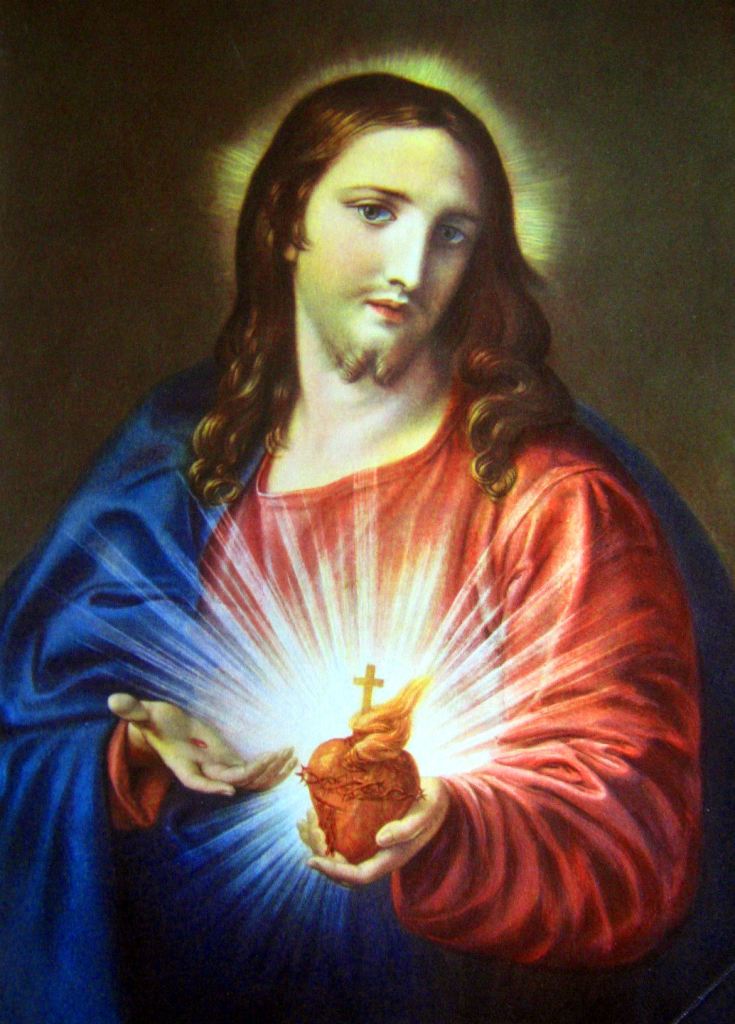
Dedicated to the Sacred Heart

Lately, I’ve been writing a journal with various thoughts on my job. I have many. Just as soon as I think I’ve heard it all, somebody calls the office and finds a new way to stump me. The journal, however, catalogs not only the learning process, but the interplay between people and priests and thoughts on the spiritual life. It’s the kind of journal I could never publish, at least not in my lifetime, as privacy is a central component of what I do. In order to publish, I would have to keep things vague and/or change names. I suppose that would be true of many jobs — a medical receptionist, for example, has an entire office filled with private information. My journal entries don’t often dwell on specific information, though. Just as often, I’m cataloging what we did to wing it for the Corpus Christi procession last Sunday, and how that turned out. In fact, I was going to adapt that journal entry into a blog post (I wrote it on the Monday after Corpus Christi), until Friday arrived. At that point, the stunning overturning of Roe V Wade took precedence in my mind and journal.

Catholics are celebrating, you see. They’ve been at the forefront of the prolife movement for years. These activists, who will leave prolife rallies with sad grimaces and “see you at next year’s rally” defeatist statements, are dazed and confused, wondering what just happened. But they are also in the thrall of excitement, the adrenalin flowing. At least, they were yesterday. Adrenalin will always wear off, but the general consensus is that what happened in the Supreme Court yesterday was a big win on the side of goodness and holiness, and it couldn’t have happened on a better day, when Catholics were celebrating the Sacred Heart of Jesus. The Sacred Heart is a special yearly devotion, particularly dwelling on Jesus’ love for mankind. It’s this heart that compels Catholics to fight against the scourge of abortion, which is in opposition to the Sacred Heart of Jesus. Abortion is antilife and anti-humanity. It’s evil at its finest and darkest — destructive to those whom Jesus died for before they’ve had a chance to perceive the sunlight, except perhaps what little penetration occurs through skin, muscle, and fluid.

A few weeks ago, a parishioner brought me a history of a local nun who is now in her nineties. She asked if it could be posted on a bulletin board, and if I could format it and make it look nice. I did format it, and I could understand why this parishioner wanted the story told. The nun had lived a life of service, including working for years in a home that helped teen girls. But what was particularly fascinating to me was her history of prolife rallies that had landed her in jail multiple times. Overturning Roe V Wade is what women like this Sister have been fighting for all these years.

I know this post could merit some cynical responses, particularly from conservatives. I’ve already heard those, seen those. Yes, I realize that overturning Roe V Wade didn’t outlaw abortion nationwide. We still have a war in front of us, both politically and culturally. And yet, this is still a win. Conservatives are loath to acknowledge any win in a larger battle. They come up with reason after reason why overturning Roe V Wade was not a good decision — I think conservatives must be the real Eeyores amongst us. This is part of why I haven’t called myself a conservative in a very long time. Their attitude is simply rotten. If they can’t acknowledge the goodness in overturning Roe V Wade, perhaps they could acknowledge that a Supreme Court justice decision that overruled all state laws is at the very least unconstitutional. Roe V Wade should never have had the overarching affect that it did. Getting rid of it will help restore state rights, at the very least.

It does something more, though. It rips open that outer layer of demonic possession of our nation. Yes, that sounds a bit extreme. As someone who believes in the spirit world, I don’t know what else to call the slaughter of babies. We had a veil over our nation that didn’t allow individual regions to stop this bloodbath from occurring. Every time a state or county or city tried, it was challenged at the Supreme Court level and held up to the supposed sacrosanct Roe V Wade. Now we can have sanctuaries for the unborn, in states like Texas. Of course, there will be backlash. Of course, the evil entities of the world will find a way to turn this decision to their destructive ends. That doesn’t mean it wasn’t the right decision to make. It just means there will be more work to do.

An Artist You Should Know

My dad is my favorite artist. Let’s face it: in many ways, he’s my favorite person. Of course, he’s up there with my mom and husband and children as being the best people in the world. As a parent, though, he has the distinction of knowing me longer than the rest of the best people, except my mom, of course.

I say he’s an artist you should know, but he’s much more than that to me. He’s my life mentor, and I don’t happen to be an artist. In other words, he’s not just a summation of the various media he works with. For a start, he’s the one who taught me to be a jack-of-all trades. I’ve discussed this subject before; while I admire the type of people who can focus on one skill and master it, I can’t imagine limiting myself that way. And I learned this from my dad.

On the job front, he worked his way from night janitor at Tektronixs to electrical engineer. On the home front, he gardened, canned, explored different cuisines when cooking, built many things and repaired others. On the artistic front, he carved things from wood, painted in oil and watercolor, did cartooning and pen-and-ink illustrations, and wrote poetry — often in calligraphy. He also played the guitar and harmonica. On the exercise front, he had a pullup bar in the garage, jump-ropes, various weights, and that’s not to mention that we did a lot of hiking and biking and fishing and camping as a family. On the education front, he took the occasional class for his job and read everything. And I do mean everything. He read fiction and nonfiction of all varieties and then take handbooks out into the wilderness to identify vegetation such as wildflowers, trees, berries, etc. He still does all the above, by the way.

As a child, I thought my dad knew everything and could do anything. In a sense, I was correct, despite that no humans can know and do everything. He has always had a zeal for doing and learning. He’s a Rennaissance man born into the postmodern world of James Joyce’s Ulysses. And, yes, he did read that, but mostly because he thought it was edgy when he was a teenager.

He introduced me to so many poets and writers and artists and musicians. Because of him, I can still detect when I’m listening to Mozart vs Handel or Vivaldi. I fell in love with Willa Cather and Coleridge and Christina Rossetti in high school…because of him. I browsed through art books with beautiful paintings because they were all over the house. I read the works of St. Augustine of Hippo and St. Thomas Aquinas, as those passed for bathroom reading in our house growing up.

If this sounds like a fan-girl post, wherein I wax poetic about my father and don’t have any other point, yes. Yes, it is. It was just Father’s Day, after all, and I want the world to know how blessed I was as a child. This is what happens when you aren’t perfect, and yet you live with the desire to do what is right and experience the joy of God’s world: you bless those around you. There is so much wrong with the world. There is so much that could make me very angry every day. But I was blessed with a father who loves God, and that’s something to be grateful for, despite that so many of my generation were harmed by their parents’ divorces and selfishness. It’s something to be grateful for owing to the selfishness of my generation’s parents. There will always be envious people in the world who can’t stand other’s good fortune when they haven’t had it themselves, but there is nothing I can do about that.

There is also nothing I can do about the fact that clown world just added about a thousand cars to their crazy train and is driving that train right over a cliff. I read in a news article just the other day a quote from the executive director of the Global Fund, in which he states that his little group is working on putting together billions to “strengthen” medical care systems to cope with the effects of the starvation that’s coming to the world. Think about that for a minute. The Global Fund doesn’t really care that we are headed into a purposefully created food shortage, only on lining the pockets of the medical community as the world’s weak and impoverished lie dying in their beds, probably with tubes jammed down their throats, as that seems to be the preferred method since Covid. Add to that all the rainbow flags waving as though life is some kind of eternal party, where we’ll dance right into our graves. So, we have a world of clowns who are members of the Global Fund, but really they are more akin to Killer Clowns From Outer Space, while the rest of us are ordinary clowns who will go for their candy cotton floss.

Or some of us will. Shudder. If that turned dark, it was only because a good writer always provides a contrast: those people who want others to starve and those who can’t or shouldn’t be fathers contrasted with good fathers who grow their own food to care for their families and create beauty at the same time.

This is just a screenshot on my phone. I recommend clicking the link below.

https://3cranesart.com/gallery/stream-in-the-desert/

What is the Truth?

In my last post, I discussed my frustration with generic appeals to truth. Of course, I believe there is objective truth to the universe, God, and his system for redemption. But who has this truth? This is what Christians have been arguing over for centuries. Did God give us church authorities who would guide us through the Holy Spirit? Did he mean for us to read Holy Scripture and come to our own determination and what the truth is? If we are deciding between those choices, I answer yes to the first question and not the second. Each person can’t be his own arbiter of truth. We aren’t demigods who create our own reality.

This is the true failing of Protestantism: they have no Magisterium. They are fractured into thousands of pieces because of a lack of authority. Each one was begun by a man who believed himself to be the arbiter of truth. Sometimes, these men were simply idealists who believed they alone knew how to arrive at the purity of the early church. There are still idealists like that floating around today, many of whom simply call themselves nondenominational and start a new group of churches [group being very, very different from denomination] based off their purity model. Others simply go their own like the dudes of the manosphere and expect others to be “red-pilled” into their model…if they’re enlightened enough to see the truth. It becomes difficult to parse.

Insanity Bytes had mentioned in a comment to my previous post that humans do best when given concrete truths they can grasp. She quoted Jesus: “I am the way, the truth, and the life. No man comes through the Father except through me.” She’s absolutely correct. The personhood of Jesus is the ultimate truth. He is why we are Christians. His act on the cross, his dying for humanity and rising from the grave, is why we have a reason to hope in God and the afterlife.

Amen and amen.

Now what? How do we know if we are saved? How do we live our lives as Christians? Of course, the Bible answers these questions, but they are precisely the kinds of questions Christians argue over when they have no church authority to answer them. If all Christians are filled with the Holy Spirit, how do we all come to different interpretations of Holy Scripture? I’m not going to lie. I’m more analytical and logical than I’d like to be. I don’t prefer this type of confusion that extends to the very roots of our faith, such as how do we know we’re saved? It unsettles me that there isn’t one clear answer.

Years ago, I had Reformed voices niggling at my soul, making me question my salvation. If salvation was only for an Elect, I would surely not be it. How could I be? I’m pathetic compared to other humans. I’m not bold, attractive, or dynamic. Despite how harrowing it was, I could understand the case the Reformed Christians made from Scripture. I could also recognize the Arminians had a solid case. On a scale of unsettling doctrine, Arminian doctrine was much less so. But choosing the least comfortable doctrine is not my way. I prefer certainty. And I didn’t have it. It was terrible.

In this particular circumstance, God settled the answer for me. No, he didn’t tell me which of these doctrines was correct; instead, on a sleepless night, he spoke to me in an audible voice: My sheep hear my voice. He told me in no uncertain terms that I belonged to the Good Shepherd. I had heard his voice. Audibly — in the middle of the night, when disembodied voices shouldn’t have been speaking to me at all. I’m not sure there is a proper time for disembodied voices.

God’s voice settled my spirit, but it didn’t answer the doctrinal questions I had. How are we saved? What does it mean to be born again? I don’t know; I’ve never had a specific salvific moment, as some Protestant sects like to say. I’d never uttered the sinner’s prayer. I’d heard the gospel proclaimed in church in my childhood, believed it, and tried to follow God’s path for my life. I was also baptized.

And yet, for all that, I know there are people right now who still don’t believe I’m saved. I know this because they’ve told me. They’ve witnessed to me and tried to compel me to do whatever it is they think is the proper method of following Jesus – their definition of “born again.”

This happened to me recently, actually, at a nondenominational church our family used to attend together. I would attend Mass before the nondenominational church service and otherwise kept my affiliation with the Catholic church quiet. If somebody asked, I told them; I wasn’t going to lie about it, but neither did I want to start a debate. As far as I know, the woman who tried to save me at that church had no idea that I was a Catholic. If she’d known, I’m sure she would have used it as evidence against me.

To this day, I don’t know what she thought I was missing. She only said that she sensed I wasn’t truly saved. I explained to her that I’d been a Christian all my life, that I’d always felt the call of Christ and had responded to it. But, no, that can never be enough for Protestants who require an act or a cathartic moment: responding to the altar call, praying the sinner’s prayer, etc. It was confounding to me, as though the demonic forces were at work trying to shake the faith God had given to me in the dark of night. It came right at the cusp of churches opening up again, and I was seeking his will by going to a prayer group I’d been invited to. It was frustrating to be preached at and prayed about in the group. The other ladies there didn’t know any better and simply assumed I wasn’t a Christian because their leader was praying for my conversion.

I had to stop going for the sake of my sanity. I also stopped going to that particular church, but that was mostly because my Protestant husband had lost interest in attending church. He gets burnt out on formal church services. Based off that kind of experience, I don’t blame him! I wanted to tell the woman to get behind me Satan, but I figured she wouldn’t understand and take offense. Thinking back on it, she might have needed to hear it regardless.

What does it mean to be saved? If I supplied an answer, it would look like this: repenting, believing the gospel, and following Jesus. There is enough biblical proof of that definition, surely. But what does it mean to be born again? Is there a mysterious act that makes one born again? Is so, what it is? What about baptism? The Catholic church would say yes to that, but only with a few clarifications. After all, the imagery in the Bible, from Jesus’ own mouth, is that we must be born of both water and the spirit.

I’ve put to rest many of my questions over the years. Still, I’m always curious what others think. What do you think it means to be born again? How do you know you are saved? What brings you certainty?

Whoa-oh! The Things People Say

I’m imagining this as a song, you see. People say the darndest things. It keeps life interesting, creates fascinating dialog in stories, and just as often as causing confusion or laughter, annoys us deeply. Okay, this post is not about a collective. I will rephrase that. On occasion, I get annoyed by the things people say, usually the pat or disingenuous answers. There are a couple of modern aphorisms that especially annoy me, and I happened to hear/read two of them last week. Not that they are unusual. They are not. I will give a third just to be as contrary as possible.

The first: Correlation does not equal causation. There are, of course variations on this theme, but it’s a really, really dumb aphorism no matter how it’s formed. This week, I read it in the first comment on an informative article by Alex Berenson about cannabis use causing psychosis. It was a pinned comment; that’s why it was first. I’m pretty sure it was pinned to ward away any other nerds who felt they should whine that way. Mr. Berenson’s response: “Yeah, I don’t. And neither do the psychiatrists and researchers who have been studying this relationship for 40 years.” His response, naturally, was ignored and followed by some other whopping good logical fallacies, such as, “Yeah, what about alcohol?!” Well, he wasn’t discussing alcohol, nitwit. He was discussing cannabis and its use by this latest shooter who simply walked into a school and psychotically shot up a bunch of children.

My problem with this aphorism — and yes, I do think it counts as an aphorism by now — is that studying correlations is how scientists get to causation. Yes, there are some idiotic correlations that can be made, but that doesn’t mean that scientists write off correlations as unimportant. If they did, they would be like infants, which is how I view people who run around whining that “correlation does not equal causation.” Actually, even infants understand basic correlation, such as pain that comes from certain activities like sticking fingers in electrical outlets or touching hot pans. But they are just narcissistic enough that they often don’t see the correlation at all and blame their pain on their caregivers or siblings. I’ve seen it happen; I’ve watched young children trip and fall ten feet from their mothers and still cry out, “You made me fall!” This is how I view people who, instead of thoughtfully examining a correlation being made, cry out, “Correlation doesn’t equal causation!” Can you imagine for a moment a world in which scientists abandon correlation and search for completely unrelated phenomena to answer life’s pressing issues? For example: “This is what happens when African elephants die from the pox; disenfranchised American homosexuals go on shooting sprees.” And then they might go on to demonstrate charts of elephants dying at the exact moment killers picked up guns. Wait, don’t answer that because I’m 100% positive you’re going to come up with real-world examples of academics doing exactly that.

The second: All that matters is the truth! This one is generally found in conservative Christian circles, and it sound wonderful until you realize it’s completely meaningless. This came up in the quasi debate we were having about sola scriptura the other night. When Protestants pull this out of their hats, I know the conversation is over, even if it will wearingly continue on with the quoting of noncorrelated Bible verses (see previous paragraph about elephants and their pox). I always feel a bit like Pontius Pilate when I ask, “What is the truth?” There is a big difference between me and Pontius Pilate, however. I use the article the for a start. There are obviously numerous differences between me and a Roman statesman from centuries past, but the main difference is that I actually want an answer to my question. I don’t want the truth to go undefined.

I don’t want to mock well-meaning people who really do follow Jesus and have a strong sense of right and wrong; I do believe, however, that there is some disingenuousness with proclaiming that truth is all that matters, and then leaving the truth undefined. It goes along with the ideal of sola scriptura and wanting desperately for there to exist one infallible interpretation of the Bible that we will understand if only we pray and ask for the Holy Spirit’s guidance. I’m sure there is one infallible interpretation of Scripture, but which group of Christians has that? How do we know if the Holy Spirit has guided us to this purity of truth? As it’s evident that spirit-filled believers around the world and throughout the centuries have arrived at different interpretations, how do we know the one we believe is the truth? This is why I rarely get an answer to my question answering after the truth. Christians like to make general proclamations but are often too humble to go into details. They don’t want to be wrong before God. That’s a good thing.

The third annoyance I dedicate to a person I’ll call Bob. Bob outlined a hypothetical for the others in the room. Normally, I’m not annoyed by hypotheticals, as they are an attempt to distance people from the very real emotions that are coloring their arguments, and I even appreciated Bob’s attempt at using one. They become annoying only when they aren’t actually hypothetical. So, in essence, this phrase can be anything that starts with “Hypothetically speaking, …”. In this case, he wasn’t being hypothetical. Hypothetically speaking, I was a Catholic who believed in purgatory, and the other person in the room (we’ll call her Sue) was a Protestant who believed that to be absent from the body is to be in the presence of Christ. But I am a Catholic, and Sue is a Protestant (that leads to another oddity, if not annoyance, and that is the very prevalent modern protest of Protestants that they aren’t Protestant; they are, rather, Bible-believing Christians. Sure, that might be true if one were to erase history. I digress, though…). And I do believe in purgatory, and Sue does not. Bob’s hypothetical went like this: “You are (pointing at me) a Catholic who believes in purgatory, and you are (pointing at Sue) a Protestant who doesn’t. Which position is the truth, and which one is a false interpretation?”

Bob’s hypothetical was meant to be helpful to my anti sola-scriptura stance. Despite his not being Catholic, Bob doesn’t outright accept sola scriptura. Instead of appreciating his attempt at helping my position, I immediately recoiled because the vast majority of Protestants don’t know what purgatory means. Thus, his hypothetical elicited an emotional response from me; it was not right to bring up a subject that is so misunderstood and pit it against a verse taken directly out of the Bible that doesn’t by itself defeat purgatory. Of course, Sue had an immediate emotional reaction to being called a Protestant (see parenthetical phrase above) who believes xyz. She didn’t appreciate being put in a box and being told what she believes.

It was just a hypothetical! Bob pleaded. Perhaps that is ultimately the phrase that gets my ire up, as there are few subjects that can be relegated to hypotheticals without being slightly disingenuous. It reminds me of the way lawyers speak when they demand that the witness on the stand only answer yes or no. The lawyer knows he is being disingenuous and trying to elicit a specific answer, even if that answer doesn’t fully encompass the truth and can even subvert it. For the record, though, Bob was doing the opposite of that: trying to demonstrate that we probably don’t know the difference between truth and interpretation. Well, that’s kind of laweryly, too, to be honest. But who is the judge? Who is the judge? That night, nobody. And eventually, we all decided to go to bed and leave it alone.

I love Bob and Sue. They are people I want in my life, regardless of differences. I can’t imagine having friends or family who unpack correlation doesn’t equal causation. God forgive me, but it’s true. And honestly, Protestants should try to understand purgatory before arguing against it.

Apologetics Is Also a Vocation

There is a time and place for it. Years ago, I eschewed Bible studies because I didn’t desire to be a student any longer. I didn’t want to sit in a room arguing about the proper definitions of words in Scripture and what they might or might not mean. There is a time and place for education and sitting under a mentor or teacher; there is even a time and a place for questioning the mentor’s teachings. At a certain point — and my heart has always longed for it — Christians should take on vocations and live them rather than engaging in endless studying. Apprenticeships are supposed to be temporary — aren’t they? In most vocations, education is finite, even if the occasional recertification is required.

But there are people who are given the gift of teaching, and they engage in this type of wrangling to keep their minds sharp. The other word for this is apologetics. I suspect I have little of the teacher about me, and that is why (most of the time) wrangling over words doesn’t appeal to me. Yes, despite that, I’ve been teaching for years. In fact, I just finished my last tutoring gig last week. I taught all subjects, with a focus on math. This was not because I’m particularly gifted in math, but because this was what most of my students needed help in. And by the grace of God, I’m a jack of all trades and can switch from English to math to Spanish in one session. Not that this switching always happens with ease. And certainly not because I wish to make this a life task and keep switching from subject to subject.

God allowed me to teach, even though it was not a skill I possessed, nor something I have a passion for. Thank you, God. And thank you, God, for taking me out of it. I don’t know what my calling is. I like to encourage people and give them chance after chance to do the right thing (if I had ever taken on a full-time teaching job, I’m afraid I would have done the same, and my students would have been spoiled). I suppose my vocation is hidden in there somewhere. I was thinking on this subject because there is a natural prejudice in my household against Christian debate, and I am first among the prejudiced. I don’t find it profitable. Yet, I’ve found myself listening for hours to apologetics on my favorite YouTube channels. That would mean, I guess, that I like it more than I admit. Then again, I’m not the one engaging in argumentation when listening to a video. Argumentation is much easier to take when other people are doing it, and I have no stake in winning or losing.

Let me be clear though: there are only certain apologists I appreciate. And what I appreciate them for is not their egos or their gotchas or their numerous words. I appreciate those who make their ideas and the ideas they are defending very clear. They clarify ideas for me, rather than muddying the waters. Not all ideas are of equal importance, of course. But some are truly foundational. And I need those foundational ideas to be as solid as possible, if I’m allowed to switch word imagery on you. I need clear waters and solid foundations. Thank you very much.

That’s all I have to say about that because we’ve just had a long discussion in my prejudiced household, which began with an apologetic against Sola Scriptura (from me, and only at my husband’s bidding). Huh. We all claim not to enjoy debate, yet we do engage in it at times. If you had seen us thirty years ago, you would understand a little better that we used to be debaters. Hardcore. Ah, well, perhaps we were just going through the challenge phase of our apprenticeships. Arguments are for the young, and after that, they are only for old, decrepit teachers who can’t give them up.