
Se murió como…un acordeón. It’s true. I had a moment last weekend in which my life flashed before my eyes, mostly in retrospect, though, because at the scene, it took me a while to process. I was involved in an accident with a semi truck, and I won’t say more than that. But I climbed right out of the car in one piece, and it was only later that I realized my accordion probably didn’t survive. I checked, of course; it was crumpled in the accordion that the back end of my car had become. Is that an appropriately poetic way for an accordion to die? I’m not sure yet, but it’s always better to laugh than cry. Well, it’s not always better. But when God spares your life on the interstate, I’d say laughter is an appropriate response.
The Galileo Syndrome
Yes, I made that up, but it’s bonafide. Also, even though I’m not a diagnostician, I’m ready to diagnose a great many people with it. Those afflicted with Galileo Syndrome believe the powers-that-be in the past unjustly persecuted scientists who wouldn’t stick to the mainstream narrative, while simultaneously believing that the modern-day criminals are those scientists who won’t stick to the mainstream narrative.
There are multiple levels to this psychotic delusional state, one of the most hopeless being those lost souls who believe that Galileo was executed by the Catholic church for conducting science™ and forwarding a true heliocentric narrative. I don’t know who started that rumor, but it’s quite absurd. In fact, he wasn’t executed at all but put under house arrest. Like most of history, the story is not as straightforward as some would like it to be.
It would be good to backtrack a little and remember that the mainstream scientific narrative in Galileo’s time didn’t agree with a heliocentric model of the solar system. Clinging to the geocentric model was not merely a case of religion pitting itself against the scientific experts of the day. In fact, the great Aristotle had already debunked heliocentrism because of the absence of detectable parallax. All those many centuries later to Galileo’s day, the equipment necessary to detect parallax still didn’t exist. Because neither Galileo nor anyone else had proven heliocentrism, it wasn’t widely accepted. Mostly, this was because it violated what scientists of the day could observe. The stars did not appear to shift.
So, what exactly happened to Galileo? Well, he grew arrogant. I suppose that’s my opinion. But it’s likely that if he hadn’t pronounced his theory to be truth with a capital T, mocked people who might have aided him, and insisted on his own interpretation of biblical passages, his soft sentence might never have happened. By “soft,” I mean being forced to stay home with a servant attending him (a far cry from execution). One thing the church authorities didn’t like was being told what capital T truth was or how to interpret the Scriptures. Or mockery, apparently. You might find that to be small-minded, but it was mostly meaningless when viewed from a broader perspective because Galileo’s case didn’t involve papal infallibility; the Pope declared no dogma regarding models of the solar system (or universe, for that matter). Ultimately, that’s as it should be. What if the church had endorsed Galileo’s theory of the universe? Well, wouldn’t it be considered foolish now, since we don’t hold to a Galilean model of the universe? The poor persecuted Galileo was not correct … according to modern scientific knowledge.
Let’s return to mainstream science because our modern reflections on Galileo can be quite muddled. The Catholic church did not control all scientific thought, albeit religion and politics were intertwined. Like the government today and the government-controlled media, the political world at that time had their own reasons for controlling the narrative and pushing an official story. And there were people assuredly who had no desire to control others, but rather believed they were right. They were experts, see — they had done their due diligence. Perhaps you could fault the Catholic and Protestant churches for holding too tightly to the official scientific narrative of the day, under the misapprehension that it would help to solidify the truth of Christianity, when it had little to do with the Gospel, nor even with the truth of Scripture.
Essentially, as I already stated, the Galileo Syndrome finds fault with the experts of the past for making martyrs of out-of-the-box thinkers like Galileo, snidely siding with a man who had only a small part of the truth, meanwhile considering the entirety of modern-day mainstream thinkers to be martyrs of a few out-of-the-box Galileo types. I guess simpler terms for this would be hypocrisy and cowardice. It’s so much easier to believe the experts of your day. It just makes life simpler. Also, people like Galileo can be hard to take. They can likewise be humble and well-spoken … and still hard to take.
In conclusion, try to avoid delusion. The Galileo Syndrome is not a good look. Suppressing ideas that don’t fit the most popular ones of your day just means you will be viewed 500 years from now as a foolish religious nut, even if you pretend not to adhere to any religion at all. The future humans won’t believe your pretenses. They will be like most of their ilk, ready to declare that if you crack like a nut and bounce like one too — you’re a nut. Because that’s science.
La razón del ser
This blog is titled Joy in the Southwest. There is an entanglement of peace and joy; the two go together. And where is this elusive entanglement to be found, you ask? It’s found in the inheritance of what our forebears have passed down to us. For example, look at the image above. I live in New Mexico because my great-greats passed on a legacy of rippling clouds over a desert landscape that rolls down into a lush River Valley. I live here because it’s my inheritance.
My forebears–my maternal grandmother specifically–passed down Christianity to me, as well. She passed it down to my mother, who passed it down to me. My father, of course, also found Christ and passed his faith along, but the story of the desert is centered around my maternal ancestors, who were enamored with the beauty of New Mexico. There are, in fact, reams of photographs from a great-great grandfather who was an early Wild West photographer.
It is funny, but my phone just rang, and after I was done talking, I glanced at the news articles on my phone and spotted this title: El ‘boom’ de la espiritualidad laica: la nueva religión es creer en uno mismo. In other words, the new secular religious fad is to believe in oneself. That is exactly the opposite of what I’ve found to be fulfilling in life. Why would I believe in myself? That is not a religion. It’s extreme myopia. It centers the universe around a single person instead of a history, a chain of people that has led to a distinct person, and a creator who brought it all about.
Some might tell me I need to believe in myself a little more. As a daughter and granddaughter to all these forebears who lived and died before me and left me with a legacy, why not be confident in that? Yes, I should be confident in that. There is a certain limited sense in which I have to acknowledge that God has given me gifts, some of which were brought about due to heredity, and I should stand strong in those. All this shillyshallying around with feeling incapable of accomplishing even those things I’ve worked so hard at over the years is ridiculous and needs to stop. But believing in oneself is not an end unto itself. It’s not a “secular religion.”
I don’t live on my inheritance property any longer. Lately, I’ve realized I might not for years to come. This is because I was able to get a job that will keep us in the land of aliens, instead. While still New Mexico, it is a far cry from the peaceful enclave of the River Valley.
I visited my home last weekend, though. My true home. Well, perhaps, not my true home as depicted in Christian gospel songs that wax poetic about heaven — my home in the Southwest that was passed along to me by my forebears. I love to visit. There are many dark and disappointing aspects about the town where my home is located, and yet I can’t stop loving its beauty and strangeness. Walking in the desert, at that high elevation, looking out over the landscape, my heart is filled with joy. Of course, I’m generally walking with my parents or one of my daughters. There is, no doubt, at least one dog with us, who is loping after jackrabbits and splashing through the warm spring water that feeds the pond. Can this be a piece of what heaven looks like? If not, it surely is an image of worldly joy. Dogs, family, the beautiful desert.
I’m sure you know I didn’t grow up here in the Southwest, but I fell in love with it as soon as I first laid eyes on the landscape. But it’s also the history here that ties me to this place, both my own family history and the much older history of the peoples who settled this land. There were the native pueblo peoples, and then there were the Spanish, who brought with them Christianity.
Along with a walk in the desert with my parents and their dog last weekend, I attended Mass at San Miguel Mission. San Miguel Mission is one of the oldest churches in the United States; it is also one of the most beautiful. However, it doesn’t get the tourist traffic and fame that the old churches in Santa Fe and Albuquerque get. Instead, it’s a quiet gem tucked into the heart of central New Mexico.
On our first visit to New Mexico, many years ago, we did play the tourists and slip inside San Miguel to study the architecture. Well, I can’t say I was there to study the architecture. Yes, the history of the church is fascinating, but I was instead interested in what the church felt like inside. Yes, felt. This is a building that has bodies of long-ago people buried beneath it — it has been a refuge for the living and the dead for roughly 500 years. Buildings have personalities (for lack of a better word). They contain their histories and soak up the tangible and intangible elements in their walls.
I was captured by the beauty of the church, yes, assuredly. The main church is a small building with the muted colors of the desert on its walls and in the old woodwork. It also has the gentle colors of the Mediterranean in the statuary, while the stained glass boasts the vibrant church tone of royal blue. But more than that, I was captured by the feeling of peace inside its walls. I wanted to sit in a pew or kneel on the bench and stay there forever. Peace is not a feeling I was or am generally used to experiencing — I generally run off of agitated energy stores from caffeine, exercise, vitamins, and an average of three hours of sleep a night. I wanted whatever was present in that church. It was something, obviously intangible, that I had never felt in a Protestant church building.
I didn’t know at that time that all Catholic churches feel that way inside. I hadn’t spent too much time in Catholic churches in my young adulthood. In my youth, I had several Catholic friends, and I went to Mass with them once, but I hardly remember the building and what it felt like inside. I only remember being devastated that they hadn’t explained to me beforehand that I couldn’t partake of the communion as I could in the Protestant church my parents attended. When I became a Lutheran briefly before going full Catholic (Lutherans are often described as “Catholic Lite”), I remembered and understood … but that was many years later.
Why do Catholic churches contain a perpetual feeling of peace? One of my daughters asked me that; she apparently has slipped in and sat in a handful of Catholic churches and made note of it. Devoid of congregants gathering, Protestant churches feel vacuous. It is a very different reality. I spent some time as a church janitor in a Protestant church, and I loved it because it was empty. I could sing and fill the space and think deep thoughts, or not so deep thoughts, and get my work done with zero interruptions. But “peaceful” would not be a word I would use to describe the building. Empty and echoing — yes, those are the correct adjectives.
At a Catholic church, the sanctuary building is generally unlocked during the daytime, and many people are coming and going. There are daily Masses and Adoration prayers at various times. So, for a start, they simply aren’t empty as often as Protestant churches are. But it’s more than that: if you ever have the opportunity to sit for a few minutes in a Catholic church, you will notice there is a candle lit almost perpetually during the liturgical year. That candle signifies the presence of Christ in the small tabernacle, set into a niche on the back wall behind the altar. Through the Eucharist, Christ is present in a Catholic church almost all the time. That’s what I attribute the difference to — the constant presence of Christ.
As Christians, we should all have that constant peace inside our bodies, which are the living tabernacles of Christ. And in a sense, we all do. Even I do, with my agitated insomnia and caffeinated mind. The problem with being human — oh, and there are many more than one — is that we have our corporeal bodies there, ready to snuff out the peace of Christ in us. That is a primary reason why I look to my inheritance for a peaceful joyfulness. My people and my God have passed along so much to me, and I cling to that like a drowning person in a shipwreck. It gives my life purpose and meaning. And, also, of course, I go to Mass. While Christianity in general was a family legacy, Catholicism wasn’t. It will be now, though. It’s a legacy that I will be leaving for my descendants who come after me, who might inquire Why did our great-great grandmother convert? Perhaps I’ll even write a book about it.
Removing the Fitbit
I’ve had a Fitbit for about seven years now. Prior to that, I had an old-fashioned pedometer, the kind you clip onto the top of your pants. It fell off on a road trip, sadly. I don’t think the Fitbit brings more to the table than these old-fashioned devices. And I also don’t believe it’s necessary to count your steps at all.
Let me qualify that last sentence. We are, as a society, sedentary. Most people would not argue with that. If wearing a pedometer helps inspire you to move, it’s no doubt a positive tool in your arsenal. But that comes with a huge caveat, which is that ignoring other aspects of your health or becoming obsessive about steps can be counterproductive. Plain pedometers don’t have bells and whistles, but Fitbits will give you a special shot of happy hormones every time you get a notification that you’ve achieved your goals. You don’t get a star or fireworks if you achieve 9,735 steps though; you have to achieve those 265 extra steps. And does pacing up and down the hallway at ten till midnight in order to achieve fireworks really improve your health?
No, it does not. In fact, rest of the mind and body is probably better. Obsessing is not healthy; the health benefits of reaching an arbitrary number of steps a day does not exceed the benefits of a restful mind. In addition, neglecting other types of exercise will not ultimately be a net good. If you are not doing stability and strength style exercises because they won’t greatly increase your steps, you will open yourself up to falls and weak bones and muscles as you age.
All of that doesn’t even touch on the inaccuracy of all types of pedometers. Old-fashioned pedometers were limited, obviously, only detecting movement. But Fitbit does a terrible job of counting steps accurately, as well. The disparity between my husband and me when we take long walks or hikes together is astonishing. He’s three inches taller than I am; he shouldn’t have 16,000 steps when I have 10,000. If the Fitbit were accurate, I would have more simply because I have to take more steps to keep up with him. It also doesn’t catalog sleep or activity levels accurately. I regularly have several-hour gaps when the Fitbit does not pick up on any of my activity, despite my walking around, sweeping floors, etc. The sleep function is almost useless. It tells you how long you slept and what cycles of sleep you were in by your activity level and your heartrate. I have a low resting heartrate and it takes a lot of movement to get my heartrate up; therefore, I’ve had the Fitbit mark my wandering around the house (when I couldn’t sleep) as sleep. This is probably also the reason it doesn’t detect hours’ worth of my house chores and movement as activity.
So, I will reiterate: use it if it helps inspire you to be more active. For my mental health at this point, I’ve taken it off…again. I’ve done this several times, and then it lures me back because I’m obsessed with exercise and counting things. But I think my established routine is enough. I exercise first thing in the morning and walk in the afternoons or evenings. It’s enough; it really is.
***
I hit the publish button earlier when I wasn’t quite done. I’m coming back now to complete my thoughts. There is a modern song floating out there with a line that goes, “Blame it on my ADD, baby,” or something like that. It might also add “OCD.”* These are common modern self-diagnoses (they can also be real diagnoses; that is not what I’m talking about), stemming from a lack of mental discipline and perhaps other issues as well. The conditions are circular, one feeding the other. Many modern people fall into this never-ending circular loop, which goes about like this: I can’t focus; there is too much going on. I’m overwhelmed because I’m scattered, and I can’t decide what to do first or next to get things done. Because I can’t control my surroundings, I’m going to do what I can do. I’m going to count things, follow repetitive patterns that will make me feel in control even though I’m not.
The Fitbit, unfortunately, feeds into this thinking. However, what really needs to happen is better mental discipline, so that you can learn how to compartmentalize a job list and complete the first and then the next item on the list without being overwhelmed by the bustling atmosphere around you or the length of the to-do list.
If that’s you, I’d recommend putting exercise into a compartment and keeping it there–and I’d also recommend taking the Fitbit off. It will make you feel better; I promise.
*It only says “blame it on my ADD;” I looked it up. The song is called Sail and is by AWOLNATION. Apparently, I filled in OCD…because the two go together. Reaction–>overreaction.
Folk Songs R Us
This is what most of country music is composed of, phoned-in folk songs. As a genre, it’s about as tepid as other pop music. It tends to wash through the brain like sludgy water going through a drainpipe and down into the septic field, carrying the concepts of the little bitty people leading little bitty lives with it.
My children have told me the music I like is basically Mexican country. Once, they happened to make this accusation while one of the Mexican stations was playing on the radio. Well, I suppose one said it and the other agreed because Mexican radio was playing. The best part of knowing a language nobody in your house understands is being able to employ plausible deniability, even though the lyrics pouring out to the cadence of a fast two-step are all about the ranching life, wearing a cowboy hat and boots, and riding horses. Still: deny, deny, deny. It’s not country music!
Folk music, of course, isn’t always phoned-in. It has a history of incorporating all aspects of a given culture, even the very uncomfortable ones. Well, those uncomfortable stories can be phoned-in, too. This is no doubt because the average person doesn’t like to expand their audio interests with complex or unusual instrumentation and sound, even if the edgier songs are on their radar of life existence. So, it’s quite possible that musically dull pop country songs tell emotionally exciting tales of the fallout from adultery and drunkenness, for example.
This is igual to the Mexican music I listen to: in both regards. Despite that banda and mariachi can be very complex musically, many of the songs sound similar. Similar arrangements, melodies, etc. I have often bemoaned that they pulled out the twenty-piece band members with their lavish, matching suits just to play a song that sounded like the last three I heard on the radio. There also happen to be many Mexican songs about adultery and drunkenness. One concept that seems peculiar to Mexican folk, though, is the narcocorrido, that is, songs about drug dealers. This is a harsh reality that is eulogized in numerous songs, made famous by bands such as Los Tigres del Norte. I don’t have a problem with these songs as others might. They are cataloging a lifestyle that often leads to prison or death. This is quintessential to folk music. Now I suppose they will have to write songs dedicated to the dark tales of the narcocorrido singers who were murdered because that is also history, raw and dark, in the making.
I used to love singing American folk songs such as Long Black Veil, but I would shudder when I contemplated the stories. At some point, the story in songs like that happened: an adulterous man went to the gallows because he wouldn’t admit he was sleeping with his best friend’s wife the night of a murder. It’s probably happened many times in history, actually. Now, of course, I occasionally sing narcocorridos — maybe because I’m learning to play one on the accordion or because it’s a catchy tune. To be honest, most narcocorridos don’t reach my heart like other Mexican songs. I’m partial to the ones about love. Who isn’t?
Love songs cross every genre, don’t they? From banal to classical to heartfelt singer-songwriter (otherwise known as folk singers), love fills the lyrics. Love is truly the universal theme among humans in every walk of life, at every stratum. If you want to meet true folk music, you will find it in songs of love. I believe I briefly mentioned this concept in my post about the left being unable to write poetry, but I suppose I’m reiterating it because it’s true. What appeals to humans is folk music, and folks love love.
Because I started writing this post at my son’s basketball game earlier, I have no idea where I was going with it. Competitive games and bleachers filled with cheering families make me profoundly uncomfortable; I was thus using this as a distraction. I suppose it ultimately had to do with the snowstorm that blew through this morning, nipping the spring birds and bees and fluttering white butterflies. Love was frozen in a moment, life snuffed out under a layer of frost. I’m being dramatic! Yes!
Thankfully, I discovered this song nearly twenty years ago, and it has always renewed life, energy, and love to my heart with its ardency.
It’s the Douay Rheims, Señor
In addition to throwing down gauntlets, as a family we have taken all manner of plunges that we might not have done even a few months ago. We cast things down and we jump into the depth of waterfalls. Or…we chase down waterfalls? Or…we slide down cellar doors? Perhaps down razor blades, too? How did that childhood song, Say, Say, Oh Playmate, go? As with any absurdly innocent song, most of my childhood friends sang it as slide down my razorblades, and into my dungeon door. This is because children have wicked senses of humor. They are also quite savage and primal until they are trained to be otherwise.
This plunge was jumping into attending a Baptist church to see if a family member we’re caring for would be comfortable there. Baptist doctrine and I don’t get along. And talk about plunges! They like to re-plunge you in the cleansing flood, even if you’ve already been plunged in the waters of baptism. I guess that’s why they call themselves Baptists. To be fair, the particular church we attended is one of the friendliest I’ve ever been to, and the members there prefer old-timey hymns that I adore. But if we continue going, they will find out the truth at some point: that I’m a Catholic and I go to Mass every weekend, if possible. Also, I don’t plan on changing my mind about being Catholic. Honestly, it’s not the mind that would have to change. I would have to have a heart change, and my heart loves the Catholic Mass and the Eucharist. I love being Catholic, despite the arduous journey to get there.
It is unfortunate that Baptist churches in general are anti-Catholic. I got a little taste of it our first Sunday there. There were no direct accusations, no mention of the Catholic church, nothing as direct as that. No, the pastor instead made a claim that the King James version of the Bible was the first English Bible to have been written in 300 years. I leaned over and whispered in my husband’s ear: What about the Latin Vulgate? What I meant, of course, was not the Latin Vulgate, but the Douay Rheims, which was translated from the Latin Vulgate. The New Testament portion of the Douay Rheims was completed before the King James was even commissioned to be written, but it was within fifty years of the other. Therefore, it fit into those 300 years when, supposedly, no English translation was written.
The problem is that the Douay Rheims was a Catholic version of the Bible. And Catholic authorities, you know, wanted to keep the word of God from the unwashed masses. It’s convenient to forget that when they were better equipped to bring the Bible to the world, they did. Does anyone remember these days that the title Latin Vulgate means Common Latin? Latin used to be the language of Italy, and it had a common, nonscholarly form. That form was eventually translated into English (and other languages) after the invention of the Guttenberg printing press. But even if the printing press made it easier to produce approved versions of the Bible, it didn’t make it easier to ensure that scholars were able to do this. It was a complicated process that took time.
Unfortunately, history isn’t as neat and tidy as people would like it to be; there simply wasn’t a far-reaching conspiracy in the Catholic church to prevent people from reading the word of God. Prior to the printing press, most of the population of the world was illiterate. They were illiterate because books were very expensive to produce. They had to be handwritten. The world of lending libraries did not exist; how could they? Books could not be mass produced. RIF was not an organization. It took a long time and a lot of sporadic effort for the world to become educated. It’s actually incredible that after a couple hundred years, a lowly nun in the far reaches of the New World could read and write in her native tongue as well as the scholarly languages that were traditionally taught in universities. I’m speaking of Sor Juana, but she wasn’t an isolated case by any means. Three-hundred years after the printing press, 85% of western countries such as the UK were literate — a similar rate to today.
I’m not going to lie. The Catholic church did try to prevent unapproved versions of the Bible from being promulgated and passed around. Primarily, they were concerned with preserving a trinitarian perspective. There were other dogmas they would “throw down the gauntlet” over — ha, sorry, I had to bring it in again somewhere. You can agree or disagree with the morality, but the world used to be a cutthroat place to live. Even Sor Juana was threatened by the tail-end of the Spanish Inquisition. People fought to the death over many issues, and that included people outside the Catholic political hierarchy. After the Reformation, the new religious authorities were just as cutthroat, forcing their detractors to slide down razorblades into dungeon doors [sigh, not really — that was a joke]. Clearly, they were more like children, savage and primal.
I don’t know how long we will last at this Baptist church. I sorely wish the above-average people of the world, which include pastors who spend a great deal of time reading and studying, would try to have a little more common sense when they delve into history. If they did, perhaps the rest of us would have a more balanced perspective. Wishful thinking, perhaps?
There are many side issues and arguments I haven’t even touched. That’s fine. I’ll leave that up to anyone who wants to make a comment below. I’ve had a long day, and I’ll have another long day tomorrow. The thing about that gauntlet I threw down — it involved applying for and getting hired for a full-time job. But I haven’t actually finished my extant freelance projects…so, freelance plus. Do you remember The Eye of the Tiger? Yeah, that.
Throwing Down the Gauntlet
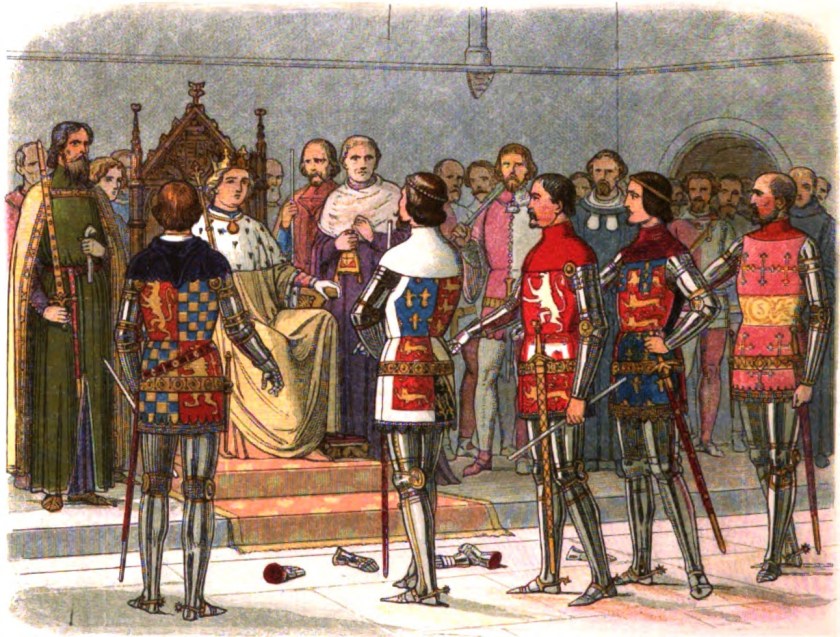
Back when men were men and were offended by each other, they could challenge each other to a duel. If a man happened to be a medieval knight, he could tear off his heavy armored glove and throw it down and, in one fell swoop, alter his or another man’s fate. This glove was called a gauntlet, hence the expression throwing down the gauntlet. In the image above, you can see that several gloves have been cast down. To be honest, I have no idea what the context of the image is. Why are so many gloves cast down in front of Richard II? All I know is it must be serious; a knight doesn’t just casually throw his gauntlet at the king’s feet.
In modern days, the expression has much less dire implications. It’s merely a challenge and doesn’t involve swords. Of course, dueling is no longer a legal activity for a pleasant Saturday in the village green. Perhaps challenges should have more dire consequences, though. I speak as someone who is obstinately independent to a fault. So much so that I tend to throw my metaphorical gauntlets before God.
Okay, I take it back. I don’t want the dire consequences that might come from issuing challenges to God because I can’t seem to stop doing it. A duel with God is a losing battle, unless you are Jacob. To be fair, that wasn’t a duel, but struggling with God is by its nature a battle that could prove deadly. Jacob understood this, as he called the place he had his battle Peniel, which means Face of God. Jacob said, “It is because I saw God face to face, and yet my life was spared” (Genesis 32:22-32).
Recently, I threw down a gauntlet before God and got what I deserved thrown right back at me. I’ll talk more about that later, as it’s still in process. Because of this recent experience, it got me thinking about the other times I’d thrown down gauntlets and God had responded, “Okay, Jill, have it your way.” Although I don’t want to talk about the recent gauntlet-throwing yet, I’ll give you a happy example of God answering one of my challenges positively — one of my favorite answered challenges, in fact.
Back when I was caring for a toddler and homeschooling two children and working toward my degree at UNM, my husband proposed that since we had three daughters, we ought to try for a son. Before we were married, we’d decided that we were going to have three children, and here he was changing things up on me. How dare he! I know it’s silly that we selected as if from a checklist how many children we were going to have, and now we were ready to choose the sex of our next child that we would…yes, choose to have. Oh, my. This “choice” ideal might seem powerful, but the thought of caring for another baby made me panic instead. I was tired. So, I put an absurd challenge before God: I told him I would only agree to this male child my husband wanted if he was born before my 35th birthday and after I had graduated from college.
I repeated this challenge to other people, as though that would set it in stone. If I told it to three people, God would have to honor it, right? Most people did the math and scratched their heads. They insisted it wouldn’t be possible due to how long it was taking me to finish my degree. Inside, I was sardonically saying, “Exactly!” I don’t like to think of myself as a smug person, but perhaps….
The thing about motherhood is it’s hard. A woman’s body gets tired. In a traditional society, the man takes on the monetary responsibility, but the actual physical act of bearing and rearing the young falls on women. Both can be backbreaking, to be honest. The fact that a man wants to take on the responsibility of working even harder to provide for another child demonstrates he is a good man. Ultimately, I knew that having a fourth child would be a positive. Despite my challenging him with absurd terms, I would never tell God no when it comes down to it. That still didn’t mean I wasn’t afraid to have another baby.
I’m sure you’ve already guessed the end of my story: God brought me a son within the absurdly unrealistic parameters I had made. At the beginning of my final year in college, I got pregnant. No joke, I gave birth a week after graduating and a month before I turned 35. I did not intend to get pregnant at that time. I still didn’t want to get pregnant. I had to cope with the many taunts from people at the university, such as, “Don’t you know how babies are made?” Seriously, do people think they’re funny when they say that? They don’t sound funny; they sound like snarky haters of life who care more for their own selfish desires than being part of gifting the world with beautiful children. It assumes that couples must hate babies so much that if they knew how they were created, they would do everything in their power to prevent babies from being born.
Continuing along that tangent, bringing life into the world is what God expects of us. Because we’ve decided as a culture not to do this, we are experiencing demographic decline. Like coddled queens, we have thought we could live only for ourselves (like my useless college degree*) and then bring in immigrants to do our heavy lifting when we no longer have a big enough work force to keep us in the fat delights we enjoy. I suspect the liberal-minded people who push for one or even zero child per household would never admit their system requires either soft slavery or genocide of elders who can no longer work. When you don’t have enough people growing food and manufacturing products and bringing everything to the market and selling those goods, certain segments will have to die off, either naturally, or by eugenicist means. Or — you import slaves from other countries to do your work for you. There really is no other way for the system to work unless we get going on our robot slave class, instead.
In conclusion, now that my son is a teenager, I wouldn’t go back for a single minute and change my challenge to God, or my acceptance of the gift he gave me in exchange for my belligerence. It might be better not to throw those kinds of gauntlets at his feet in the first place, but, hey, at the very least, if you do, you will find out who is really in control. And I can tell you right now I’m not the one.
In secondary conclusion, the whole point of this post was Bring Dueling Back! Men need to be knights again and wear heavy armor that makes a loud clash as it hits the floor. But wait, Jill, that’s an antilife sentiment. Oh, all right, so it is. Don’t bring dueling back. We should solve our disputes through rap battles instead.
 Jill Domschot