Organization!

If it seems that I’m trying to write more on my blog, yes, I have been. I get overwhelmingly busy, and this is the first to go. I no longer wish that to be the case. As today is a day off, and I’m being lazy more than I am productive, I thought I would write a simple note here on productivity. It happens through A. hard work and B. organization.

I’ve long been organized with my exercise routine. I walk for 30 minutes every evening, and do a focused exercise for 30 minutes in the morning. I follow a routine: cardio, strength, stability, repeat. That makes 6 workouts a week, with Sunday reserved for one long, relaxing walk only. This combination, which has some overlap — e.g., some stability workouts are combinations of cardio plus balance and standing abs — works. I’m only exercising an hour a day, but my organization keeps me fit.

As I’m staring at my laptop from the office shed I rarely have time to use, I’m wondering why I can’t apply this kind of organization to finishing my current novel or playing the accordion. To be fair, I subscribed to the Acordeonisticos website to try to create a more focused approach than playing an hour a day of whatever I feel like playing. But I’m still prone to playing whatever I feel like playing, even after subscribing. I need a focused plan! An example might be: music theory, practice old songs, learn a new song, repeat, with Sunday my anything-goes day.

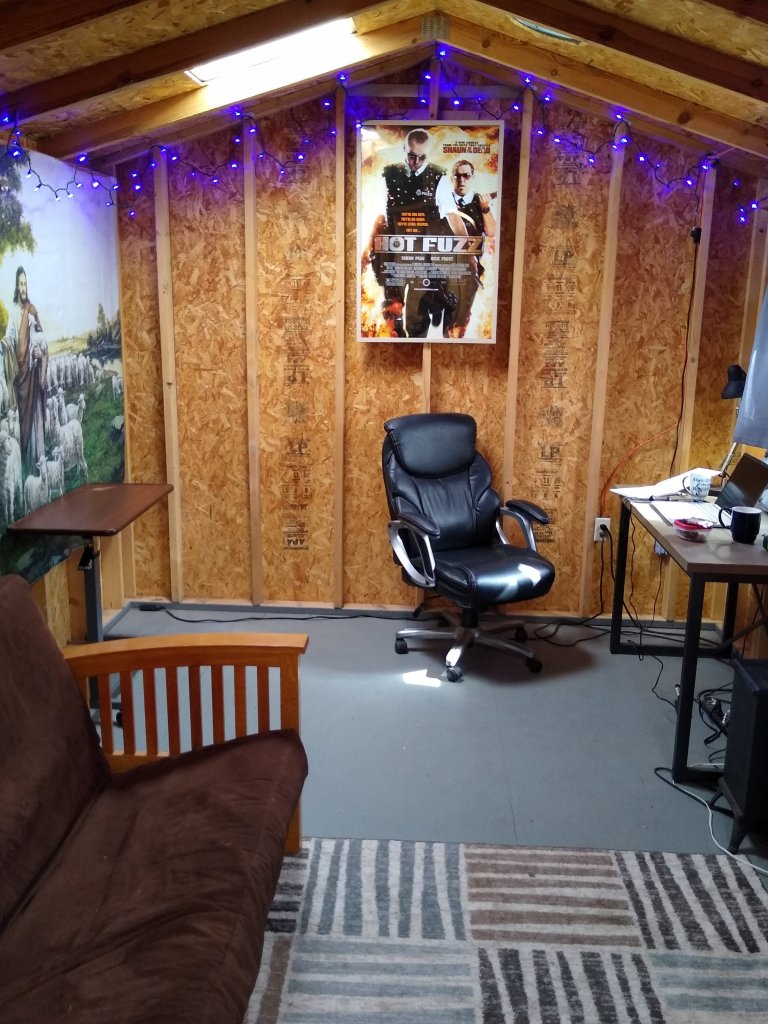
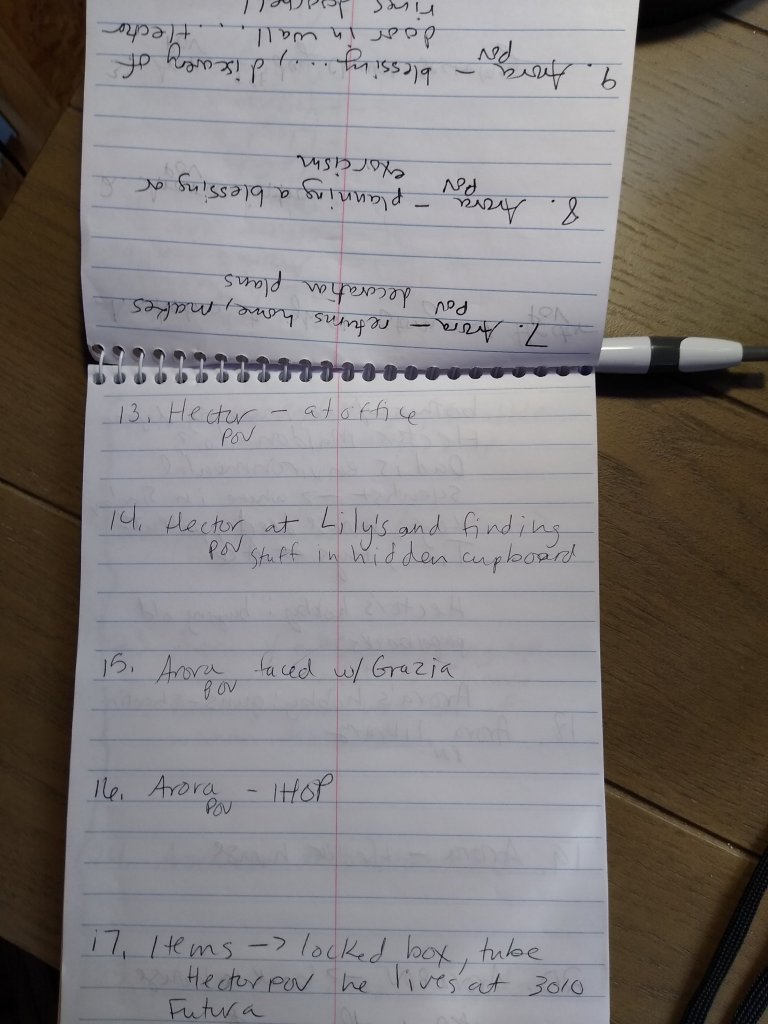
Re writing, my organization amounts to writing 1000 words a day. This is an extremely disorganized plan. I need those 1000 words to be focused. I need to do more mapping and editing. My mapping exists, but it is very slapdash. I will provide a pic, so you can see how slapdash it is. I will also provide a pic of my beloved office that awaits me, a dusty place shut up most days because I have an office at the parish I use 45 hours a week. But I can’t use that office to write; my only shot at that is to sit in the office kitchen on my lunch hour and slam out a few words.

I’m not one for outlining. It gives me the horrors and bad memories from failing at English class in my childhood. I probably should have paid more attention to it. I need to start outlining. Following an outline is the only way to write a book, unlike the pattern of threes that could work for music, as it does for exercise.

My book mapping.
My shed, with Jesus as the Good Shepherd and a poster from one of my favorite films.

SCIENCE TODAY!

Maybe some lightning bolts should be worked into my title. You think you’ll have a Eureka moment when you read the news, but instead, you end up frizzling your brains on their magic bus.

I’m generally like a moth to flame regarding absurdist article titles like this: Study receives $3.3 million grant to address COVID-19 vaccine hesitancy among people with anxiety or depression. What kind of Suzy Do-gooders are the new generation of scientists, anyway*? But maybe it has more to do with feeling relevant when there’s a several million dollar pricetag attached to your research. The article went on to discuss how they would use weakened forms of disinformation to inoculate doubters against — I guess? — strong disinformation:

“The intervention will work the way some vaccines work: by exposing people to weakened forms of mis/disinformation, which can strengthen their ability to identify and resist mis/disinformation when they encounter it in the future.”

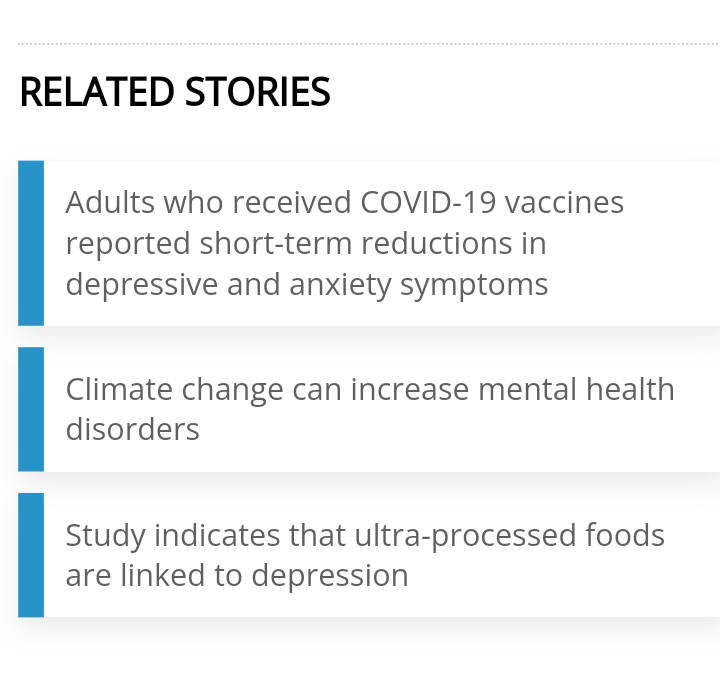
After this quote, the article listed several articles titles, and I genuinely thought they were providing examples of weak disinformation:

Examples of weak disinformation?

Of course, I did notice after a few moments’ contemplation that these were other articles on their site. That is to say, they weren’t provided as examples. They all sound too hard to believe, though, and I suspect that’s what’s meant by “weak disinformation.” The last article might have some validity, as long as it properly defines “overly processed foods.” Most food we eat is processed in one way or other; that’s what sets us apart from animals. Cheese, for example. Cheese is a highly processed food. Or maybe some weak disinformation is disseminated through ambiguous language, which would put the last article back squarely in the camp. I mean, I don’t know what they mean. For millions of dollars, I hope they do. And good luck learning anything from this article on what constitutes weak disinfo, as it’s mostly gibberish, almost impossible to comprehend — itself an example of weak disinformation?

Funny thing, as I spent my Friday night watching videos of Jose Torres El Rey de Alto Mando (accordion player), I realized I could learn as much from him about health as from science articles. He’s an accordion player, and he posts recipes of health elixirs. He also seems to enjoy helping and encouraging people, which is very important for mental health and the world in general*. Unlike many pasty-faced doctors, he looks fairly healthy. And if you want a good laugh, watch his La muchacha interesada video. Millennial-style cumbia? I honestly don’t know; maybe they are Zoomers. I don’t know where these arbitrary lines are anymore, but they do look young to my eyes.

Yes, I can bring everything back to the accordion. Just wait and see.

*The difference between do-gooders and normal people who help others is actually quite large. Do-gooders are controlling of and diminishing towards others’ humanity; the others are not.

El Tema Más Importante

I wrote several very long paragraphs on the Social Contract and then put it aside in my drafts because I honestly hate preaching about subjects such as this. While I appreciate reading about philosophy, politics, and religion, and how they intermingle, there comes a point where people are preaching and nobody is listening. Furthermore, nobody is changing society at all. Oh, yes, of course, one can change society little by little through the infiltration of ideas in schools and universities; progressives did this throughout the 20th C and are still at work today. But sadly, my post was triggered by irritation at the manipulation behind the phrase social contract…and if I keep going, I might as well just pull out my post from its place in the dreaded wasteland of drafts. Another tantalizing yet frustrating subject I had brought up in that post is my unpopular opinion that lowering the teenage pregnancy rate is not positive progress but negative decline. And on that note…

The most important subject is obviously the Gospel. However, the most important subject to this blog has become music. Accordions. My mind has been dwelling on purchasing a new one. After spending $4K on one, you’d think I wouldn’t buy another one for a long time. What you don’t understand is that accordions are like very expensive harmonicas, and acordeonistas need different keys. The one that died in the traffic accident was a GCF. After reviewing numerous norteño songs, I discovered that most are played on the FBbEb accordion. Hence, I purchased one. However, I would still like to have a GCF again, as that is the second most commonly played instrument. Someday, I will purchase an EAD because that one is also occasionally played in the genre. In fact, the master Ramon Ayala often plays an EAD. This confused me for a long time, as I thought EAD was commonly played, but I was being swayed by the sound of Ayala’s songs.

Apart from desiring a GCF accordion, I would also like an accordion with bass buttons that aren’t dummy buttons. Yes, that’s correct; my expensive Gabbanelli has dummy buttons. I suppose this is so that bass blocks could be added at some point; there are tiny tornillos that can be unscrewed to open up the left-handed bass side of the instrument. I’ve heard it’s difficult to persuade the company to put in bass blocks because it will create a weightier instrument with an altered sound. When norteño as a genre has a familiar sound due to the fact that so many of the musicians play Gabbanellis, it’s a bit risky to make any changes. The only way to have pre-installed bass blocks is to buy a cheaper instrument. Therefore, I’m considering purchasing a Hohner Corona II or Classic, which are quality instruments (made in Germany), in order to practice with the left hand again. Also, if the accordion is the only instrument available, and I’m playing for family or friends, songs would be more complete with their bass parts. Of course, norteño bands have rhythm instruments, so they don’t use the left hand anyway. In fact, one of my favorite online accordion tutorial teachers has a video on how to remove the bass blocks from your instrument for the above stated reason. There is already a bajo sexto y bajo in the group.

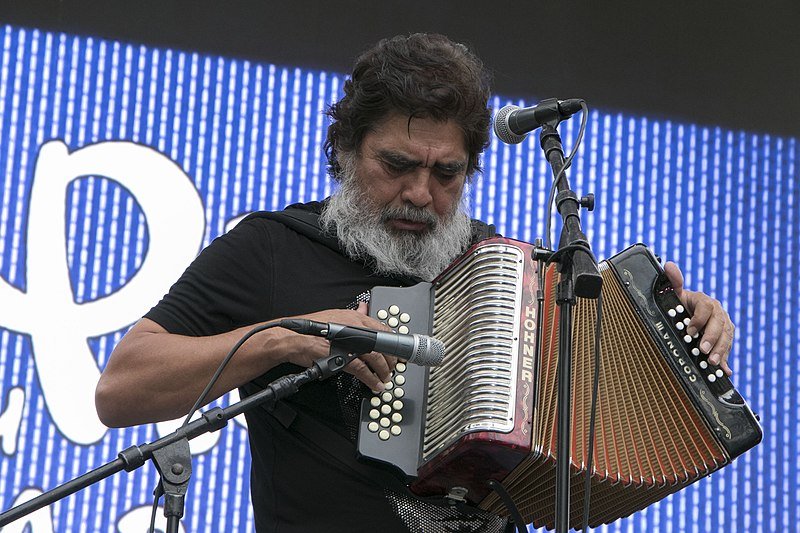
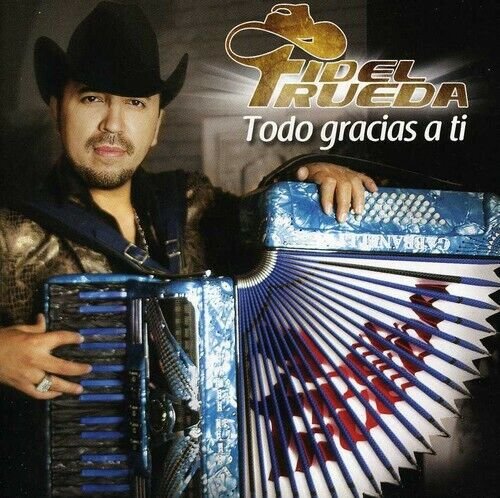
But that isn’t to say no norteño acordeonistas use the left hand — Celso Piña, who has now passed away, used his bass buttons in cumbias. I enjoy his songs because they have a different sound. I also really enjoy watching videos of him playing live. It’s exciting, the music infectious. He played a Hohner Corona, by the way. Believe it or not, you will even find musicians who play piano accordions in this genre. One of my favorites is Fidel Rueda. I don’t know how to describe his music, except as “sexy” but that sounds crass and doesn’t quite express what I want to say when his vocals, the accordion, and the brass blend together. I should probably make up a word, instead.

Speaking of word invention, there is a word for that in Spanish. It is jitanjáfora. I learned this word some time ago when I was trying to figure out what El Pávido Návido means. That’s the name of a song, and it disheartened me when I realized one day I had no idea what it meant, and I’m tired of my poor Spanish vocabulary. Don’t get me wrong; I can understand the music tutorials and interviews I listen to because they have necessary context. But then I’m thrown by a catchy song title. As it turns out, the title is a jitanjáfora. That’s either a relief or not, since I don’t know Spanish well enough to recognize nonsense rhyming words. Today, I will post pictures of the two rebel accordion players I mentioned. You can seek out their songs if you choose.

From Wiki Commons
This is an album cover; I hope it’s okay to post. I wanted an image with accordion!

“Mexicano hasta al tope…” and other not so random thoughts

The part in quotes is a line from Corrido de Juanito, which, as you know, I’ve been learning on the accordion. Because I listen to the song on repeat, I have it permanently stuck in my head and consequently sing it all the time, especially the line above. The funny thing is the line ends up sounding like a commercial when sung on repeat, por ejemplo, “The best part of waking up is being Mexican to the top!” I’m sure you can hear the Folgers song in there, no need to spell it out.

Most of the time, I live in my musical fantasy world, my favorite songs filling my head and keeping me going after my three hours of sleep per night. But then I will have moments when reality wakes me out of my sleep-deprived reverie, and I ask myself who exactly I think I am. I’m certainly not Mexicana hasta al tope. Because of that, some old college friends might call my norteño obsession and accordion playing cultural appropriation. Is it, though? Is it really?

The accordion is German in origin; the name comes from the German akkordeon. Mexicans appropriated the instrument from another culture, in other words — from the German immigrants who settled in Texas and Northern Mexico. This is what happens when cultures rub shoulders. They influence each other. It is unavoidable, or should be. When cultures share music, dancing, and food with each other, they tend to get along a lot better than if they stay suspicious and aloof from each other. There is much cultural snobbery and myopia when people get their hackles up over hoarding aspects of their culture.

I will never forget the article I read years ago, in which a Chinese-American woman claimed the bone-broth fad was appropriation of Chinese culture. It didn’t seem to occur to her that cultures all over the world might have been cooking bone broths for millennia. This doesn’t even fall under the category of sharing; it rather signifies our forebears’ mutual necessity to utilize all parts of the animals they slaughtered. The Chinese were not alone in this.

If I were to only play the music of my culture, I would play the fiddle or one of those tiny accordions popular with hillbillies and the Irish. My family was part of Irish dance culture for years, and I distinctly recall hearing the accordion playing the same jigs and reels fifty times over. I mean, it’s not a matter of recall. All those jigs and reels are indelibly printed on my psyche along with big wigs and bling. But alas, the Irish don’t count Americans of Irish ancestry as being Irish, and there goes my culture. Like so many Americans, I simply have a mezcla of cultural parts and pieces, which includes Mexican pieces because I’ve lived around them my entire life.

Is there such a thing as cultural appropriation in America? I’m going to say yes. I was thinking about this at dawn, having been awake for hours. My body was achy and sore and I thought I might like to do some yoga. I don’t do yoga, though. Oh, sure, I used to. I appreciated its efficiency in strengthening and stretching the body at the same time. I also argued with other Christians who claimed it was wrong to participate in another religion’s worship. They argued against it because yoga, after all, means yoked, as in yoked to spirits and gods Christians don’t worship. I’ve always found it a little bizarre when Christian churches offer yoga hours in their fellowship halls, but doing it as exercise in one’s living room, sans spiritual components, I thought was quite all right.

The way Americans practice yoga is areligious to be sure, but it’s hugely disrespectful of another culture’s religious practice. I’m not sure what hyper conservative Hindus, who still believe in modesty, think of Americans who do Yoga Booty while wearing pants so clingy you can see every bump and jiggle on the legs and backside, wearing the pants to show off the effectiveness of the exercise. The way we practice yoga might very well be what people mean when they cry, Cultural appropriation! It’s rude and offensive. That and maybe chintzy plastic Native American dolls and fake moccasins. Marketing off a culture we very nearly wiped out to extinction no doubt leaves a bad taste in the mouth of the extant native tribes.

Speaking of weird activities Christian churches get up to, along with showing off their jiggly booties…no, I don’t think they make moccasins or plastic dolls or even bone broth. At one time, it was standard charity in England for bones to be used multiple times, once at the wealthy person’s house, who supped on the richest broth, of course, until finally the picked-clean bones were ransferred to the poorest of the poor to make broth with. But church food pantries these days are more inclined to collect canned vegetables and beans than spare animal parts. No, the weird activity I was going to mention is doing counseling sessions using the Enneagram personality typing system. In response, Reformed-style Christians are horrified, despite the dubious occultic roots behind Enneagram.

There are no known accusations of cultural appropriation regarding Enneagram; I just find it amusing that Christians have latched onto it AND that more Reformed types are making a fuss of it. I wouldn’t care one way or the other if Christians didn’t have a peculiar problem with lacking self-awareness. They make lofty claims that we shouldn’t be looking to any other source but the Bible for help, but what they really mean is “I don’t want to know anything about what I’m really like inside.” In other words, they don’t want to be faced with their own egos. Obviously, the ones using the Enneagram are busy identifying with their egos, looking straight into them, but that is not to say that there aren’t many Christians who refuse to look.

I took the Enneagram once, at my husband’s insistence, as he found it gave him an accurate description of his personality. Modern Enneagram type descriptions are incredibly detailed, unlike the truly occultic horoscopes. This might be why some people have an aversion to Enneagram. It’s not always pleasant to read that you fit an archetype that isn’t 100% positive. Was the type I tested as an accurate description of me? Sure, it was…at the time. And I really didn’t like it; hence, it motivated me to not be “my type” as much as possible.

Being self aware is a good starting point for making good choices in this life; I suppose one could be self aware and still make wrong choices. For example, a truly invested thief could be a proud criminal. Or maybe in more ordinary circumstances, a person might learn to identify with their negative traits and never seek growth. Well, I admit I still have personality traits I’m working on. I often shut the world out so I can pursue my personal goals, which my Enneagram description predicts. That pattern of behavior is so ingrained I believe it would be difficult to change. Like my pursuit of the accordion, for example… No, no, I have examined my interior and decided playing norteño on the accordion is a good choice. A wonderfully positive choice. It had better be. That norteño style accordion I bought was really expensive. Plus, I love singing in Spanish. Here it comes again. I. Can’t. Stop. Singing… Mexicano hasta al tope. It’s somehow gratifying to sing a song about someone with an intact culture, even though part of the song’s sadness is the subsequent loss of culture in the US, loss brought on by Juanito’s children no longer speaking Spanish.

El Tau Tau

Since this is the year of the accordion, it has suddenly occurred to me that I should be playing El Tau Tau. Why? you ask. Well, it’s one of the greats. It’s played everywhere, at every party. Like most cumbias, it’s highly repetitive, and it might be simple, but the accordion parts are played very rapidly. In other words, it’s easier to pick out the tune than it is to play it with aplomb and adornos. Adornos are what make norteño and tejano accordion distinctive. The trills and noodling are downright magical. No matter that I now know the secrets to the magic tricks; like any apprentice magician, my own sleight of hand could use a great deal more practice.

The song is by one of my longtime favorites, Grupo Control. Their songs give me a thrill of happiness. Funny thing, I caught my son singing El Tao Tao today, and he admitted he had a playlist with Grupo Control on it. Being my son, he’s grown up listening to Mexican music but always professed to dislike it. His cover is now blown. It is funny the synchronous moments life brings us. I generally play my accordion while he is at basketball practice, so he isn’t exposed to my new song obsessions. I had been playing the song like a mad woman, and then I went for my walk-jog-dance through the neighborhood (it’s been below freezing for days, but the old lady dog still needs her walk — this old lady does too). When I returned, my son was home and singing El Tau Tau as if the notes of the accordion were still hanging in the air.

Grupo Control is not just distinctive for their magical cumbias; they also happen to now have that rare breed in norteño, a female accordion player. Her name is Jennifer Degollado; she’s the daughter of the main singer and bass player for the band. Previously, they had a male accordion player, though I’m not sure what he is doing now. Miss Degollado can also sing, which does not surprise me. Musical talents tend to be clustered in families. I’ll post a couple of videos below, one of the titular song, and another with Jennifer Degollado singing and playing.

New Year’s Resolutions

I don’t make them, though they are, I’m sure, worthwhile if you have the gumption to carry them out. On the other hand, I’ve made all manner of resolutions to keep on moving forward, no matter how tired and listless I feel. There’s no choice but to do that. There’s no point in sitting around waiting to find out if something is meant to happen by design or fate.

Do you remember that old movie Stranger Than Fiction? As a writer of fiction, I enjoyed the concept of that movie quite a bit, in a which an author is writing people into existence. After her hero realizes he’s a book character, an English professor — a professor with an expertise on the phrase Little did he know… — recommends that he sit around and do nothing all day to find out how much free will he has according to the story world. Alas, a wrecking ball destroys his apartment, suggesting his deck is stacked. Rather than allowing this deterministic universe get the better of him, he chooses to live in a way he’d never allowed himself to live before. E.g., he learns to play the guitar and falls in love. Of course, this being an old movie, spoilers don’t matter, right? Ultimately, he chooses to live the purpose he was written for and sacrifice his life to save a little boy.

The author realizes that she’s unwittingly become a monster and decides that it would be wrong to kill off a man who’s willing to sacrifice his life for others. Therefore, she changes the ending of her story, despite that it ruins the great artistic aesthetic of the work. Movies like this are rare, which is why it stuck with me. It’s philosophical, it’s fundamentally pro-life, it’s funny, and it has a happy ending.

But mostly, I don’t want to be the person who waits for fate to bring her a wrecking ball. For that reason, I should make resolutions, but I’m sorry; I’m just too busy. My list is already full. If fate, that is, God, wants me to do more, he’s going to have to make that clear.

On the other hand, it’s the tradition to have a New Year’s song, which is, fatefully, whatever comes on the radio as the clock strikes midnight. Who listens to the radio these days? We used to in the car on the way back from Albuquerque after our New Year’s Eve movie (LOTR and The Hobbit trilogy kept us going for a lot of years.) I do listen to the radio, though. I have a radio app on my phone. To stay awake, we were watching a movie called Alpha (highly recommend). As it approached midnight, I put in my earbuds and tried to find a channel that wasn’t playing ads. My husband had fallen asleep despite the film, and it was obvious I had to find a song on my own.

Finally, just before it was too late, I clicked on a Tejano station, which began to play Un rinconcito en el cielo. I smiled at the accordion intro. You see, when I first explored Norteño by listening to the Mexican stations coming out of Albuquerque, that song had taken my breath away. I fell in love with the accordion, and there was no going back. This song was how it started, and now I can play it on my very own Gabbanelli. I’m happy and grateful my New Year song is this one. It puts a positive spin on my year. This might sound superstitious to some people, but it’s really not. It’s a game, and not so very different from choosing a word to be the theme of the year, except I let the radio choose it for me. Whatever the case, I must find inspiration in it. Let me tell you, it’s not easy to find inspiration in all songs. I cringe when I consider my New Year song could have been from a country station if it hadn’t been playing ads. Maybe if Garth Brooks sang Standing Outside the Fire it might be inspirational. But what are the odds of that? Then again, what are the odds of music existing at all unless there’s a creator? I don’t know. It’s kind of difficult to create a set of odds with an infinite God as the one given.