Una página más

When I was out walking the other day, this song began to play on the list Spotify had created for me. It’s not a new song, but music is a living, breathing art form that affects the soul, and I suddenly heard the lyrics for the first time. Or, I should say, they impacted me for the first time. It is, I guess, my current theme song. I will post the lyrics and a video below. Yes, of course I’m now learning to play it on the accordion. It’s by Los Cadetes de Linares. I don’t have the energy to translate it for you. I don’t do that when I listen to songs, anyway. Head translation is a difficult hurdle to leap over when conversing in a second language. I can happily say on some level I understand song lyrics I’m familiar with and don’t have to go through the tedious process of translation. Anyway, most people know at least a little Spanish these days. The English-only movement in this nation seems to be dying with the boomers and silents. It was always a stifling stance, albeit one that colonizing nations use to defeat other nations — any language suppression, that is, not just English-only. The Spaniards obviously used this tactic, too, or Latin America wouldn’t speak Spanish. This is because language is an essential part of culture.

I didn’t start this meaning to be so long-winded. I have no moralistic attitude towards colonizing nations; this is simply the history of the world. I have rather more an educative attitude towards it. Speaking multiple languages is a valuable skill; why be so snooty about speaking only one? My own grandparents were like this, despite being otherwise lovely, generous Christian people. I sorely wish I could be a better conversationalist in Spanish, but I often remind myself I’m awkward at having conversations in English, too. That’s all I have to say. The song says everything else. Well, almost everything else. Like so many norteño songs, it’s a lost-love song from the masculine perspective. Ultimately, what matters is the concept of new beginnings, turning over a new leaf — which is the English idiom matching the title and sentiment of the song. Life gives us crossroads at critical junctures — do we remain on the same path, even if it’s grown dark and weedy and impossible to traverse, or do we turn down a new one? In the context of the song, he chooses the new path. I have been so tired lately, and I have found myself halted at the crossroads. That’s the reason I haven’t written anything here. Also, I discovered I hadn’t worked on my book about the delivery-driver detective for over a month, even though he is currently my favorite protagonist, and his face haunts my mind. My life is an empty book. Yours? Is it empty, too? I used to listen to bedtime stories made for insomniacs. Maybe life is closer to these stories than to an empty book: meandering, turning, never ending until death with no heightened climactic moments. I prefer to see life as a library with many completed stories, and fresh, bright empty ones waiting to be filled.

Es inútil que vuelvas
Lo que fue ya no es
Es inútil que quieras
Comenzar otra vez

No interrumpas mi vida
Ya no te puedo amar
Solo sé que tu boca
No la vuelvo a besar

Tengo un libro vacío
Y lo voy a empezar
Tengo sed de caricias
Tengo ganas de amar

Hoy comienza mi vida
Una página más
Hoy me enseña la vida
Que me quiera ella más

Es la historia de siempre
Un amor que se fue
Y yo espero mañana
Comenzar otra vez

Sin rencor ni temores
Quiero vivir en paz
Quiero encontrar mi suerte
Y no dejarla jamás

Es la historia de siempre
Un amor que se fue
Y yo espero mañana
Comenzar otra vez

Sin rencor ni temores
Quiero vivir en paz
Quiero encontrar mi suerte
Y no dejarla jamás

Sueño en español

(English translation below, as much for the English speakers as the Spanish speakers who can’t understand my bad Spanish.)

Voy a escribir una canción — tal vez más de una! — en español para cantar mientras toco mi acordeón. Será como la de Los Alacranes, el grupo de Alemania (no el grupo mexicano, Alacranes Musical), quien cantaban sus canciones en inglés. Sus letras eran un poco extrañas; que es decir, eran obvias de una manera un hablante nativo no las habría escrito. Creo que podré traer una perspectiva diferente, como “The Scorpions”, aunque no escribiré de perras que tienen hambre de pecados en la turbulencia de un huracán.

Mis canciones serán de pajarillos y amor porque estos son los temas que yo prefiero. Tal vez, escribiré una canción de mariposas, tambien. Las mariposas, los pajarillos, y el amor. Tengo romance en el alma, incluso cuando no existe en la vida actual…y casi nunca existe (ser honesta). Es como una fantasma que se siente pero pocas veces se ve. Y ahora, estoy triste y llena de melancolía por tantos pensamientos.

Hace muchos años yo escribí muchos poemas en español. En esos días, estudiaba la literatura tradicional española, y estaba aprendiendo a reconocer las formas de la poesía tradicional. Por eso, escribí unos romances y sonetos y unas decimas, letrillas, etcetera. Estas formas no se pierden en la niebla de la vida diaria, claramente no. ¡Mentirosa! Por el contrario, se pierden, pero puedo encontrarlas de nuevo. ¡Ahora, es el año del acordeón y de encontrar la poesía y de escribir español muy malo!

I’m going to write a song — perhaps more than one! — in Spanish to sing while I play my accordion. It will be like that of The Scorpions, the group from Germany (not the Mexican group, Alacranes Musical), who sang their songs in English. Their lyrics were a little strange; that is to say, they were obvious in way a native speaker wouldn’t have written them. I believe that I’ll be able to bring a different perspective, like The Scorpions, even though I won’t write about bitches that are hungry for sin in the turbulence of a hurricane.

My songs will be about little birds and love because these are the subjects I prefer. Perhaps, I will write about butterflies, too. Butterflies, little birds, and love. I have romance in my soul, even when it doesn’t exist in real life…and it almost never exists (to be honest). It is like a ghost that is felt but rarely seen. And now, I’m sad and full of melancholy because of such thoughts.

Years ago, I wrote numerous Spanish poems. In those days, I was studying traditional Spanish literature, and I was learning to recognize the traditional Spanish forms of poetry. Because of that, I wrote some decimas, sonetos, letrillas, etcetera. These forms aren’t lost in the fog of daily life, clearly not. Liar! On the contrary, they are lost, but I can find them again. Now, it’s the year of the accordion and of finding poetry and writing really awful Spanish!

Spanish, Dalí, & a Little Lorca

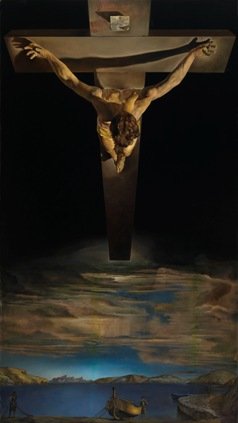
Christ of St. John of the Cross

Imitations or reproductions of Dalí’s famous painting are rife in the Catholic world, with an imitation in the office where I work. It takes me back to high school, when I loved Dalí’s artwork. Also, I had just started taking Spanish in school and therefore believed I could read my dad’s battered paperback of Federico Garcia Lorca’s poetry. These are related subjects, I promise, and not simply because I’m discussing Spaniards who, obviously, spoke Spanish.

We had to study a language; it was mandatory in high school. It doesn’t make much sense at that point, however. Learning a second language should have been mandatory from kindergarten onwards. I have an elderly friend at my parish who attended a private American school where they spoke Polish in classes. She still understands and speaks Polish to this day because of her early exposure to it, despite living in an English-only culture. I will never understand the English-only cultural philosophy. It’s not just xenophobic; it’s an example of my least favorite personality trait in individuals, let alone entire cultures: proud ignorance. Generally, I call this the Cult of Stupid. You can spot members because they roll their eyes and complain if you use words with more than two syllables. They think it’s snooty or some such, without recognizing the irony that syllables has three.

Could I actually read the Lorca book? Sure. It had English translations on the right hand-pages. My dad is not a Spanish speaker, after all. I loved learning the pretty vocabulary in the book, as it set me apart from other first-year learners of Spanish. I’ve always had a big vocabulary, and even though I failed pretty badly at English classes in school, I do have the ability to dissect words to determine what they mean. This gives me an even further edge regarding an intellectual grasp of a second language. It’s too bad this process often confuses words for me rather than making them clear. I ran into a funny example this morning. The word equivocarse and its various forms are related to the verb in English to equivocate. By the way, this might not be a commonly used word in English, but it is a common word in Spanish — like so many Latin words that have more than two syllables. In English, this word takes on the meaning of obscuring the truth. To equivocate is either for the purpose of being circumspect or being deceptive. In Spanish, it has the connotation of simply being wrong. I came across a video with the title, Estos policias se metieron con la chica equivocada… It took me a pretty minute, being in an English frame of mind, to realize a correct translation would be “The police messed with the wrong girl…!” My mind wanted it to be deceptive instead of wrong, but it was clear from the context of the video that the girl was innocent, and the police were the deceptive ones. Context is the best guide to learning a language, and so much for my intellectual, dissecting approach. In fact, although this is a bit of a digression, the only way to understand someone speaking Spanish to me is not to be myself, and to listen without focusing on any one word, picking up the sense from the context. If I stop to pick apart words, I have already lost the rest of the conversation. And unlike a language test in school, I’m not going to earn points for translating a few words correctly.

Lorca and Dalí were close friends, albeit I didn’t know this when I was in high school. I only knew I liked reading through my dad’s books, which also included art books featuring Dalí. I’ve loved Spanish ever since I was first introduced to it; that’s all I want to say about that. This post was meant to be about Dalí. But there is a point of overlap with my previous discussion that is much greater than my dad’s bookcases, as it’s clear from reading about Dalí and studying his artwork that he also took the analytical approach to life. He studied the master artists and picked apart the elements in them in order to understand them, and then he spent some time imitating them. Because of this, he’s known as a master of craft. When he created surreal art, he was playing with ideas that intrigued him. For much of his young years, Freudian psychoanalysis was a large part of what intrigued him. He met Freud; Freud didn’t like the surrealists and couldn’t understand why they were fascinated with him. He liked Dalí, though. He liked his genuine fanaticism.

Dalí was also intrigued by the physics of time and space. This in turn intrigued me as a young person. Beauty is timeless, and I will never cease to appreciate landscapes and portraits that capture the personalities inherent to people and places. But playing with ideas perhaps appeals to me even more. Another artist I appreciate for this is M.C. Escher. They both clearly loved playing with what is possible in flat geometric spaces. These two artists have a number of similarities in thinking, to be honest. They both loved the ideas they were representing and loathed politics. Neither wished to be pinned down politically, during a time when being a surrealist artist meant something political. Dalí was actually voted out of the surrealists because he eschewed Marxism and, especially as he grew older, defended Catholicism, eventually returning to his nation’s historical faith (he even had his longtime civil marriage “convalidated” in the church.) Escher was apparently part of a Christian religious order, as well, but he was as quiet about that subject as he was about politics. Dalí enjoyed creating controversy; Escher did not. There are other artists I love because they have an absurdist, intellectual approach — William Hogarth is one that long predates surrealism.

What about Lorca, though? I don’t know; for me, he was simply the first Spanish poet I read. He and Dalí were artistic friends, but Lorca’s approach was different than Dalí’s. He was a gay socialist, fitting neatly into the world of the avant garde. Dalí never fit in, and nor did he want to. He lived to a ripe old age, changing his psychoanalytic approach over the years to bizarre perspectives of Jesus on the cross. Meanwhile, Lorca was assassinated under a fascist regime (though there is some controversy regarding why and by whom).

Like Dalí, ideas are really what drive me forward. Because of that, I will probably never arrive at a place where I’m an artist at storytelling or making music, or a natural with language and communication. But every time I see Dalí’s crosses in my environment, I’m reminded that there are famous artists who don’t approach the world with a traditional artistic temperament. So, perhaps, I still have a fighting chance. By the way, I have tried to subvert the intellectual approach in learning the accordion, but mostly because I don’t have time to give it an extensive study. I want to live in the magic of the instrument and play the songs I love. However, I’ve determined that taking a more intellectual approach will work better for me, having the emotional artistic state of a gnat. So, I’ve stepped back to think through music theory. In Spanish. The problem with my accordion playing is that it’s always been in Spanish. Switching to English would not be a great idea now that I’m used to Do Re Mi Fa Sol La Si, mi acordeon en tono de Fa, and hearing ahora, tocamos la escala de Sibemol en terceras. I know what that is and can play it. If someone switched to now we’ll play the scale of B flat in thirds, I’d probably panic. Intellectuals just do not switch gears with ease, I’m sorry to say. That’s why we’re often labelled fanatics (see Freud on Dalí above). We get obsessed and taken with an idea and must hammer it out to its conclusion.

“Mexicano hasta al tope…” and other not so random thoughts

The part in quotes is a line from Corrido de Juanito, which, as you know, I’ve been learning on the accordion. Because I listen to the song on repeat, I have it permanently stuck in my head and consequently sing it all the time, especially the line above. The funny thing is the line ends up sounding like a commercial when sung on repeat, por ejemplo, “The best part of waking up is being Mexican to the top!” I’m sure you can hear the Folgers song in there, no need to spell it out.

Most of the time, I live in my musical fantasy world, my favorite songs filling my head and keeping me going after my three hours of sleep per night. But then I will have moments when reality wakes me out of my sleep-deprived reverie, and I ask myself who exactly I think I am. I’m certainly not Mexicana hasta al tope. Because of that, some old college friends might call my norteño obsession and accordion playing cultural appropriation. Is it, though? Is it really?

The accordion is German in origin; the name comes from the German akkordeon. Mexicans appropriated the instrument from another culture, in other words — from the German immigrants who settled in Texas and Northern Mexico. This is what happens when cultures rub shoulders. They influence each other. It is unavoidable, or should be. When cultures share music, dancing, and food with each other, they tend to get along a lot better than if they stay suspicious and aloof from each other. There is much cultural snobbery and myopia when people get their hackles up over hoarding aspects of their culture.

I will never forget the article I read years ago, in which a Chinese-American woman claimed the bone-broth fad was appropriation of Chinese culture. It didn’t seem to occur to her that cultures all over the world might have been cooking bone broths for millennia. This doesn’t even fall under the category of sharing; it rather signifies our forebears’ mutual necessity to utilize all parts of the animals they slaughtered. The Chinese were not alone in this.

If I were to only play the music of my culture, I would play the fiddle or one of those tiny accordions popular with hillbillies and the Irish. My family was part of Irish dance culture for years, and I distinctly recall hearing the accordion playing the same jigs and reels fifty times over. I mean, it’s not a matter of recall. All those jigs and reels are indelibly printed on my psyche along with big wigs and bling. But alas, the Irish don’t count Americans of Irish ancestry as being Irish, and there goes my culture. Like so many Americans, I simply have a mezcla of cultural parts and pieces, which includes Mexican pieces because I’ve lived around them my entire life.

Is there such a thing as cultural appropriation in America? I’m going to say yes. I was thinking about this at dawn, having been awake for hours. My body was achy and sore and I thought I might like to do some yoga. I don’t do yoga, though. Oh, sure, I used to. I appreciated its efficiency in strengthening and stretching the body at the same time. I also argued with other Christians who claimed it was wrong to participate in another religion’s worship. They argued against it because yoga, after all, means yoked, as in yoked to spirits and gods Christians don’t worship. I’ve always found it a little bizarre when Christian churches offer yoga hours in their fellowship halls, but doing it as exercise in one’s living room, sans spiritual components, I thought was quite all right.

The way Americans practice yoga is areligious to be sure, but it’s hugely disrespectful of another culture’s religious practice. I’m not sure what hyper conservative Hindus, who still believe in modesty, think of Americans who do Yoga Booty while wearing pants so clingy you can see every bump and jiggle on the legs and backside, wearing the pants to show off the effectiveness of the exercise. The way we practice yoga might very well be what people mean when they cry, Cultural appropriation! It’s rude and offensive. That and maybe chintzy plastic Native American dolls and fake moccasins. Marketing off a culture we very nearly wiped out to extinction no doubt leaves a bad taste in the mouth of the extant native tribes.

Speaking of weird activities Christian churches get up to, along with showing off their jiggly booties…no, I don’t think they make moccasins or plastic dolls or even bone broth. At one time, it was standard charity in England for bones to be used multiple times, once at the wealthy person’s house, who supped on the richest broth, of course, until finally the picked-clean bones were ransferred to the poorest of the poor to make broth with. But church food pantries these days are more inclined to collect canned vegetables and beans than spare animal parts. No, the weird activity I was going to mention is doing counseling sessions using the Enneagram personality typing system. In response, Reformed-style Christians are horrified, despite the dubious occultic roots behind Enneagram.

There are no known accusations of cultural appropriation regarding Enneagram; I just find it amusing that Christians have latched onto it AND that more Reformed types are making a fuss of it. I wouldn’t care one way or the other if Christians didn’t have a peculiar problem with lacking self-awareness. They make lofty claims that we shouldn’t be looking to any other source but the Bible for help, but what they really mean is “I don’t want to know anything about what I’m really like inside.” In other words, they don’t want to be faced with their own egos. Obviously, the ones using the Enneagram are busy identifying with their egos, looking straight into them, but that is not to say that there aren’t many Christians who refuse to look.

I took the Enneagram once, at my husband’s insistence, as he found it gave him an accurate description of his personality. Modern Enneagram type descriptions are incredibly detailed, unlike the truly occultic horoscopes. This might be why some people have an aversion to Enneagram. It’s not always pleasant to read that you fit an archetype that isn’t 100% positive. Was the type I tested as an accurate description of me? Sure, it was…at the time. And I really didn’t like it; hence, it motivated me to not be “my type” as much as possible.

Being self aware is a good starting point for making good choices in this life; I suppose one could be self aware and still make wrong choices. For example, a truly invested thief could be a proud criminal. Or maybe in more ordinary circumstances, a person might learn to identify with their negative traits and never seek growth. Well, I admit I still have personality traits I’m working on. I often shut the world out so I can pursue my personal goals, which my Enneagram description predicts. That pattern of behavior is so ingrained I believe it would be difficult to change. Like my pursuit of the accordion, for example… No, no, I have examined my interior and decided playing norteño on the accordion is a good choice. A wonderfully positive choice. It had better be. That norteño style accordion I bought was really expensive. Plus, I love singing in Spanish. Here it comes again. I. Can’t. Stop. Singing… Mexicano hasta al tope. It’s somehow gratifying to sing a song about someone with an intact culture, even though part of the song’s sadness is the subsequent loss of culture in the US, loss brought on by Juanito’s children no longer speaking Spanish.