Who Knew?

God is my favorite health & beauty “guru”. This Psalm of David struck me yesterday:

Bless the LORD, my soul;

all my being, bless his holy name!

2
Bless the LORD, my soul;

and do not forget all his gifts,

3
Who pardons all your sins,

and heals all your ills,

4
Who redeems your life from the pit,

and crowns you with mercy and compassion,

5
Who fills your days with good things,

so your youth is renewed like the eagle’s.

Psalm 103:1-5, NAB

Notice the pattern, though. David praises God first, thanking him for his gifts and for forgiveness of sins. He also thanks God for his health. Then, he says that God fills his days with good things, and these are what renews his youth.

I love this. I’m honestly terrified of stagnation; I never want to be in a place in my life where that occurs. Why? It makes you old fast. If you sit in the same chair by the same window every day, both your mind and body will grow old and weary. In contrast to that, God fills our days with good things that will rejuvenate us.

Thank you, God, for new blessings in my days! I feel younger just thinking about it.

Good things in my days!

Una página más

When I was out walking the other day, this song began to play on the list Spotify had created for me. It’s not a new song, but music is a living, breathing art form that affects the soul, and I suddenly heard the lyrics for the first time. Or, I should say, they impacted me for the first time. It is, I guess, my current theme song. I will post the lyrics and a video below. Yes, of course I’m now learning to play it on the accordion. It’s by Los Cadetes de Linares. I don’t have the energy to translate it for you. I don’t do that when I listen to songs, anyway. Head translation is a difficult hurdle to leap over when conversing in a second language. I can happily say on some level I understand song lyrics I’m familiar with and don’t have to go through the tedious process of translation. Anyway, most people know at least a little Spanish these days. The English-only movement in this nation seems to be dying with the boomers and silents. It was always a stifling stance, albeit one that colonizing nations use to defeat other nations — any language suppression, that is, not just English-only. The Spaniards obviously used this tactic, too, or Latin America wouldn’t speak Spanish. This is because language is an essential part of culture.

I didn’t start this meaning to be so long-winded. I have no moralistic attitude towards colonizing nations; this is simply the history of the world. I have rather more an educative attitude towards it. Speaking multiple languages is a valuable skill; why be so snooty about speaking only one? My own grandparents were like this, despite being otherwise lovely, generous Christian people. I sorely wish I could be a better conversationalist in Spanish, but I often remind myself I’m awkward at having conversations in English, too. That’s all I have to say. The song says everything else. Well, almost everything else. Like so many norteño songs, it’s a lost-love song from the masculine perspective. Ultimately, what matters is the concept of new beginnings, turning over a new leaf — which is the English idiom matching the title and sentiment of the song. Life gives us crossroads at critical junctures — do we remain on the same path, even if it’s grown dark and weedy and impossible to traverse, or do we turn down a new one? In the context of the song, he chooses the new path. I have been so tired lately, and I have found myself halted at the crossroads. That’s the reason I haven’t written anything here. Also, I discovered I hadn’t worked on my book about the delivery-driver detective for over a month, even though he is currently my favorite protagonist, and his face haunts my mind. My life is an empty book. Yours? Is it empty, too? I used to listen to bedtime stories made for insomniacs. Maybe life is closer to these stories than to an empty book: meandering, turning, never ending until death with no heightened climactic moments. I prefer to see life as a library with many completed stories, and fresh, bright empty ones waiting to be filled.

Es inútil que vuelvas
Lo que fue ya no es
Es inútil que quieras
Comenzar otra vez

No interrumpas mi vida
Ya no te puedo amar
Solo sé que tu boca
No la vuelvo a besar

Tengo un libro vacío
Y lo voy a empezar
Tengo sed de caricias
Tengo ganas de amar

Hoy comienza mi vida
Una página más
Hoy me enseña la vida
Que me quiera ella más

Es la historia de siempre
Un amor que se fue
Y yo espero mañana
Comenzar otra vez

Sin rencor ni temores
Quiero vivir en paz
Quiero encontrar mi suerte
Y no dejarla jamás

Es la historia de siempre
Un amor que se fue
Y yo espero mañana
Comenzar otra vez

Sin rencor ni temores
Quiero vivir en paz
Quiero encontrar mi suerte
Y no dejarla jamás

La decisión más importante…

…es, ¿cuál marca de acordeón debería comprar? When I first started playing, the decision seemed obvious. The most common student accordion is the Hohner Panther, and its sound is surprisingly nice for a cheaper instrument. Hohner is a trusty brand of German-made accordions, though I’m guessing the Panther is cheaper because it’s made in China.

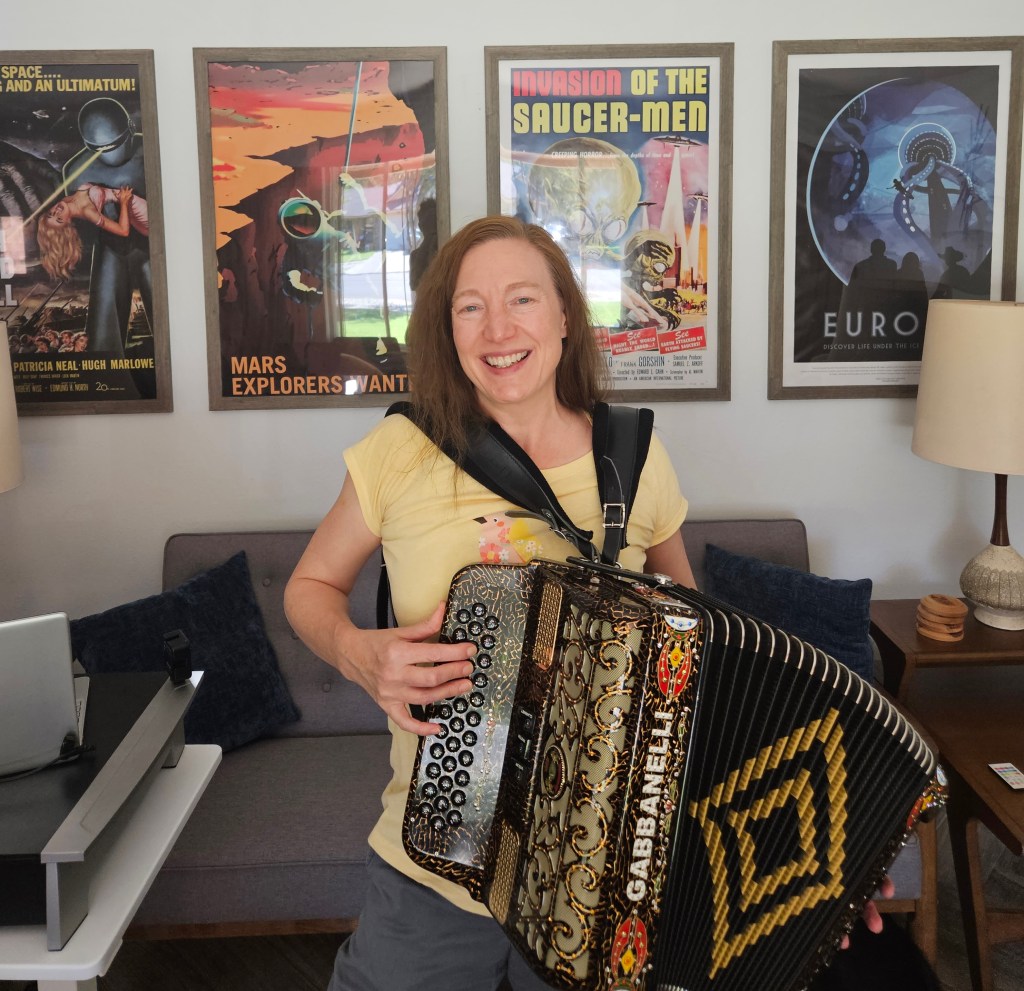
As a self-taught musician, I’m no expert on brands. I can only listen and follow what sounds magical to my ears. That was why I chose a Gabbanelli to replace my Hohner. I realized that most of the musicians I enjoy play Gabbanellis. I also listened to numerous videos of people demonstrating the various brands of accordions, and I tended to prefer the Gabbanelli sound.

But now I’m considering buying another accordion, and I’m wondering if I should buy a different brand. I could return to the Hohner brand with an upgrade from the Panther. The Hohner Corona was originally designed with Flaco Jimenez in mind, and as far as I know, he’s always played Hohners. So did Celso Piña when he was alive; they’ve now developed an accordion called the Rebelde after him. The band Los Tigres del Norte also prefer Hohners. Again, the company has an accordion in honor of this legendary band. For the record, I find Los Tigres a little too whiny and brassy for my taste, but I have still loved a good many of their songs over the years. Their repertoire is enormous, and I can’t judge an accordion brand over their whininess.

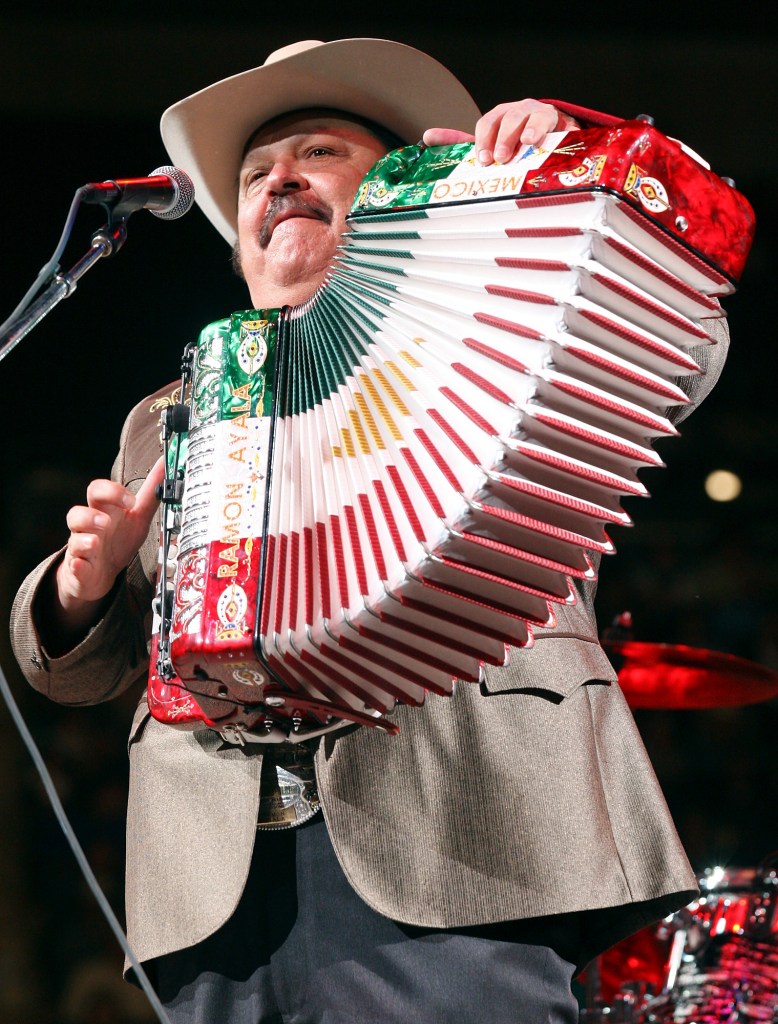
Then, to confuse me further, the Cantabella is the brand I’ve seen my latest favorite band, Los Dos Carnales, playing. Their songs have a wonderful sound. I would love to hear that sound when I play. Not that it ever works that way precisely. I never sound exactly like other musicians. Some people are good imitators. I’m not. I’m not proud of this because it means I’m deficient at hearing and replicating. By the way, Ramón Ayala also plays Cantabellas. He’s a poster boy for that brand. But he also plays Gabbanellis. His iconic Mexican flag accordion bearing his name is a Gabbanelli. One of them is, anyway. The other is a Cantabella. The Gabbanelli has little fish on it. I will always recognize those iconic little fishes. My Gabbanelli has the little fishes on either side of the brand name. See below this post OR below this paragraph. His little fish are surrounding his name.

The acordeonista for another favorite band, Calibre Cincuenta, plays a Dino Baffetti. Speaking of sound quality, it’s hard to beat this accordion. The creator of the Acordeonísticos site I subscribe to for tutorials plays a Dino Baffetti in recent years and might even be a sales rep for the brand. I’m pretty sure I read that on one of his social media sites. Not being on social media sites (except this one), I don’t pay regular attention to anyone. When I was looking into subscribing, however, I read his other sites. I’m guessing this brand is in the same price range as the Gabbanelli accordions, but it’s hard to tell, as they don’t post prices on their site.

Yes, this post was mostly an excuse to write about accordions, despite that I don’t have an audience that cares or is in the market for one. All of that is immaterial, she said with a snooty wave of her deft, accordion-playing fingers. I want to buy one; I’ve been pinching my pennies to afford another. However, what I thought would be an easy decision is not. I plan to visit the Gabbanelli store this summer (yes, there is only one store in the entire world that sells them). Maybe I will be so overwhelmed by the bling that I will never buy another brand.

¡Ay, dolor, hecho de la música!

My history as a musician is a sad one, or a lacking one. Sadness is for those suffering losses. I simply lacked education and/or the motivation to get it. I never learned to read music, for a start. We had free violin lessons at school, but they taught via the Suzuki method, which did not teach sight reading of music until students were at a more advanced level than I reached. I took up the guitar in high school but mostly learned chords and scales. I gave it up at some point in my twenties, as I wasn’t passionate about it. There was other dabbling, such as with harmonicas and piano. My skills for my dabbling instruments never moved beyond beginner level. In other words, I’m not a natural at music. Fast forward to the future when my heart was taken by the accordion. Learning an instrument, really learning it this time, in one’s forties is probably not the best way, but it isn’t impossible.

At the start of my journey, I had a few instructional books, including a book of scales. I used to keep my books in a pocket in my accordion case. It wasn’t a proper case, but a “gig” bag. That was why it had a pocket in it for music. As it was a cheaper Hohner Panther accordion, buying an expensive hard case for it didn’t seem worthwhile. All my books were, therefore, destroyed with the Hohner in the accident. Some of these books I’ve moved past in skill and don’t care much about. Others, I’d like to replace, but, unfortunately, they are all out of print and nearly impossible to find. One of them specifically taught sight reading for the accordion, which I appreciated, albeit it used the American music notation. None taught the songs I listen to on the radio — or YouTube or Spotify. I had one video tutorial I’d purchased on CD that had Flaco Jimenez teaching some traditional songs. Just watching him is inspirational. Flaco is the best. Also, I like his personality.

I’m a stereotype, really, amongst norteño accordeonistas because the first song I learned was Tragos Amargos. It’s not a difficult song, though I’m not sure why it’s the ultimate song for student acordeonistas to learn first. It’s funny how the word “ultimate” has evolved in English to not just mean “last” but to also imply something is “the epitome.” Because I listen to Spanish so frequently, I found myself adding the word “first” as a descriptor so that my audience didn’t think I meant “last.” Moving past that little rabbit trail, I found Tragos Amargos on El Bigshow’s YouTube channel. I used to love doing his tutorials. I still do them every once in a while. He’s easy to follow and has a teaching personality I like; I’m particular about personalities, and that’s going to be a heightened snobbery regarding any artists. I’m sorry, I apologize — it’s just that artists are annoying. Anyway, for most people struggling to pick up an instrument, mastering a song they enjoy will help get them past the hurdle of frustration that comes with learning an instrument. There’s a reason I used to force myself to play only half an hour a day five days a week. It was hard work, but I knew if I put at least a little time in, I’d start enjoying it and experience less frustration. Now I play an hour each day, seven days a week. I would play longer if I had the time.

Another goal that helped me jump over my hurdles of frustration was to be able to play along with songs I liked. It’s one thing to know how to play a song. Playing at speed and with good musicality is another skill. The first song I could play along with was Abeja Reina. I didn’t, however, learn that from one tutorial. I learned the song from various sources, including listening to the song itself (by Los Traileros). Playing with my favorite accordion players has been tricky, to put it mildly. Yes, I can play a handful of simple songs with the recordings, such as the aforementioned, and La del Moño Colorado, Navido Pavido, Hay Unos Ojos, etc. Simple songs…but honestly, playing along is a big hurdle to jump over.

Sometimes, I look at my musical history and realize that it’s a royal mess. Despite never learning to read music with fluency, I did learn the basic structure. FACE and Every Good Boy… You know. And then along came this obsession with norteño, and I’ve had to adapt to the tonic scale. In Spanish, the tonic scale is do, re, mi, fa, sol, la, si. No ti with jam and bread, sorry. I play a Fa accordion, which has a row of Fa, Sib, and Mib. The b stands for bemol, which means flat. In America, they are denoted as F, Bb, Eb; I assume the b used for flat comes from the Latin. This is the most commonly played accordion in norteño; that’s why I chose it. I’ve also noticed numerous songs are played in Sib and Mib. I was listening intently to a song the other day because I wanted to learn it and realized the entire song is played on the Mib scale in terceras (thirds). In theory, it’s an easy song to play. More on that in a minute.

I often watch Body Project videos for my exercise, and even when they’re not that difficult, Daniel, in his Aussie accent, tells us we’ve gotten to the point of “mass carnage” on the exercise floor. That’s how I feel about my musical journey at this point. Norteño musicians speak and sing and write in Spanish. They use the tonic scale…in Spanish. I started playing in my forties. I’m still in my forties (for a little while longer), so I haven’t been playing that long. It’s carnage, my brains splattered everywhere. Some days, I understand everything because my brain has adapted, and other days, I just can’t. I can’t figure out the fingering on a song, and if I watch a tutorial, I can’t understand the Spanish. Well, I’m sure I can. It’s just so much extra work. And I’m tired. I suppose opera singers feel the same if they didn’t grow up speaking Italian or German. Maybe scientists do, too, because it’s guaranteed they didn’t grow up with Latin spoken at home. If I’m going to be a norteño accordion player, Spanish will be my trade language, and I have to accept that. By the way, I love Spanish. My love of Spanish long predates my love of the accordion. The only problem is it’s not my first language.

Unfortunately, I’ve reached a point where the frustration with my instrument has returned. Yes, it’s carnage on the exercise floor. I don’t know how to push past this intermediate level I’m playing at. If my fingers were more flexible or if they could keep up with the complicated songs, I could enter the realm of competent musicians. Being competent isn’t what it’s about, though. It’s about the magic. That’s what I want. There are mechanics to it. A song that sounds easy almost never is. There are runs of hidden notes that are played in fast arpeggios that add to that sound but aren’t immediately obvious. And don’t forget the trinos. Trinos are everywhere. In English, that would be a trill. Trinos are what give the norteño accordion such a distinctive and magical sound, and they aren’t as easy as noodling back and forth between alternating buttons; I mean, yes, they are that easy. But there is still a technique to it. There is also the…whatsit that can’t be defined or broken down. Achieving that is like trying to physically capture any intangible. Music itself is inexplicable to a materialistic world. How does one capture the inexplicable? The magic? The thoughts, prayers, or feelings that can’t be put into words? The norteño accordion is, in my not so humble opinion, the most magical of all instruments. I just wish that magic would emerge from my fingers.

Organization!

If it seems that I’m trying to write more on my blog, yes, I have been. I get overwhelmingly busy, and this is the first to go. I no longer wish that to be the case. As today is a day off, and I’m being lazy more than I am productive, I thought I would write a simple note here on productivity. It happens through A. hard work and B. organization.

I’ve long been organized with my exercise routine. I walk for 30 minutes every evening, and do a focused exercise for 30 minutes in the morning. I follow a routine: cardio, strength, stability, repeat. That makes 6 workouts a week, with Sunday reserved for one long, relaxing walk only. This combination, which has some overlap — e.g., some stability workouts are combinations of cardio plus balance and standing abs — works. I’m only exercising an hour a day, but my organization keeps me fit.

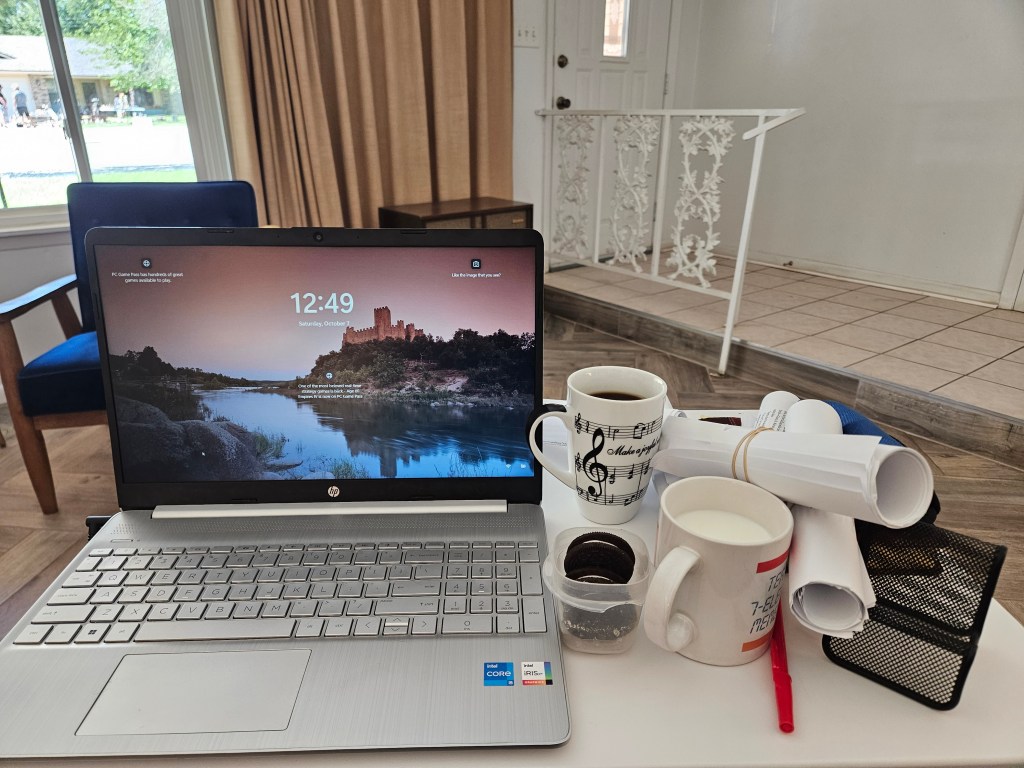
As I’m staring at my laptop from the office shed I rarely have time to use, I’m wondering why I can’t apply this kind of organization to finishing my current novel or playing the accordion. To be fair, I subscribed to the Acordeonisticos website to try to create a more focused approach than playing an hour a day of whatever I feel like playing. But I’m still prone to playing whatever I feel like playing, even after subscribing. I need a focused plan! An example might be: music theory, practice old songs, learn a new song, repeat, with Sunday my anything-goes day.

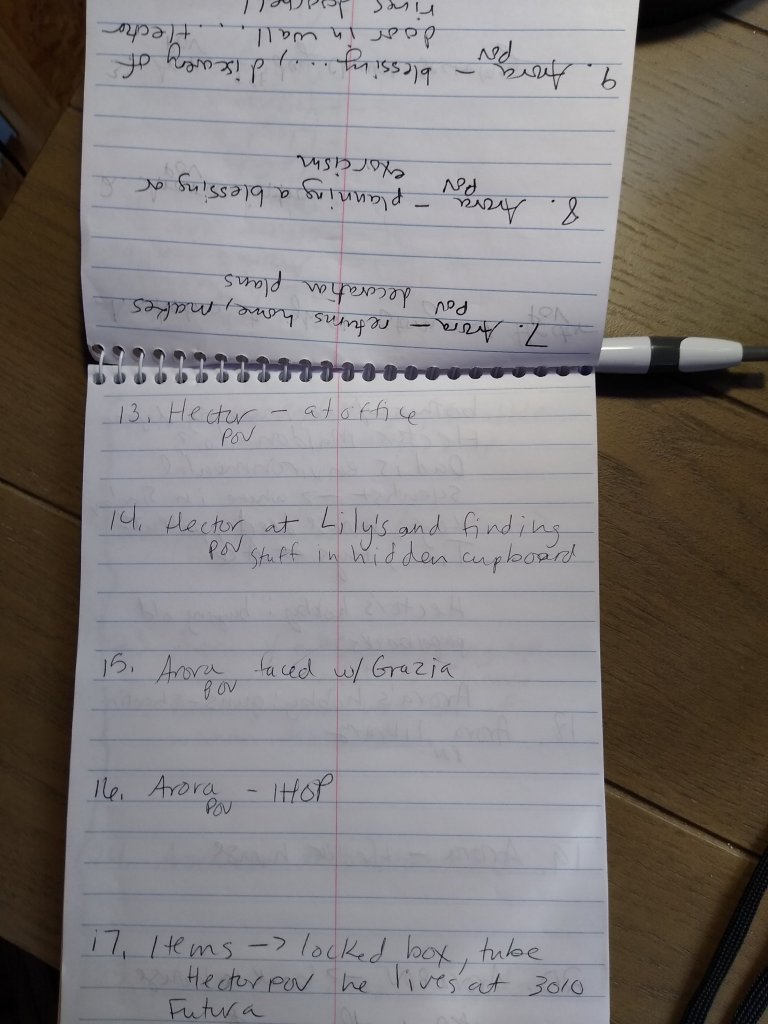
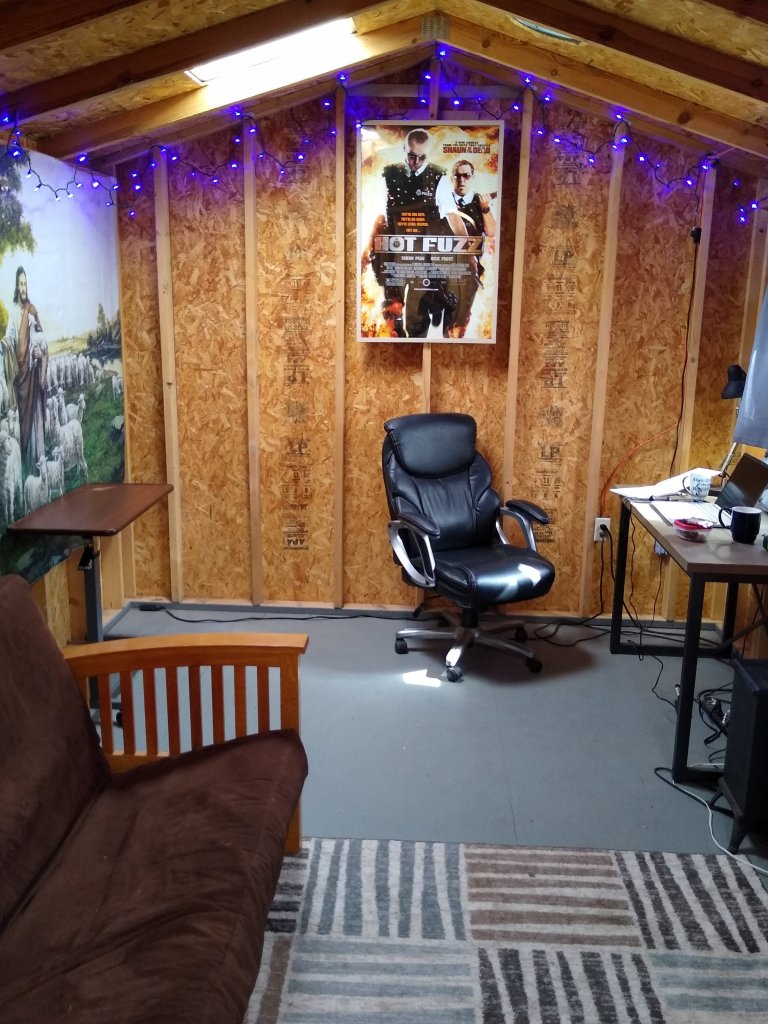
Re writing, my organization amounts to writing 1000 words a day. This is an extremely disorganized plan. I need those 1000 words to be focused. I need to do more mapping and editing. My mapping exists, but it is very slapdash. I will provide a pic, so you can see how slapdash it is. I will also provide a pic of my beloved office that awaits me, a dusty place shut up most days because I have an office at the parish I use 45 hours a week. But I can’t use that office to write; my only shot at that is to sit in the office kitchen on my lunch hour and slam out a few words.

I’m not one for outlining. It gives me the horrors and bad memories from failing at English class in my childhood. I probably should have paid more attention to it. I need to start outlining. Following an outline is the only way to write a book, unlike the pattern of threes that could work for music, as it does for exercise.

My book mapping.
My shed, with Jesus as the Good Shepherd and a poster from one of my favorite films.

Spanish, Dalí, & a Little Lorca

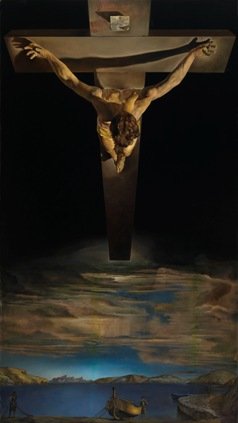
Christ of St. John of the Cross

Imitations or reproductions of Dalí’s famous painting are rife in the Catholic world, with an imitation in the office where I work. It takes me back to high school, when I loved Dalí’s artwork. Also, I had just started taking Spanish in school and therefore believed I could read my dad’s battered paperback of Federico Garcia Lorca’s poetry. These are related subjects, I promise, and not simply because I’m discussing Spaniards who, obviously, spoke Spanish.

We had to study a language; it was mandatory in high school. It doesn’t make much sense at that point, however. Learning a second language should have been mandatory from kindergarten onwards. I have an elderly friend at my parish who attended a private American school where they spoke Polish in classes. She still understands and speaks Polish to this day because of her early exposure to it, despite living in an English-only culture. I will never understand the English-only cultural philosophy. It’s not just xenophobic; it’s an example of my least favorite personality trait in individuals, let alone entire cultures: proud ignorance. Generally, I call this the Cult of Stupid. You can spot members because they roll their eyes and complain if you use words with more than two syllables. They think it’s snooty or some such, without recognizing the irony that syllables has three.

Could I actually read the Lorca book? Sure. It had English translations on the right hand-pages. My dad is not a Spanish speaker, after all. I loved learning the pretty vocabulary in the book, as it set me apart from other first-year learners of Spanish. I’ve always had a big vocabulary, and even though I failed pretty badly at English classes in school, I do have the ability to dissect words to determine what they mean. This gives me an even further edge regarding an intellectual grasp of a second language. It’s too bad this process often confuses words for me rather than making them clear. I ran into a funny example this morning. The word equivocarse and its various forms are related to the verb in English to equivocate. By the way, this might not be a commonly used word in English, but it is a common word in Spanish — like so many Latin words that have more than two syllables. In English, this word takes on the meaning of obscuring the truth. To equivocate is either for the purpose of being circumspect or being deceptive. In Spanish, it has the connotation of simply being wrong. I came across a video with the title, Estos policias se metieron con la chica equivocada… It took me a pretty minute, being in an English frame of mind, to realize a correct translation would be “The police messed with the wrong girl…!” My mind wanted it to be deceptive instead of wrong, but it was clear from the context of the video that the girl was innocent, and the police were the deceptive ones. Context is the best guide to learning a language, and so much for my intellectual, dissecting approach. In fact, although this is a bit of a digression, the only way to understand someone speaking Spanish to me is not to be myself, and to listen without focusing on any one word, picking up the sense from the context. If I stop to pick apart words, I have already lost the rest of the conversation. And unlike a language test in school, I’m not going to earn points for translating a few words correctly.

Lorca and Dalí were close friends, albeit I didn’t know this when I was in high school. I only knew I liked reading through my dad’s books, which also included art books featuring Dalí. I’ve loved Spanish ever since I was first introduced to it; that’s all I want to say about that. This post was meant to be about Dalí. But there is a point of overlap with my previous discussion that is much greater than my dad’s bookcases, as it’s clear from reading about Dalí and studying his artwork that he also took the analytical approach to life. He studied the master artists and picked apart the elements in them in order to understand them, and then he spent some time imitating them. Because of this, he’s known as a master of craft. When he created surreal art, he was playing with ideas that intrigued him. For much of his young years, Freudian psychoanalysis was a large part of what intrigued him. He met Freud; Freud didn’t like the surrealists and couldn’t understand why they were fascinated with him. He liked Dalí, though. He liked his genuine fanaticism.

Dalí was also intrigued by the physics of time and space. This in turn intrigued me as a young person. Beauty is timeless, and I will never cease to appreciate landscapes and portraits that capture the personalities inherent to people and places. But playing with ideas perhaps appeals to me even more. Another artist I appreciate for this is M.C. Escher. They both clearly loved playing with what is possible in flat geometric spaces. These two artists have a number of similarities in thinking, to be honest. They both loved the ideas they were representing and loathed politics. Neither wished to be pinned down politically, during a time when being a surrealist artist meant something political. Dalí was actually voted out of the surrealists because he eschewed Marxism and, especially as he grew older, defended Catholicism, eventually returning to his nation’s historical faith (he even had his longtime civil marriage “convalidated” in the church.) Escher was apparently part of a Christian religious order, as well, but he was as quiet about that subject as he was about politics. Dalí enjoyed creating controversy; Escher did not. There are other artists I love because they have an absurdist, intellectual approach — William Hogarth is one that long predates surrealism.

What about Lorca, though? I don’t know; for me, he was simply the first Spanish poet I read. He and Dalí were artistic friends, but Lorca’s approach was different than Dalí’s. He was a gay socialist, fitting neatly into the world of the avant garde. Dalí never fit in, and nor did he want to. He lived to a ripe old age, changing his psychoanalytic approach over the years to bizarre perspectives of Jesus on the cross. Meanwhile, Lorca was assassinated under a fascist regime (though there is some controversy regarding why and by whom).

Like Dalí, ideas are really what drive me forward. Because of that, I will probably never arrive at a place where I’m an artist at storytelling or making music, or a natural with language and communication. But every time I see Dalí’s crosses in my environment, I’m reminded that there are famous artists who don’t approach the world with a traditional artistic temperament. So, perhaps, I still have a fighting chance. By the way, I have tried to subvert the intellectual approach in learning the accordion, but mostly because I don’t have time to give it an extensive study. I want to live in the magic of the instrument and play the songs I love. However, I’ve determined that taking a more intellectual approach will work better for me, having the emotional artistic state of a gnat. So, I’ve stepped back to think through music theory. In Spanish. The problem with my accordion playing is that it’s always been in Spanish. Switching to English would not be a great idea now that I’m used to Do Re Mi Fa Sol La Si, mi acordeon en tono de Fa, and hearing ahora, tocamos la escala de Sibemol en terceras. I know what that is and can play it. If someone switched to now we’ll play the scale of B flat in thirds, I’d probably panic. Intellectuals just do not switch gears with ease, I’m sorry to say. That’s why we’re often labelled fanatics (see Freud on Dalí above). We get obsessed and taken with an idea and must hammer it out to its conclusion.

Speaking of El Diablo…

As I’ve said before, I don’t do social media, unless this counts. I listen to podcasts and accordion tutorials on YouTube, but I have very low desire to engage with others in the comments. Therefore, I’m sheltered from much of the toxicity in the world right now. But I know it exists — it’s out there damaging others’ lives instead of mine.

Imagine my lack of surprise that while I was joking about cultural appropriation here on my blog, a long-time writing friend was cancelled for it. I suppose I can say what her penname was, as it doesn’t really matter at this point. She was writing under the name Jessica Tescher when she invoked the wrath of the black romance hashtag folks on TikTok. She had the gall, you see, to write about a black couple in her sweet romance southern-themed books.

Naturally, she thought that she should write from the diversity that exists in the South. But this is not okay because she’s white. Whites can only write whites. She was hit so hard by trolls that she trended on TikTok for a day and now, to rescue her sanity or career or both, she’s shut down all her social media. Of course, white writers can’t win in this rigged game. The narcissists on TikTok have to get attention and harm others at the same time. Narcissists do that. They play victim at the expense of other people. If Jessica were to have written her series with no black romances, I’m sure she would be accused of whitewashing. I’ve heard that accusation, too. It’s a balancing act I don’t care to participate in of having a diverse backdrop to a white-prioritized book. The diverse characters have to be given voices…just not too loud and descriptive, so as not to pretend that an outsider can know someone else’s perspective. They must still remain visible in the background, however, and yet not be stereotypes. I don’t know why anyone would bother trying to please narcissists; it’s an impossible task that will get you nowhere.

When you can’t win, anyway, you might as well just write what you want. Write from a perspective that all people are humans who feel the way humans feel and love the way humans love. Write from the understanding that not every member of an ethnic or racial group has the same experience. And also understand that racism is real because people are hateful and tribal and will ostracize others if they perceive it will give them social credit. Most people have been ostracized and rejected if they’ve lived in the world long enough, even if it doesn’t rise to the level of oppression. Therefore, write from that understanding. Write about how hard it is to fit into a majority culture.

I’m not sure if TikTok is aware of this, but when observational people like writers try to understand the world, they are opening their minds and hearts to people different from themselves. This is something we should want. We should want more empathy in the world, not less. Empathy begins with you. And me too, but now I’m simply addressing those people on TikTok who haven’t expressed any empathy towards an author who was trying to develop an audience. She certainly didn’t have that yet; she was no JK Rowling that you just stuck it to. No, you harmed someone who had a very small voice. You punched down, in other words.

What if her book was really that bad, though and deserved the hate? I doubt it. I haven’t read the book she’s being cancelled over, but I’ve read her other work (published under a different name). But let’s just assert for the sake of argument that she screwed up royally with this book. Should you have brought a mob to destroy her, or given her honest criticism? Stop! I already know the answer.

I’ve long given up hope on people being reasonable. Most people just aren’t as a rule. It was a frustrating realization I had to come at about age forty. I’m not even sure why I’m writing this post, since I know people are unreasonable. I guess hope still lives inside my soul.

I’m currently writing this post on my lunch hour; that’s how upset my friend being destroyed has made me. Normally, I use my lunch hour in better pursuits, such as staring at the wall and thinking of that moment later when I can clock off, drive home, and play my accordion for an hour. Yes, I’ve changed my schedule such that I play seven hours a week. I manage this by playing as soon as I get home instead of cuddling my doggies and slowly changing my clothes for my evening walk. The dogs can listen to my music, and the evening walk will still happen eventually. One must have priorities. Because playing gives me great joy lately, I’m living day to day off the excitement of it. I’ve solved my chronic insomnia by replacing sleep with excitement! Try it out! See how it works for you!

I can’t wait to go home and watch the sun disappear through my enormous front window while I squeeze and extend my bellows. From my window, I can actually see the whole world! Or at least my tiny portion of it. There’s so much to discover out there that doesn’t involve worrying about cultural appropriation. Please pray for my friend, as the future must look dark for her at this moment. If she hadn’t already shut everything down, I would instead exhort you to buy her book and give it an honest review. Too bad she caved under the intense pressure — would I have, too? I don’t know. I don’t particularly like being visible. It brings up bad memories of childhood bullying.