
The concept that humans are worthless is very popular in both Catholic and Protestant circles. I’ve been in Protestant services where the extended worship time focused on repeating mantras of self-immolation in song. I’m glad my husband stopped attending that church. To be fair, I stopped attending Protestant services with him entirely because I’m burned out on all of them.
But self depreciation certainly isn’t confined to Protestantism. Catholics have a long history of self hatred, which they have demonstrated through absurd physical means such as flagellation and the wearing of hair shirts. I don’t have a problem with self denial at all; fasting is biblical and can take our focus off the emphasis of meeting our physical needs and onto crying out to God to meet our spiritual needs. But the intentional acts of self hatred and proving our worthlessness to the world is 100% lost on me and, in my opinion, not consistent with either God or other Christian beliefs. Thankfully, these are private rather than corporate Catholic practices. In other words, the Mass is the Mass; there will never be a “led by the spirit” lengthy worship service in which Christians chant about how they need to disappear so that God’s glory can shine.
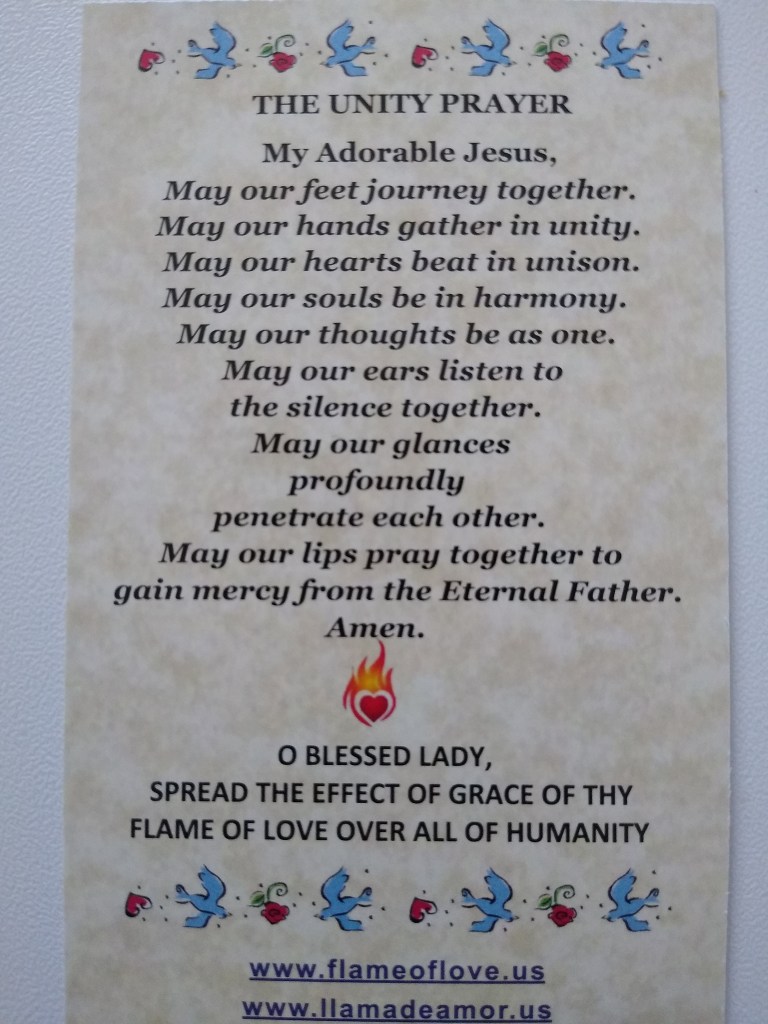
There is a viral Catholic prayer, The Unity Prayer by Elizabeth Kindelmann, that has caught fire in Catholic circles. The prayer itself is lovely (I will post it below) and the testimonies about it binding Satan’s influence over us probably true. That is the power of praying to Jesus. Being that these types of viral movements, in which numerous miracles are attributed to a specific prayer, fascinate me, I decided to read Kindelmann’s autobiography for more context. What a mistake that was! It wasn’t entirely a mistake. However, it is a tale of human suffering that can be very depressing to dwell on for any length of time. On the other hand, trust in God in the midst of suffering can be inspirational. There is both in the text, but unfortunately too much of the former for my mental health.
I stopped reading not too long after the words spoken to her by the Blessed Virgin Mary and Jesus turned the direction of “your priority is to remember that you are nothing.” Granted, this is a translation into English. In fact, it went from Hungarian to Spanish and then to English from the Spanish, so what I’m reading is twice removed from the original language. How difficult is that concept to translate from any language? I don’t know. I’m asking an honest question. Hungarian is a Uralic language and is therefore quite different from English or Spanish, but it still has a word that translates as “nothing.”
Why is this such a problem for me? On an emotional level, I struggle with nihilism. If there is no purpose to my or anyone else’s life on earth, I’d rather just off myself right now. Please don’t be alarmed by that, as I don’t believe my life is meaningless. I don’t buy that lie the evil one is selling. On a practical level, the pro-life movement, which is very important to the Catholic church, has as its core philosophy the value of all human life. Humans aren’t nothing. They matter. That’s why Catholic crusaders are willing to go to jail for protesting against abortion and euthanasia, as well as the maltreatment of humans. That’s why thousands of priests were killed by Nazis — they stood against the Nazi maltreatment of humans. How can they hold that philosophy while believing they themselves are nothing? Are they not as human and, therefore valuable, as the lives they’re fighting for? It’s a strange dichotomy you find all over the Christian world. I’m meaningless; I don’t have value, but I’m going to save the starving people in a refugee camp because somehow they have value despite being humans, too.
In a larger theological framework, there doesn’t seem much sense to God creating humans and sending his Son to die self-sacrificially for them if he regards them as nothing. What kind of capricious God would do that, and then advise these same humans when they are struggling through poverty and loneliness, as Kindelmann clearly was throughout her life, that their number one job was to remember that they are nothing? Her life as a poor woman and young widow had already taught her she didn’t have value. If she is writing that she is nothing, my guess is it’s coming from the worm in her brain implanted by maltreatment and not from God.
The Good Shepherd does not look pragmatically at his sheepfold and say, “Well, I have ninety-nine here. It would probably be better if I keep watch over these than go out and look for that one that left the fold. She left of her own free will. Her choice. She was warned about wolves. Besides, that’s one less mouth to feed, and who wants to give food to a poor female nobody loves? She’s nothing to us. Should we take a vote?” Those are not godly words. Jesus said he would leave the fold to find that one sheep that was lost. The sheep obviously being a metaphor for us, does the Good Shepherd strike you as a savior who would tell us we are nothing? That we don’t matter?
Humans want and need love. They want and need to know that they have value. They want to matter. It is no surprise to me that God built us chemically to produce pleasurable feelings when we do good for others. Doing good gives us a sense of purpose, a vocation. Yes, our chemical reactions can be tainted; there are sadists who instead feel pleasure when harming others. But we are appalled by that twisting of our God-given natures, condemning such people and their behavior, and rightfully so.
Maybe if I read the rest of her story, I would learn why it was important for her to remember she was nothing. I do not know because I’m not going to finish reading something that has already struck me as being false, closer to Zen Buddhism than Christianity. Instead, I’ll return to my fictional murder mysteries, where the sense of justice enacted in the end is predicated off human life mattering. If it didn’t, there would be little point to punishing murderers — which is, by the way, a biblical concept.
 Jill Domschot
There is a point where the belief we are nothing is true. If we disregard the love of God, we are less than nothing. If we never turn to Jesus in repentance for our sins, we will eventually become beings consumed by one wish, the wish we had never been born.
If we repent — if we ask for forgiveness and mercy — if we strive to love our Lord with all our heart, mind, soul, and strength, then we have great value because we matter to Him.
Compared to the vastness of God’s creation, we are insignificant. We are as nothing. Yet the Creator thinks we matter. Without His concern for us, we are as nothing. Because of His love, however, our existence has value. Each of us has value.
LikeLiked by 1 person
Yes, it’s exactly the immensity of God’s creation that has tended to bring on my nihilistic thoughts. At best, Christian existentialist thoughts. This is why I’m always seeking Jesus’ love.
LikeLiked by 1 person
There is a joint tragedy with the ‘worthless’ thing. It’s extreme to be sure.
Sin and worthless are not twins. Look at the patriarchs. Abraham lied, yet the father of the faithful. Peter denied- yet a pillar of the church. David had a nan killed- yet a man after Gods heart.
On the other hand, some say ‘they have no sin.’ Truly a stupid thing to say, because they think they are ‘worthless’ if they confess to sin.
On a train track we have two truths not touching. The rails are always apart. One rail says ‘there are none good, no not any.’
On the other we have ‘now Zack was a good man.’
Ah, but what’s the perspective? How can we do good if we are not good? The Lord asked: ‘why do you call me good?’ What standard are you using? A drunk is considered good when he buys his friend another drink. What is good to one may be evil to another.
But worthless? Never. Everything has value. But agreed, Protestantism has used this ‘worthless’ thing quite poorly, and to be fair, RC has shared blame on many fronts- but we know one thing: God cannot lie, and His word is truer than true.
LikeLiked by 1 person
I guess you could say that the good is always worthy, but that worthiness isn’t dependent on being good. Thank goodness. What a funny expression that is. I suppose it’s meant to be “thank God” for people who don’t want to even produce a whiff of using His name in vain.
LikeLiked by 1 person
Difficult subject, Jill! There are a lot of paradoxes in our faith and some of them have delicate, fine lines. “I am nothing” can mean worm theology and self flagellation or it can mean the blessed freedom of being free of ego, pride, at rest and simply abiding in the Lord. It’s not abuse at all, more like freedom from cares and worries. Sometimes it is that state, on the other side of ourselves, that we truly discover God, and realize we really are something remarkable with great worth and value. Sometimes I have experienced that blessed sense of “I am nothing,” when I’ve gotten so engrossed in a project or task and am having such fun, that I forget all about myself.
LikeLiked by 1 person
There’s a hymn I really like that says “Shepherd me, O God, beyond my wants, beyond my fears, from death into life.” But there again, it’s a song about the Good Shepherd. I love that image of Jesus. I want to be cradled in his arms.
LikeLiked by 1 person
I’m with you on this. Jesus didn’t die for “nothing”. His death had a purpose, to save sinners. For God so loved us…
I’ve been thinking about the two words idolatry and adultery. They have the same root. God wants us to be faithful to him .
LikeLiked by 1 person
Yes, and I suspect there’s something to self idolatry involved in adultery, which will lead to self loathing. We make very bad mini gods.
LikeLike
I’m working on my doctorate in misanthropology…
LikeLiked by 1 person
I was too for a long time, but the hopeful heart beats eternal that I will come out the other side a philanthropist, loving the unlovable, not least of which because I’m one of them.
LikeLiked by 1 person